
All Series > Seven Chief Virtues > Part 7
The Virtue of Temperance
(Series 5, Part 7, Teaching #39)
Quick Links
Help fund this video: Donate

1. The Virtue of Temperance
The protector of purity and custodian of balance is temperance.
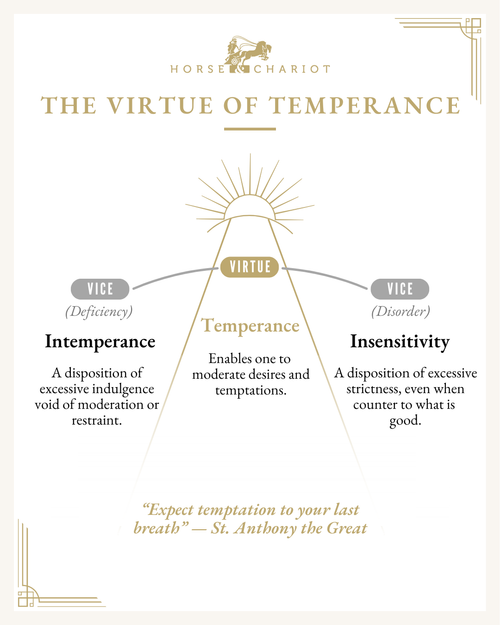
The virtue of temperance enables one to moderate desires and temptations.
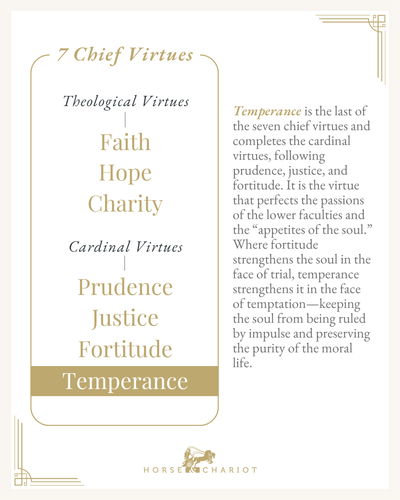
Temperance is the last of the seven chief virtues and completes the cardinal virtues, following prudence, justice, and fortitude. It is the virtue that perfects the passions of the lower faculties and the “appetites of the soul.” Where fortitude strengthens the soul in the face of trial, temperance strengthens it in the face of temptation—keeping the soul from being ruled by impulse and preserving the purity of the moral life.
Temperance is the virtue of self-mastery—the habit of rightly ordering desires, moderating pleasures, and restraining excess so that the soul remains free to pursue what is truly good. It is not the rejection of pleasure, nor is it a life of harsh strictness; rather, temperance ensures that pleasure serves the soul rather than enslaving it. It allows you to enjoy life’s blessings without being controlled by them, ensuring that emotions, appetites, and desires are ruled by reason rather than ruling over it.
Just as a charioteer must keep a firm yet measured hold on the reins, temperance governs the passions—making sure neither indulgence nor deprivation derails the soul from its course. If the reins are too loose, the horses run wild in reckless excess; if pulled too tightly, the chariot grinds to a halt in unnecessary rigidity. But with temperance, the reins are held in perfect tension—the passions are not denied, but directed; the desires are not destroyed, but disciplined.
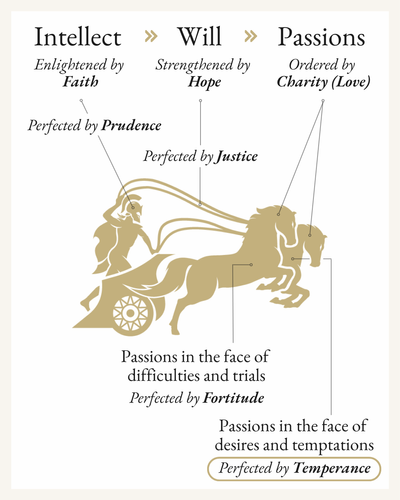
Unlike worldly restraint, which often stems from fear, vanity, or pride, true temperance—for the faithful—is a supernatural grace that aligns the soul with God’s divine order. Left unchecked, human desires—whether for food, drink, comfort, pleasure, or recognition—quickly become disordered, leading to excess, addiction, or idolatry. But through temperance, those same desires are rightly ordered, allowing you to live in harmony with both body and soul—experiencing joy without excess and sacrifice without bitterness.
“Moderation is necessary in all things, except in our love of God” (St. Teresa of Ávila). This is why Scripture calls for self-discipline, reminding us, “Every athlete exercises discipline in every way. They do it to win a perishable crown, but we an imperishable one” (1 Corinthians 9:25). Temperance is not about denying yourself happiness—but about pursuing the lasting joy that only comes when desire is subjected to truth.
2. Pillars of Temperance
Temperance is upheld by the pillar virtues of orderliness, discipline, and self-control. Upon these pillars, temperance stands, enabling one to moderate desires and temptations. Without all three, temperance implodes.
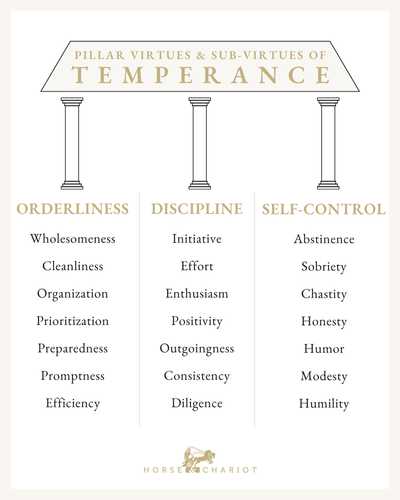
The virtue of orderliness enables one to moderate disorder. It ensures temperance is not chaotic or unbalanced but structured and measured, making sure time, priorities, and surroundings remain in harmony rather than falling into a neglectful mess. The orderly tend to maintain clean spaces, complete their tasks on time, and keep their responsibilities in order. Without orderliness, life falls into disarray—where impulse reigns over intention and distraction clouds purpose. Its sub-virtues include wholesomeness, cleanliness, organization, prioritization, preparedness, promptness, and efficiency.
The virtue of discipline enables one to moderate deficiency. It ensures temperance is not weak but strengthened by habit, preventing laziness and inconsistency from leading the soul astray. The disciplined do not wait for motivation to do what is right—they train themselves to resist complacency, to develop self-drive, and to persevere in virtue even when it is difficult. Just as a charioteer must train the horses for endurance, so too must the one with temperance train the will to resist slothfulness. Without discipline, virtue is abandoned when it becomes inconvenient, and inner drive is lost to indolence. Its sub-virtues include initiative, effort, enthusiasm, positivity, outgoingness, consistency, and diligence.
The virtue of self-control enables one to moderate excess. It ensures pleasure serves the soul rather than enslaves it—preventing desires from growing out of control, overpowering reason, and leading to addiction or vice. One with self-control does not deny pleasure entirely but ensures pleasure remains a servant, not a master. Just as a charioteer must hold the reins firmly, allowing the horses to run without losing control, so too must the one with temperance govern the passions—allowing enjoyment without excess, desire without disorder, and fulfillment without ruin. Without self-control, the passions run wild, leading the soul into indulgence, wastefulness, and sin. Its sub-virtues include abstinence, sobriety, chastity, honesty, humor, modesty, and—fittingly—the last of all the virtues, but by no means the least: humility.
These pillars form the foundation of temperance. To live in temperance is to live in freedom—where desires no longer rule the soul, but serve it as powerful forces for good. It is the balance of body and spirit, the harmony of passion and reason, the mastery of self that leads to a life of virtue and fulfillment in Christ.
Without temperance, one either lives so loosely that they chase every indulgence, or so rigidly that life becomes unbearable. But one who upholds temperance rightly directs their passions with wisdom—ensuring that neither excess nor deficiency hinders the pursuit of the good.
3. Temperance in Action
Temperance is the grace-filled strength that keeps desire in its proper place, allowing you to enjoy the good without being mastered by it. In a culture that idolizes indulgence and constant stimulation, temperance invites you into something deeper: self-possession, inner peace, and the freedom to choose what is good over what merely feels good. It is the art of living with discipline, dignity, and devotion to God.
One with temperance guides their lower faculties by virtue. They eat without gluttony, rest without laziness, and enjoy pleasure without being consumed by it. Their speech is measured, their eyes controlled, and their habits formed by wisdom, not whim. The temperate walk the narrow path of moderation, where their desires do not rule them, their impulses do not drive them, and their appetites do not lead them astray. Their passions serve them—and the Lord—not the other way around.
Temperance looks like the one who is satisfied with enough rather than craving more. It looks like the man who bounces his eyes away from sexual images, the woman who dresses with class rather than seeking lustful attention, and the person who exercises and eats healthily without obsession. It is found in the student who stays focused on classwork instead of scrolling endlessly, the friend who listens before responding, and the worker who knows when to labor and when to rest.
Temperance is Joseph fleeing from temptation, Daniel refusing the king’s indulgent food, and Susanna refusing to compromise her purity. It is the rich young man being challenged to let go of his wealth, John the Baptist living simply in the wilderness, and Mary embracing God’s will with humility rather than grasping for self-honor. Above all, it is Jesus Himself, who fasted in the desert, resisting Satan’s temptations—showing that true temperance is not just about rightly ordered moderation, but about living in full obedience to God.
Temperance is the quiet victory of grace over impulse, of love over lust, and of purpose over pleasure. It doesn't shout, but it endures. It doesn't shine in the spotlight, but it holds steady in the shadows. In a disordered world, the temperate soul stands as a witness to the beauty of balance—a life governed not by craving, but by Christ. And in that mastery, there is peace.
4. Vices Opposed to Temperance
The vices opposed to temperance are, at one extreme, a deficiency of temperance—which is intemperance, and at the other extreme, one can never have too much temperance, but one can have disordered temperance—which is insensitivity.
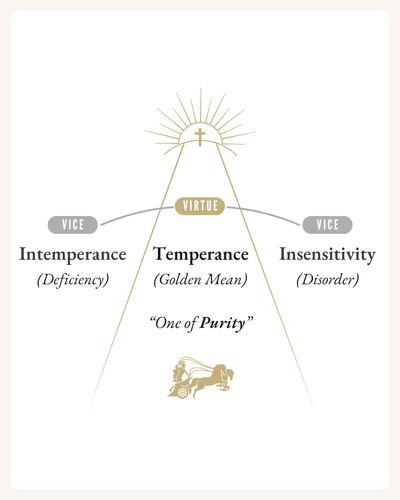
The vice of intemperance is a disposition of excessive indulgence void of moderation or restraint. The intemperate soul is ruled by its desires, allowing pleasure to dictate their actions rather than reason and virtue. It is found in the one who overeats or drinks beyond need, in the person who indulges in lustful acts without regard for purity, and in the individual who seeks constant entertainment to avoid self-discipline. Intemperance enslaves the soul, making it a prisoner to fleeting pleasures while eroding its capacity for self-mastery and true fulfillment.
The vice of insensitivity is a disposition of excessive strictness, even when counter to what is good. The insensitive soul rejects legitimate pleasure, treating all enjoyment with suspicion and suppressing even what is rightly ordered. It is found in the one who denies themselves necessary rest, in the person who views all physical pleasure as sinful, and in the overly rigid who reject joy as weakness rather than as a gift from God. Insensitivity distorts temperance, replacing self-mastery with self-deprivation for its own sake, ensuring discipline serves pride rather than fullness.
Both intemperance and insensitivity thwart the virtue of temperance—one by surrendering to excess, the other by rejecting even what is good. Together, they lead the soul away from balance, either into indulgence that weakens the will or into severity that drains the joy from life, both of which separate it from the freedom true temperance provides.
Thus, whether it be by intemperance or insensitivity, the outcome is the same—impurity. The impurity of desire, the corruption of balance, and the distortion of human freedom. Impurity, in the board sense of moral life, gives rise to sins such as gluttony, lust, drunkenness, sloth, and harsh disdain for rightful pleasure. It severs the soul from grace, leaving it either enslaved to excess or imprisoned by rigidity. Hence, it is written, “Do not follow your base desires, but restrain your appetites” (Sirach 18:30), for to abandon temperance is to forsake the harmony of the soul and to live, not in liberty, but in bondage to the very desires one refuses to master.
5. Cultivating Temperance
The best defense against impurity and the vices opposed to temperance is to develop temperance itself. And temperance is not merely about moderation—it is about freedom. The one who lacks temperance believes they are free when, in reality, they are enslaved. Enslaved to cravings they cannot resist. Enslaved to habits that control them. Enslaved to desires that pull them downward instead of lifting them up. The temperate do not live this way. They master their appetites, so their appetites do not master them. They rule their desires, so their desires do not rule them. They live with balance, so no indulgence clouds their mind, weakens their will, or takes the place of what truly satisfies.
Where have you lost temperance? Where have desires dictated your actions instead of reason and virtue? Where has order turned to disorder? For some, it is food or alcohol—overeating for comfort, drinking for escape. For others, it is technology—scrolling endlessly, consuming content instead of living with purpose. Some are ruled by laziness, putting off responsibility for another day, another hour, another moment. Some are ruled by restlessness, incapable of silence, incapable of stillness, always needing more.
And for many, it is lust. The wandering eyes. The secret glances. The quiet indulgence in images and fantasies that stain the soul. Lust whispers, “It is harmless. It is natural. It is no great sin.” But lust is never harmless. It darkens the mind, weakens the will, and distorts the way one sees others. It turns bodies into objects rather than brothers and sisters in Christ. It trains the soul to consume rather than to love. It poisons purity, leaving the soul restless, unsatisfied, and distant from grace.
It is said, “For every great temptation, there will be many small ones. Wolves and bears are more dangerous than flies, but we are bothered most by flies” (St. Francis de Sales). Hence, temperance must be cultivated in small, daily victories long before it is displayed in great acts of restraint. It is found in the one who eats with moderation instead of mindless indulgence. It is found in the one who puts the device down instead of wasting another hour. It is found in the one who trains their eyes to see rightly, their mind to think rightly, and their body to act rightly. The temperate do not reject the gifts of life—they receive them rightly, enjoy them rightly, and let them go when the time is right.
Temperance begins with the recognition that it is utterly impossible without God’s help. Daily prayer, Scripture, and reflection are essential. The soul cannot master itself apart from grace. Prayer aligns the will with God’s, giving strength to resist temptations and reorder desires. Scripture renews the mind, teaching the soul to value eternal things over fleeting pleasures, for “Whoever is faithful in very little is faithful also in much” (Luke 16:10). Reflection challenges the soul to confront its imbalances with honesty, inspiring repentance and renewal. Without these spiritual practices, the pursuit of temperance becomes mere willpower, which will falter. But with them, the soul finds both the strength and clarity to live in harmony with God’s design.
As temperance grows, it purifies the soul. The indulgent become measured. The restless become still. The impulsive become disciplined. The lustful become pure. The one who once lived for excess now thrives in balance. The one who once followed every craving now walks in mastery. The one who once felt powerless against temptation now possesses the strength to say no, to step away, and to live freely. They do not fear desire, nor do they worship it—they have placed it in its rightful place.
Ultimately, temperance is the virtue that preserves freedom and breeds purity. It cleans the dirty waters of the soul so the light of Christ shines through without distortion. It allows the soul to rise above momentary cravings and pursue the only pleasure that will never fade—the eternal joy of communion with God.
6. The Way of Temperance
The way of temperance is the path of self-mastery, where every passion, every appetite, and every desire must be brought under control. Temperance is not simply restraint—it is the art of ordering your soul, of choosing what is best over what is easy, and of ruling your desires. If you choose this path, “Expect temptation to your last breath” (St. Anthony the Great), and always be prepared for battle—for the greatest enemy you will face is yourself.
At first, temperance may feel simple: eat in moderation, avoid excess, and practice discipline. But soon, the deeper struggles will emerge. You will experience the pull of pleasure, the temptation to indulge, and the craving for comfort that dulls your will. Your impulses will rebel against you. The world will tell you that denying yourself is foolish, that excess is freedom, and that indulgence is happiness. You will see others give in to their passions without shame, and you will be tempted to do the same. At times, your desires will feel too strong, your will too weak. You will fail. And when you do, you will be tempted to think that self-mastery is impossible—that purity is a myth.
But if you hang in there, if you continue to fight the good fight, something remarkable will happen: temperance. Just as the greatest warrior bears the most scars, the marks of your past will not tell the story of a believer defeated by sin, but of one who never stopped fighting to break free from it. For when temperance rises—once and for all—from weakness to strength, from victim to victor over temptation, it becomes liberating. It will not only teach you to say no to excess but will also free you to say yes to what is truly good. You will learn that freedom is not found in indulgence, but in control—and that true joy comes not from excess but from balance. You will discover that pleasure is a servant, not a master, and that desires are meant to be guided, not obeyed. With temperance, you will no longer be a slave to your cravings, your impulses, or your passions—you will be their master.
Temperance requires discipline, patience, and a relentless pursuit of purity. It will cost you your laziness, your gluttony, your excuses. But it will give you everything—clarity of mind, strength of will, and peace of soul. Make it a habit to “sow acts of [righteous] self-denial and you will reap a harvest of character” (St. Josemaría Escrivá).
The path of temperance is long and challenging, but it leads to true freedom and holiness. You’re not alone. Lift the sails of your soul so the Holy Spirit can fill you, and the winds of grace can move you to—take control, tame your appetites, and master your desires. So in the end, you may stand with a clear conscience and carry no impure vice unto death.

Scroll down for the lesson plan and other related resources associated with this teaching.
Copyright © 2022 Horse & Chariot. All rights reserved.
New teachings like this are released often. Subscribe free and never miss a teaching!
Resources
Visual Resource
Illustration of the virtue of temperance and the vices that oppose it, including definitions.
Free Lesson Plan
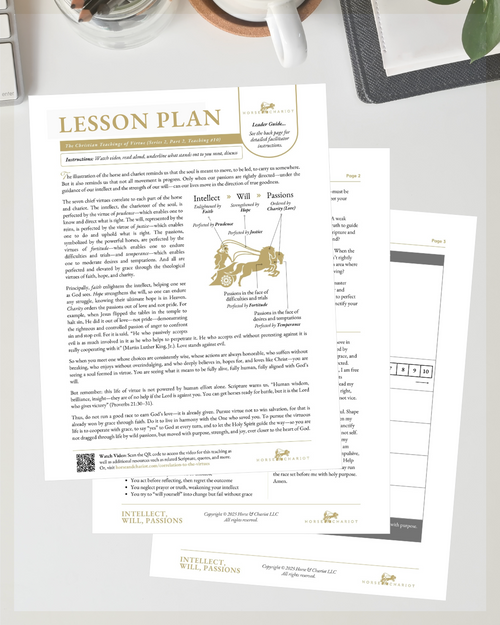
Perfect for small groups, families, classrooms, or personal reflection.
Related Quotes
What Temperance Is: Self-Mastery and Right Order
Temperance orders desire according to reason and grace. It frees the soul from slavery to appetite so that the body may serve the soul and the soul may serve God.
“I count him braver who overcomes his desires than him who conquers his enemies; for the hardest victory is over self.” — Aristotle
“From the dishonor and vileness of beastly pleasures, man is freed by the virtue of temperance, which teaches him to govern himself not by his desires, but by reason.” — Mary of Agreda
“Without this virtue [temperance], it is not possible for man to divest himself of the spoiled human nature, nor to dispose himself for the graces and wisdom of God.” — Mary of Agreda
“The body is meant to be a servant of the soul, not its master.” — St. Francis of Assisi
“Victory over self is the first and noblest of all victories.” — St. Ignatius of Loyola
“Temperance is a safeguard of all the virtues.” — St. Thomas Aquinas
“No conflict is so severe as his who labors to subdue himself.” — Thomas à Kempis
“God has entrusted me with myself. No man is free who is not master of himself.” — Epictetus
Temperance, Moderation, and the Wisdom of the Mean
Temperance does not reject desire but disciplines it. Wisdom lies not in excess or deprivation, but in the rightly ordered mean.
“To go beyond the bounds of moderation is to outrage humility.” — Thomas à Kempis
“Temperance leads to simplicity; simplicity leads to peace.” — St. Bernard of Clairvaux
“Moderation is necessary in all things, except in our love of God.” — St. Teresa of Ávila
“For both excessive and insufficient exercise destroy one's strength… This much then, is clear: in all our conduct it is the mean that is to be commended.” — Aristotle
“Without virtue, man is most unholy and savage, and worst in regard to sex and eating.” — Aristotle
“Pleasures, when they go beyond a certain limit, are but punishments.” — Marcus Aurelius
“The flourishing life cannot be achieved until we moderate our desires and see how superficial and fleeting they are.” — Epictetus
“Our body has this defect that, the more it is provided care and comforts, the more needs and desires it finds.” — St. Teresa of Ávila
Temperance in Temptation and Daily Battle
Temperance is forged through struggle. Temptation becomes the training ground where self-denial strengthens the soul.
“Expect temptation to your last breath.” — St. Anthony the Great
“Fire tries Iron, and temptation tries the just.” — Thomas à Kempis
“Virtue is nothing without the trial of temptation, for there is no conflict without an enemy, no victory without strife.” — St. Leo the Great
“Do not grieve over the temptations you suffer… look upon every temptation as an invitation to grow in a particular virtue.” — St. Philip Neri
“Occupy yourself in prayer rather than in seeking temptations to combat.” — St. Ignatius of Loyola
“How hard it is to be faithful to duty when we allow the soul to be drawn by the thousand and one foolish things around us!” — St. Josemaría Escrivá
“Sow acts of self-denial and you will reap a harvest of character.” — St. Josemaría Escrivá
“To be pure, to remain pure, can only come at a price. It is a daily battle.” — St. Augustine
Temperance, Purity, and the Beauty of the Soul
Purity is not repression but radiance. Temperance frees the soul to become a dwelling place of God’s presence and light.
“A pure soul is a dwelling place of the Holy Spirit.” — St. Bonaventure
“Nothing is so beautiful as a pure soul.” — St. Bernard of Clairvaux
“He who keeps himself pure is like a bright light in the darkness.” — St. John Chrysostom
“He who loves purity advances quickly in perfection.” — St. Alphonsus Liguori
“Modesty is the safeguard of purity.” — St. Padre Pio
“When the soul is cleansed of all sin, it becomes like crystal, radiating the light of God’s grace.” — St. Catherine of Siena
“God loves purity, and He will help us to be pure if we ask Him.” — St. Maria Goretti
“The soul cannot truly love God unless it has first purified itself of all that is not God.” — St. Scholastica
Temperance as Discipline, Simplicity, and Lasting Freedom
Temperance simplifies life, strengthens discipline, and prepares the soul for eternal realities. What passes quickly is surrendered for what remains.
“If you commit a sin and take pleasure in it, the pleasure passes but the sin remains… the tiredness passes but the virtue remains.” — St. Camillus de Lellis
“When the body is pampered, the soul languishes.” — St. John Bosco
“Do not forget that purity makes us resemble the angels.” — St. John Bosco
“The fast of the body is food for the soul.” — St. John Chrysostom
“Many live as if they did not know that they must die one day… impurity would be crushed by the thought of eternity.” — St. John Bosco
“A soul that is pure and beautiful must live a life of moderation and discipline.” — St. Faustina Kowalska
“To defend his purity… You… what have you done?” — St. Josemaría Escrivá
“The body is the garment of the soul.” — St. Hildegard of Bingen
Related Scripture
The Source of Temptation and Self-Mastery
Temperance begins with the realization that our primary struggle is not with external forces, but with our own internal desires and the need to govern them.
“No one, when tempted, should say, ‘I am being tempted by God,’ for God cannot be tempted by evil and he himself tempts no one. But one is tempted by one’s own desire, being lured and enticed by it; then, when desire has conceived, it gives birth to sin, and sin, when it is fully grown, gives birth to death.” — James 1:13-15 (NRSVue)
“Woe to the world because of things that cause sin! Such things must come, but woe to the one through whom they come!” — Matthew 18:7 (NRSVue)
“Do not follow your base desires, but restrain your appetites.” — Sirach 18:30 (NRSVue)
“How can a young person stay on the path of purity? By living according to your word.” — Psalm 119:9 (NRSVue)
“I the Lord search the heart and examine the mind, to reward each person according to their conduct, according to what their deeds deserve.” — Jeremiah 17:10 (NRSVue)
Divine Faithfulness and the Limits of Temptation
Moderation is possible because God provides the grace and the "way out" to ensure we are never overwhelmed by our impulses.
“But the Lord is faithful; he will strengthen you and guard you from the evil one.” — 2 Thessalonians 3:3 (NRSVue)
“No temptation has overtaken you except what is common to mankind. And God is faithful; he will not let you be tempted beyond what you can bear. But when you are tempted, he will also provide a way out so that you can endure it.” — 1 Corinthians 10:13 (NRSVue)
“So, if you think you are standing firm, be careful that you don’t fall!” — 1 Corinthians 10:12 (NRSVue)
“The Lord knows how to rescue the godly from trials and to keep the unrighteous under punishment until the day of judgment.” — 2 Peter 2:9 (NRSVue)
Spiritual Discipline and the Incorruptible Crown
Like an athlete training for a race, the practice of temperance requires intentional discipline and the "chastening" of the body to serve higher goals.
“I do it all for the sake of the gospel, so that I may share in its blessings. Do you not know that in a race the runners all compete, but only one receives the prize? Run in such a way that you may win it. Athletes exercise self-control in all things; they do it to receive a perishable wreath, but we an imperishable one. So I do not run aimlessly, nor do I box as though beating the air, but I punish my body and enslave it, so that after proclaiming to others I myself should not be disqualified.” — 1 Corinthians 9:23-27 (NRSVue)
“For this very reason, you must make every effort to support your faith with goodness, and goodness with knowledge, and knowledge with self-control, and self-control with endurance, and endurance with godliness.” — 2 Peter 1:5-6 (NRSVue)
“For the grace of God has appeared, bringing salvation to all, training us to renounce impiety and worldly passions, and in the present age to live lives that are self-controlled, upright, and godly.” — Titus 2:11-12 (NRSVue)
Renewal of the Mind and Living Sacrifice
Temperance is not just about "saying no"; it is about the positive reformation of our minds to desire what is good and perfect.
“I appeal to you therefore, brothers and sisters, by the mercies of God, to present your bodies as a living sacrifice, holy and acceptable to God, which is your spiritual worship. Do not be conformed to this world, but be transformed by the renewing of your minds, so that you may discern what is the will of God—what is good and acceptable and perfect.” — Romans 12:1-2 (NRSVue)
“Set your minds on things that are above, not on things that are on earth.” — Colossians 3:2 (NRSVue)
“For God did not give us a spirit of cowardice but rather a spirit of power and of love and of self-discipline.” — 2 Timothy 1:7 (NRSVue)
“Finally, beloved, whatever is true, whatever is honorable, whatever is just, whatever is pure, whatever is pleasing, whatever is commendable, if there is any excellence and if there is anything worthy of praise, think about these things.” — Philippians 4:8 (NRSVue)
The Fruit of the Spirit and Balance
True mastery of the self is a fruit of the Holy Spirit, leading to a life of peace, gentleness, and appropriate moderation in all things.
“By contrast, the fruit of the Spirit is love, joy, peace, patience, kindness, generosity, faithfulness, gentleness, and self-control. There is no law against such things.” — Galatians 5:22-23 (NRSVue)
“Let your gentleness be known to everyone. The Lord is near.” — Philippians 4:5 (NRSVue)
“A person without self-control is like a city breached, without walls.” — Proverbs 25:28 (NRSVue)
“Better to be slow to anger than a mighty warrior, and one who has self-control than one who takes a city.” — Proverbs 16:32 (NRSVue)
“Wine is a mocker, strong drink a brawler, and whoever is led astray by it is not wise.” — Proverbs 20:1 (NRSVue)

Never miss a teaching — get all new teachings of virtue sent to your inbox free!