
All Series > Seven Chief Virtues > Part 7
The Unity of the Virtues
(Series 5, Part 8, Teaching #40)
Quick Links
Help fund this video: Donate

1. The Unity of the Virtues
No virtue stands alone, for each finds its strength in the other—this is the unity of the virtues.
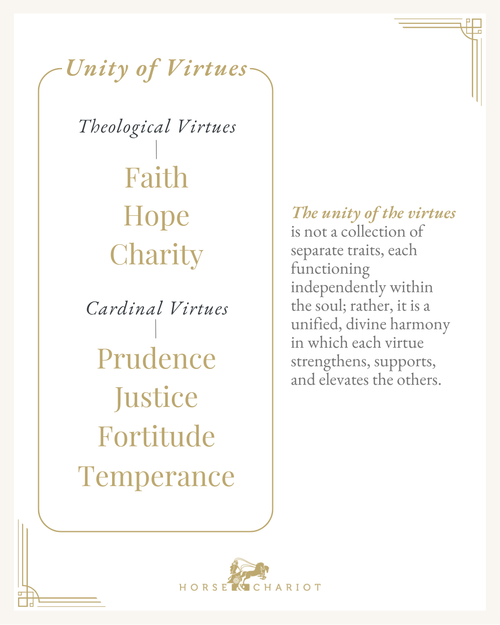
The unity of the virtues is not a collection of separate traits, each functioning independently within the soul; rather, it is a unified, divine harmony in which each virtue strengthens, supports, and elevates the others.
The life of virtue is not about excelling in isolated areas but about allowing all virtues to grow together, forming a character that reflects the image of Christ. Just as a symphony is not a series of disconnected notes but a cohesive masterpiece—where each instrument plays a role in the whole—so too is the virtuous life a work of divine artistry, where each virtue finds its place within the greater order of holiness. “And to all these qualities add love, which binds all things together in perfect unity” (Colossians 3:14).
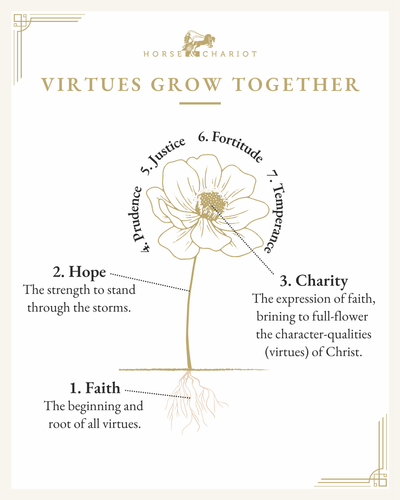
The virtues, both theological and cardinal, are like buoys in the water, rising and falling together. When one virtue is strengthened, it naturally lifts the others with it. A person who grows in faith also grows in hope, for they trust more fully in God’s promises. A soul that deepens in charity also strengthens justice, for love demands each person is treated rightly. A person who cultivates prudence sharpens their ability to act with fortitude and temperance, for wisdom enables courage and moderation to be exercised properly. No virtue stands in isolation—each is interconnected, each is dependent upon the others, and together they guide the believer toward God.
Likewise, when one virtue is weakened, the others suffer. A person who lacks temperance will struggle to act with prudence, for without self-mastery, wise choices become difficult. A person without justice will falter in fortitude, for courage without righteousness can become recklessness. When faith wavers, hope dims, and charity grows cold. The truth is, “a slight failing in one virtue is enough to put all the others to sleep” (St. Teresa of Ávila).
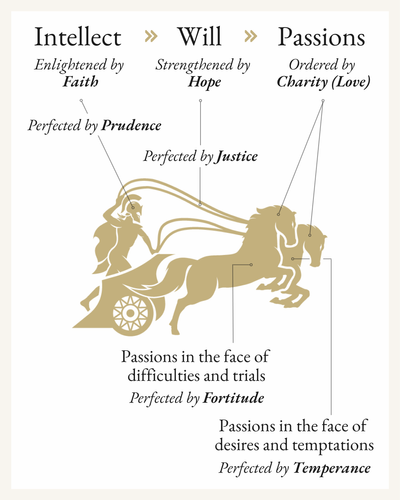
Just as the virtues must be united in harmony, so too must the soul be properly ordered—like the charioteer, the reins, and the horses that carry them forward. The intellect—the charioteer—must be enlightened by faith so it sees rightly. The will—the reins—must be strengthened by hope so it holds firm to what is good. The passions—the horses—must be perfected by charity so they are ordered by love rather than led by impulse and pride. The cardinal virtues refine and direct this process: prudence ensures the charioteer sees the path clearly; justice ensures the reins pull in righteousness; fortitude ensures the horses endure hardship; and temperance ensures the horses remain balanced and controlled. Just as a charioteer cannot reach their destination if the horses run wild, if the reins are weak, or if their vision is unclear, so too can a soul not reach holiness if its virtues are out of sync.
This is why the path to sanctification is not merely about choosing which virtues to pursue, but about embracing the life of virtue as a whole. You are not called to be partially transformed, but wholly renewed—shedding the old self and putting on the new. As Saint Paul implores, “So get rid of your old self, which made you live as you used to—the old self that was being destroyed by its deceitful desires. Your hearts and minds must be made completely new, and you must put on the new self, which is created in God’s likeness and reveals itself in the true life that is upright and holy” (Ephesians 4:22–24). Virtue is not just about moral improvement—it is about becoming like Christ, allowing His life to take form within you so you no longer live for yourself but for Him.
This transformation does not happen overnight. The unity of the virtues is forged in the trials of daily life—in moments of temptation, suffering, and perseverance. Faith is tested in uncertainty. Hope is refined in hardship. Charity is purified in sacrifice. Prudence is sharpened in decision-making. Justice is strengthened through the demands of truth. Fortitude is deepened in adversity. Temperance is perfected in self-mastery. Each virtue is cultivated through struggle, and each struggle, when embraced with grace, shapes you ever more into the character of Christ.
Thus, the virtues are not simply guides for moral living; they are the pathway by which the soul is sanctified. Through the harmony of virtue, you are made fit for Heaven and prepared for eternal communion with God. This is why the pursuit of virtue is not optional—it is essential. Without it, the soul remains fragmented, ruled by passions rather than grace, drifting without direction. But with virtue, the soul is ordered, strengthened, and led ever upward—toward its final and utmost fulfillment in God.
Ultimately, to live virtuously is to live in step with God’s divine order, to participate in the life of grace, and to walk the path that leads not only to holiness but to eternal joy. This is the beauty of the unity of the virtues: they are not merely tools for self-improvement—they are the very means by which you are transformed, drawn into the fullness of God’s love. For “all virtue is ordered toward the love of God, and in love, the virtues find their perfection” (St. Bonaventure).
2. Propelled by Prayer
The virtues do not grow in isolation, nor do they grow by mere effort—they grow in communion. And communion with Christ begins, continues, and deepens through prayer.
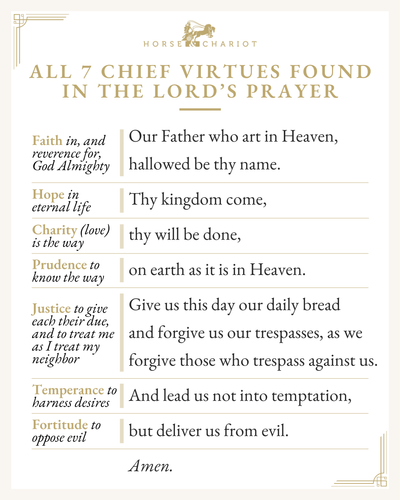
All 7 Chief Virtues are found in the Lord's Prayer
Prayer is not just a practice to support the virtuous life—it is the lifeblood of it. Without prayer, virtue becomes performance. But with prayer, virtue becomes transformation. For in prayer, we are united to the One who is virtue Himself.
You cannot strengthen your relationship with Christ if you do not spend time with Him. Just as no friendship can flourish without presence, no soul can flourish in virtue apart from the presence of God. And it is in prayer that this presence is sought, experienced, and cherished.
Not every prayer will feel powerful. Some are dry. Some make you cry. Some are short. Some are long. Some feel the same. Some feel like a strain. But every single one matters. One stacked upon the next, they draw you nearer to the heart of Christ.
It’s been said, “The function of prayer is not to influence God, but rather to change the nature of the one who prays” (Søren Kierkegaard). And it’s true—consistent, humble, daily prayer reforms the soul. It sharpens the intellect, bends the will, purifies the passions, and anchors each virtue more firmly in God.
Prayer is not just how the soul is formed—it is how the soul is protected. “If we do not fill our mind with prayer, it will fill itself with anxieties, worries, temptations, resentments, and unwelcome memories” (Scott Hahn). The absence of prayer leaves a vacuum the enemy is eager to fill. For, “There is nothing the devil fears so much, or so much tries to hinder, as prayer” (St. Philip Neri). Prayer is spiritual armor. It guards the mind, steadies the heart, and holds back the shadows that seek to distort virtue and discourage the soul.
You will find that the virtues rise and fall with the state of your prayer life. When prayer weakens, virtues wither. But when prayer deepens, the virtues thrive in harmony. Prayer is what aligns the charioteer, reins, and horses—intellect, will, and passions—so that your whole soul moves forward together in grace.
Therefore, make it your aim not to merely pray about your goals, but to make your goal to pray. For, “Prayer is an investment. The time we dedicate to prayer isn’t lost; it will return dividends far greater than what a few moments spent on a task ever could. If we fail to cultivate this discipline, prayer winds up being our last resort rather than our first response” (Charles R. Swindoll).
Prayer is not an accessory to the life of virtue—it is its engine. Without it, even the most noble intentions stall. But with it, the soul is lifted, the virtues are quickened, and grace begins to flow like wind through the sails of your soul.
So pray—deeply, frequently, honestly. Pray when it feels easy. Pray when it feels hard. Pray when it feels like nothing is happening, because it is in those hidden moments that God is often doing His deepest work. The more time you spend in prayer, the more the virtues within you will take root, grow strong, and blossom into holiness.
3. Sustained by Grace
Before you pursue the virtuous life, you must understand this truth: the unity of the virtues, perfected by love, is only made possible by grace. And that grace is accessed, nourished, and sustained through committed prayer. You cannot walk the path of virtue alone. Virtue is not a product of mere willpower, nor is holiness achieved by human strength. If you rely on yourself, your efforts will quickly falter, and pride will trap your soul. Virtue flows not from your own goodness, but from Christ dwelling within you. It is the Holy Spirit who brings virtue to life, transforming your heart from within.
Remember, your soul is like a ship upon the waters: living virtuously lifts your sails, allowing the Holy Spirit—the winds of grace—to move and guide you. When you choose sin and vice, you lower those sails, resisting the very grace that seeks to carry you forward. The key is humility—acknowledging that every good within you is God’s gift, not your own achievement.
It is said, “Few souls understand what God would effect in them if they should give themselves entirely into His hands and allow His grace to act” (St. Ignatius of Loyola). Strive to be one of these few. The unity of the virtues thrives when you surrender your heart fully to grace. As you cooperate with God’s grace, faith deepens, hope strengthens, and love becomes the bond that unifies every virtue within your soul. You are not striving by yourself; you are partnering with the God who made you, who knows your weaknesses, and who patiently sanctifies you day by day.
So, with humble trust, allow the Holy Spirit to guide you gently toward holiness. It is by God’s good grace that virtues flourish together, uniting your heart ever more perfectly with the heart of Christ. Once you grasp the truth—“Grace is the voice that calls us to change and then gives us the power to pull it off” (Max Lucado)—the path of virtue stands open before you.
4. The Way of Virtue
Seeker of virtue, you stand at the edge of the path that leads to your highest calling—the way of virtue, the road to sanctification, the journey to true fulfillment. This path is not for the fainthearted. It is steep, demanding, and filled with trials that will test your resolve. It will require you to abandon the easy road, to reject the comforts of complacency, and to embrace a life of discipline, sacrifice, and perseverance. But do not fear—for though this path is difficult, it is the only one that leads to the fullness of life, the only one that draws you ever closer to God, and the only one that will satisfy the longing in your soul.
The way of virtue is not a series of disconnected lessons or moral improvements—it is a complete transformation, where, ever so slightly, “love transforms one virtue into another, making them all one and the same in the soul” (St. Catherine of Siena). It is the road by which the old self is stripped away, where selfishness, pride, and weakness are left behind, and where the new self, strengthened by grace, is forged in the image of Christ. With every step forward, you will become more than you once were. With every struggle endured, every temptation resisted, and every sacrifice made, you will be reshaped into something greater—someone holier, someone stronger, someone freer.
But do not be deceived—this path is long, and it will test you. There will be moments when you falter, when weakness overtakes you, when temptation whispers, “Virtue is too difficult.” There will be times when you grow weary, when you wonder if the pursuit of holiness is worth the effort, when the world mocks your resolve and urges you to abandon the struggle. You will face opposition from without and from within. The world will tell you virtue is foolishness, that self-indulgence is freedom, and that pleasure is the highest good. Your own heart will resist discipline, seeking the ease of comfort rather than the trials of growth. You will be tempted to justify small compromises, to tell yourself virtue is for saints, and that holiness is beyond you.
But press on. Do not turn back. For though the way of virtue is demanding, it leads to life. It leads to peace. It leads to a joy the world cannot give and cannot take away. It leads to a heart that is strong, a soul that is devout, and a life filled with purpose. Those who walk this path do not live in regret, for they have chosen what is lasting over what is fleeting, what is true over what is convenient, and what is for the glory of God over the glory of self.
And you will not walk partnerless. The same God who calls you to this path will sustain you on it. His grace will strengthen your steps, His wisdom will illuminate your way, and His mercy will restore you when you stumble. He does not ask for perfection; He asks for faithfulness. And if you remain faithful—if you believe in Jesus Christ as your Lord and Savior, if you keep your eyes fixed on Him—He will lead you home. “For this very reason, make every effort to supplement your faith with virtue, virtue with knowledge, knowledge with self-control, self-control with endurance, endurance with devotion, devotion with mutual affection, and mutual affection with love. If these are yours and increase in abundance, they will keep you from being idle or unfruitful in the knowledge of our Lord Jesus Christ” (2 Peter 1:5–8).
The way of virtue is the way of faithfulness. It is a journey that is hard and a road that is narrow. Your faith will be attacked, tested, and questioned—oftentimes, by your very self. You will travel through periods of dryness, darkness, cold, and silence. But if you don’t give up—if you continue walking in faith, standing in virtue, clinging to Christ even when you do not feel Him, see Him, or hear Him—you will eventually walk through seasons of profound spiritual abundance, growth, and the warmth of divinely infused grace, love, and enlightenment.
“Never let go of loyalty and faithfulness. Tie them around your neck; write them on your heart” (Proverbs 3:3–4)—and wholeheartedly commit to the path of virtue, the way of faith. Be not one of the many who remain uncommitted simply because the fear of what they might lose outweighs belief in the immeasurable gift they will gain if they give their life totally and completely to Christ. Commit.
Wayfarer of faith, if you should fall—repent, rise, and recommit to the way. If you fall seventy-seven times, be remorseful, but don’t relent; reflect, atone, and return to the way. If you fall seventy-seven thousand times, do not desert the way in despair—resume it in hope, seventy-seven thousand times over if that’s what it requires. For once the way of faith is entered, sweet salvation is certain if faith is not wholly and entirely abandoned.
This is the path of virtue—the road to holiness, the process of sanctification, the journey that makes saints of sinners and transforms weakness into strength. It is the narrow road few choose, but those who do will find it leads to the only thing that has ever mattered—the eternal embrace of God Himself.
You can do this. Not by your own power, but by His. By grace. The way of virtue is the hardest path you will ever walk—but it is the only path that leads to the ultimate fullness of life. You are not alone. Lift the sails of your soul so the Holy Spirit can fill you, and the winds of grace can move you to walk with faith, endure with hope, love with charity, and live each day with prudence, justice, fortitude, and temperance. For in the end, you will see that the way of virtue is the path to fulfillment—and those who walk it will never walk in emptiness.

Scroll down for the lesson plan and other related resources associated with this teaching.
Copyright © 2022 Horse & Chariot. All rights reserved.
New teachings like this are released often. Subscribe free and never miss a teaching!
Resources
Visual Resource
Illustration of the seven chief virtues and how they work in unity, including a brief definition.
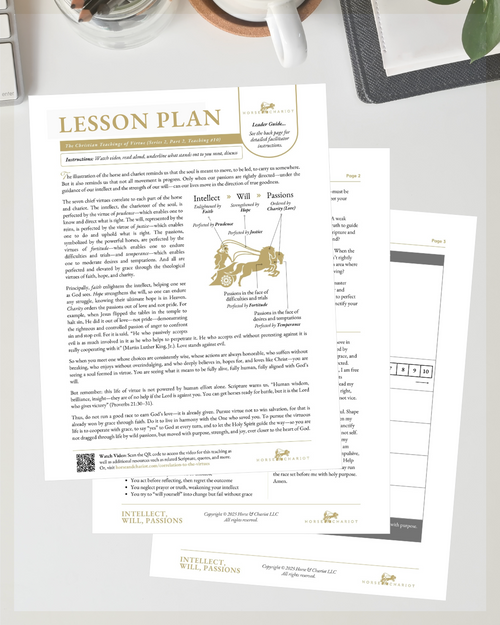
Free Lesson Plan
Perfect for small groups, families, classrooms, or personal reflection.
Related Quotes
Virtue Is One: A Single Moral Whole
Virtue is not a collection of isolated traits but a unified moral reality. To possess virtue truly is to possess it integrally, as one harmonious whole ordered toward the good.
“As the soul is one, so must all the virtues be one; divided, they perish.” — St. Bernard of Clairvaux
“Virtue is the order of love.” — St. Augustine
“Virtues are not separate but are bound together, for no one can truly have one virtue without having them all.” — St. Augustine
“The moral virtues are connected with one another; whoever possesses one in its fullness must possess them all.” — St. Thomas Aquinas
“Moral virtue is an organic whole. You cannot remove justice without harming prudence; you cannot remove temperance without weakening courage.” — Jacques Maritain
“Virtue is a house with many rooms, but they all belong to the same home.” — St. Frances of Rome
“Virtues are like the colors of a tapestry, each essential to the beauty of the whole.” — St. Louise de Marillac
“A virtue is not an isolated achievement, but part of a whole moral character. Holiness is not made up of pieces, but of a single harmony.” — Peter Kreeft
“The virtues have gone mad because they have been isolated from each other and are wandering alone.” — G.K. Chesterton
“Virtue is a single road, though it has many lanes. You do not walk the road of virtue by picking a single lane while neglecting the others.” — Frank Sheed
Charity as the Bond and Perfection of All Virtue
Charity gives life to every virtue. Without love, the virtues lose their meaning; with love, they are perfected and unified.
“All virtue is ordered toward the love of God, and in love, the virtues find their perfection.” — St. Bonaventure
“Sanctity is the fullness of charity, and charity gives life to all virtues.” — St. Josemaría Escrivá
“The bond of perfection is charity; without it, the virtues are only shadows.” — St. Francis de Sales
“True charity requires patience and perseverance.” — St. Francis de Sales
“Love transforms one virtue into another, making them all one and the same in the soul.” — St. Catherine of Siena
“The virtues are all bound together in charity, as a pearl necklace is held together by a single thread.” — St. Catherine of Siena
“Patience, humility, and charity—these three must always go together; one without the others is incomplete.” — St. Faustina Kowalska
“One virtue alone is not enough, but all must go together, like sisters, hand in hand.” — St. Teresa of Ávila
“You cannot be patient without being humble, nor humble without being charitable, nor charitable without having faith.” — St. Catherine of Siena
Balance, Harmony, and Moral Integration
Each virtue guards the others from distortion. When separated, virtues turn into vices; when united, they remain balanced and true.
“We must unite gentleness with strength, prudence with simplicity, and humility with courage.” — St. Vincent de Paul
“A man must be meek but not weak, bold but not reckless, wise but not cold. Each virtue needs the others to keep it in balance.” — G.K. Chesterton
“A perfect man would never act unjustly, never be cowardly, never be dishonest, never lose his temper. To lack any virtue is to fall short of the ideal.” — C.S. Lewis
“A slight failing in one virtue is enough to put all the others to sleep.” — St. Teresa of Ávila
“No virtue can exist alone, for without prudence, justice becomes legalism; without fortitude, temperance becomes mere asceticism; without justice, courage turns into reckless daring.” — Josef Pieper
“The virtues are a ‘group’ of things, all of them necessary. If you have not got all these qualities, you may as well not have any.” — C.S. Lewis
“Courage without prudence is recklessness, and prudence without courage is cowardice. The virtues must walk side by side.” — St. Gianna Beretta Molla
“He who is brave is also just, and he who is just is also wise.” — Seneca
Grace, Prayer, and the Action of God in the Soul
The unity of the virtues is impossible without grace. God acts first, sustains the work, and perfects what human effort alone cannot achieve.
“Few souls understand what God would effect in them if they should give themselves entirely into his hands and allow his grace to act.” — St. Ignatius of Loyola
“Just as the commander of an army pitches his camp… the enemy of our human nature studies from all sides our theological, cardinal, and moral virtues.” — Ignatius of Loyola
“If we do not fill our mind with prayer, it will fill itself with anxieties, worries, temptations, resentments, and unwelcome memories.” — Scott Hahn
“There is nothing the devil fears so much, or so much tries to hinder, as prayer.” — St. Philip Neri
“The function of prayer is not to influence God, but rather to change the nature of the one who prays.” — Søren Kierkegaard
“Prayer is an investment… prayer winds up being our last resort rather than our first response.” — Charles R. Swindoll
“Trying to do the Lord's work in your own strength is the most confusing, exhausting, and tedious of all work. But when you are filled with the Holy Spirit, then the ministry of Jesus just flows out of you.” — Corrie Ten Boom
“Grace is the voice that calls us to change and then gives us the power to pull it off.” — Max Lucado
“Trust in God strengthens all virtues, for without it, they crumble under the weight of trial.” — St. Faustina Kowalska
Faith, Hope, Charity, and the Fulfillment of the Virtuous Life
The theological virtues crown and unify the moral life. In grace, virtue becomes sanctity and the soul is transformed into Christ.
“Faith lifts the soul, hope supports it, and love perfects it—these three cannot be separated.” — St. Elizabeth Ann Seton
“Faith, hope, and charity must be lived as one, for only together do they lead the soul to God.” — St. Edith Stein
“God can make you anything you want to be, but you have to put everything in His hands.” — Mahalia Jackson
“To be virtuous is not simply to possess one virtue, but to possess all, each helping the other to grow.” — St. Elizabeth Ann Seton
“Sanctification is the work of the Holy Spirit in us whereby our inner being is progressively changed, freeing us more and more from sinful traits and developing within us over time the virtues of Christlike character.” — Jerry Bridges
“The pursuit of holiness must be anchored in the grace of God; otherwise it is doomed to failure.” — Jerry Bridges
“We are responsible to clothe ourselves with Christlike character, but we are dependent on God’s Spirit to produce within us His 'fruit.'” — Jerry Bridges
“The Spirit never lies dormant and idle within the soul…” — J.C. Ryle
“Happiness is a good flow of life, and this is achieved by living in accordance with nature, which means living with virtue.” — Zeno of Citium
“It is impossible to live a pleasant life without living wisely and well and justly. And it is impossible to live wisely and well and justly without living a pleasant life.” — Epicurus
“The shortest and surest way to live with honour in the world, is to be in reality what we would appear to be…” — Socrates
“Love is the cause of unity in all things.” — Aristotle
Related Scripture
Love as the Bond of Perfection
Love (Charity) is the "form" of all virtues; it is the glue that binds every other good quality into a perfect, harmonious unity.
“But we belong to the day, and we should be sober. We must wear faith and love as a breastplate, and our hope of salvation as a helmet.” — 1 Thessalonians 5:8 (GNT)
“Everything you do or say, then, should be done in the name of the Lord Jesus, as you give thanks through him to God the Father.” — Colossians 3:17 (GNT)
“The peace that Christ gives is to guide you in the decisions you make; for it is to this peace that God has called you together in the one body. And be thankful. Christ's message in all its richness must live in your hearts.” — Colossians 3:15-16 (GNT)
“And to all these qualities add love, which binds all things together in perfect unity.” — Colossians 3:14 (GNT)
The Chain of Virtuous Growth
Virtue is a progressive ladder; as we add one quality to another, they reinforce each other, leading to a life that is fruitful and effective.
“For this very reason, make every effort to supplement your faith with virtue, virtue with knowledge, knowledge with self-control, self-control with endurance, endurance with devotion, devotion with mutual affection, mutual affection with love. If these are yours and increase in abundance, they will keep you from being idle or unfruitful in the knowledge of our Lord Jesus Christ.” — 2 Peter 1:5-8 (NABRE)
“By his divine power, he has given us everything we need for life and godliness through our knowledge of him who called us by his own glory and goodness. Through these he has given us his very great and precious promises, so that through them you may participate in the divine nature, having escaped the corruption in the world caused by evil desires.” — 2 Peter 1:3-4 (NRSVue)
The Beatitudes: A Portrait of the Unified Life
The Beatitudes are not a list of different people, but a description of the multiple facets of a single, virtuous heart in union with God.
“Blessed are the poor in spirit, for theirs is the kingdom of heaven. Blessed are those who mourn, for they will be comforted. Blessed are the meek, for they will inherit the earth. Blessed are those who hunger and thirst for righteousness, for they will be filled. Blessed are the merciful, for they will receive mercy. Blessed are the pure in heart, for they will see God. Blessed are the peacemakers, for they will be called children of God. Blessed are those who are persecuted for righteousness’ sake, for theirs is the kingdom of heaven.” — Matthew 5:3-10 (NRSVue)
“You are the salt of the earth; but if salt has lost its taste, how can its saltiness be restored? It is no longer good for anything, but is thrown out and trampled underfoot. You are the light of the world. A city built on a hill cannot be hid.” — Matthew 5:13-14 (NRSVue)
“In the same way, let your light shine before others, so that they may see your good works and give glory to your Father in heaven.” — Matthew 5:16 (NRSVue)
Clothed in a Symphony of Virtues
The virtuous life touches every area of human interaction; humility, gentleness, and patience must work together to preserve the unity of the Spirit.
“As God’s chosen ones, holy and beloved, clothe yourselves with compassion, kindness, humility, meekness, and patience. Bear with one another and, if anyone has a complaint against another, forgive each other; just as the Lord has forgiven you, so you also must forgive.” — Colossians 3:12-13 (NRSVue)
“Finally, all of you, have unity of spirit, sympathy, love for one another, a tender heart, and a humble mind. Do not repay evil for evil or abuse for abuse; but, on the contrary, repay with a blessing. It is for this that you were called—that you might inherit a blessing.” — 1 Peter 3:8-9 (NRSVue)
“I urge you, then—I who am a prisoner because I serve the Lord: live a life that measures up to the standard God set when he called you. Be always humble, gentle, and patient. Show your love by being tolerant with one another. Do your best to preserve the unity which the Spirit gives by means of the peace that binds you together.” — Ephesians 4:1-3 (GNT)
The Mind of Integrity and the God of Peace
The unity of virtues creates an "upward spiral"—when we fill our minds with what is excellent, the God of peace dwells within us, harmonizing our lives.
“Finally, beloved, whatever is true, whatever is honorable, whatever is just, whatever is pure, whatever is pleasing, whatever is commendable, if there is any excellence and if there is anything worthy of praise, think about these things. Keep on doing the things that you have learned and received and heard and seen in me, and the God of peace will be with you.” — Philippians 4:8-9 (NRSVue)
“For those who desire to love life and to see good days, let them keep their tongues from evil and their lips from speaking deceit; let them turn away from evil and do good; let them seek peace and pursue it.” — 1 Peter 3:10-11 (NRSVue)
“For the eyes of the Lord are on the righteous, and his ears are open to their prayer. But the face of the Lord is against those who do evil.” — 1 Peter 3:12 (NRSVue)

Never miss a teaching — get all new teachings of virtue sent to your inbox free!