
All Series > Seven Chief Virtues > Part 4
The Virtue of Prudence
(Series 5, Part 4, Teaching #36)
Quick Links
Help fund this video: Donate

1. The Virtue of Prudence
The steady wisdom that steers thought to truth and truth to action is prudence.
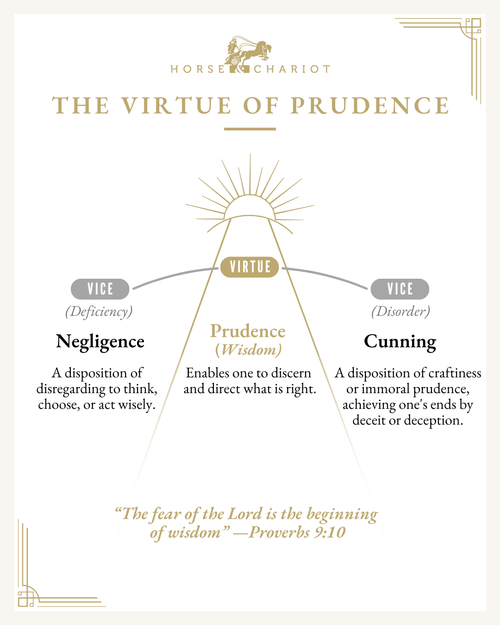
The virtue of prudence enables one to discern and direct what is right.
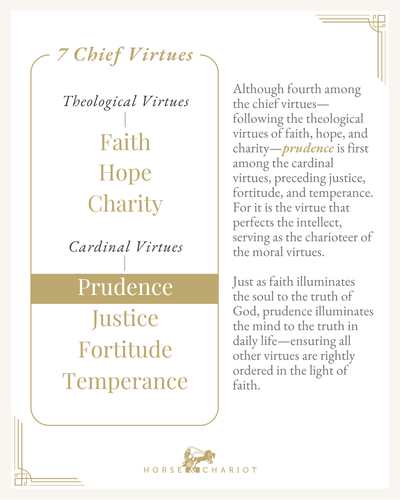
Although fourth among the chief virtues—following the theological virtues of faith, hope, and charity—prudence is first among the cardinal virtues, preceding justice, fortitude, and temperance. For it is the virtue that perfects the intellect, serving as the charioteer of the moral virtues. Just as faith illuminates the soul to the truth of God, prudence illuminates the mind to the truth in daily life in the light of faith—ensuring that all other virtues are rightly ordered.
Prudence is wisdom in action—the ability to think rightly, choose rightly, and act rightly. It is more than intelligence; it is the habit of discerning the good in every situation and deciding the best course of action to achieve it. As the guide of all virtues, prudence ensures that justice is fair, fortitude is well-placed, and temperance is balanced. Without prudence, even good intentions can lead to disaster—for virtue must be pursued not only with a desiring heart but also with a discerning mind.
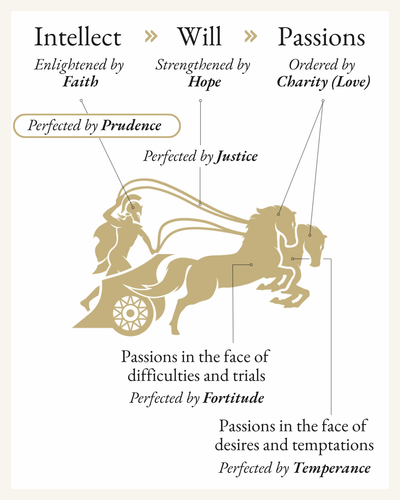
Just as a charioteer must first see the path ahead before directing the reins, prudence must show the way so the soul is not led blindly by passion or impulse. The chariot cannot reach its destination without vision and direction, and in the same way, no virtue reaches its fullness without prudence. It has been said, “The mind is the pilot of the soul” (Socrates). For without prudence, the will lacks direction, and the passions run wild. It is prudence that allows the charioteer to judge wisely, to steer skillfully, and to ensure every movement of the soul is ordered toward what is good.
Unlike worldly wisdom, which often seeks only personal gain or calculated advantage, true prudence is rooted in divine wisdom. It does not simply weigh risks and benefits but considers all things in light of God’s will. This is why prudence, for the faithful, is more than human cleverness; it is a supernatural virtue, infused by grace—elevating the mind and heart to align with the divine order. “It is through faith that we transcend our human limitations and come to participate in the infinite wisdom of God” (St. Edith Stein). Thus, Scripture reminds us, “The fear of the Lord is the beginning of wisdom” (Proverbs 9:10), for prudence begins with the humble acknowledgment that God’s ways are higher than our own.
2. Pillars of Prudence
Prudence is upheld by the pillar virtues of counsel, judgment, and command. Upon these pillars, prudence stands, enabling one to discern and direct what is right. Without all three, prudence collapses.
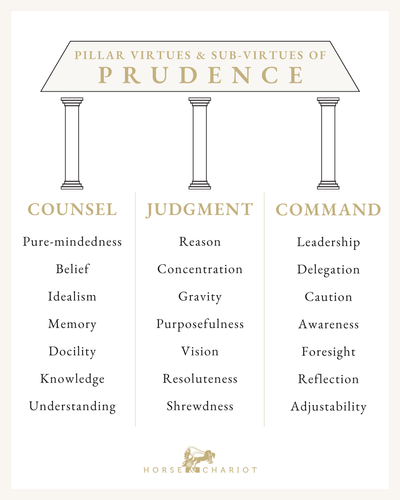
The virtue of counsel enables one to think wisely. It guides the intellect to seek the right knowledge and to weigh options carefully rather than acting on impulse. The prudent do not rush mindlessly into action but take time to reflect, pray, seek advice, and consider the consequences. Counsel ensures prudence is well-informed, not rushed, and that decisions are rooted in wisdom rather than personal bias. Its sub-virtues include pure-mindedness, belief, idealism, memory, docility, knowledge, and understanding.
The virtue of judgment enables one to choose wisely. It helps one determine the best course of action based on reason and truth rather than emotion, fear, selfishness, or convenience. It is the ability to evaluate correctly—to discern not only what is good, but what is truly best in each situation. One might receive counsel, but without sound judgment, they may still choose poorly. Judgment ensures prudence is not indecisive, that truth is not twisted by rationalization, and that choices are made with clarity and integrity. Its sub-virtues include reason, concentration, gravity, purposefulness, vision, resoluteness, and shrewdness.
The virtue of command enables one to act wisely. It is not enough to know what is right—one must actually do it. Command is prudence in motion, or “right reason in action” (St. Thomas Aquinas). It moves the will to act, ensuring wise decisions are not delayed, ignored, or lost to hesitation. Command perfects firmness of will, guarding against "paralysis by analysis." A prudent soul does not endlessly waver between options but, once the right course is discerned, chooses with confidence, acts with conviction, and sees it through to completion—making necessary course corrections along the way. It is a virtue that extends beyond oneself, directing not only one’s own will but also inspiring others to act when the prudent path requires it. Its sub-virtues include leadership, delegation, caution, awareness, foresight, reflection, and adaptability.
These pillar virtues form the foundation of prudence, equipping the believer to approach life’s many choices with wisdom. It’s important to understand, however, that prudence is not to be considered a robotic process of rigid steps. It can come in an instant burst of insight—wisdom supernaturally infused by God. For it is said, “The Lord grants in a moment what we may have been unable to obtain in dozens of years” (St. Philip Neri). Such moments of divine wisdom occur more frequently as one prayerfully pursues the prudent life, grows in virtue, and applies the lens of Truth to every situation.
Without prudence, the charioteer loses sight of the road ahead—the intellect becomes clouded, the will falters, and the passions drive the soul recklessly into error. But with prudence, the reins are held with wisdom, ensuring every decision, every action, and every direction taken leads the soul along the path of virtue.
3. Prudence in Action
Every day you’re faced with choices—some small, some life-altering—and the way you choose shapes your soul. Prudence is the virtue that helps you navigate those choices with wisdom and clarity. It teaches you to pause, to think, to seek God’s will before moving forward—then to act. With prudence, every virtue finds its proper balance, and every decision is made in the light of truth.
One with prudence sees clearly, thinks carefully, and acts wisely. They neither rush into decisions haphazardly nor hesitate in fear—they weigh the consequences, seek counsel, and choose what is truly good. Their wisdom is not self-serving but guided by God’s will, ensuring that honor is upheld, courage is rightly applied, and purity is maintained. They let prudence be the light that cuts through confusion, the compass that steers the soul toward Christ, and the guardrail that keeps all other virtues from veering into vice.
Prudence looks like the leader who seeks wise counsel before making a decision. It looks like the youth who considers long-term consequences rather than chasing momentary pleasure, the friend who speaks truth with both honesty and kindness, and the parent who disciplines with love instead of rashness. It is found in the one who thinks before acting, listens before speaking, and reflects before deciding.
Prudence is Joseph storing grain in Egypt to prepare for famine, Solomon asking God for wisdom instead of riches, and Daniel refusing to defile himself in a foreign land. It is Jesus teaching in parables, knowing when to speak and when to be silent, and choosing the perfect moment to reveal God’s plan. Above all, it is Jesus Christ Himself, who with perfect wisdom fulfilled the Father’s will, saying, “I do nothing on my own, but I say only what the Father taught me” (John 8:28).
Prudence is what allows you to live intentionally, not reactively. It gives clarity in confusion, direction in uncertainty, and peace in decision-making. When you walk in prudence, you walk in wisdom—not your own, but God's. And that wisdom becomes your strength, shaping your choices, steadying your path, and aligning your life with His will.
4. Vices Opposed to Prudence
The vices opposed to prudence are, at one extreme, a deficiency of prudence—which is negligence, and, at the other extreme, one can never have too much prudence, but one can have disordered prudence—which is cunning.
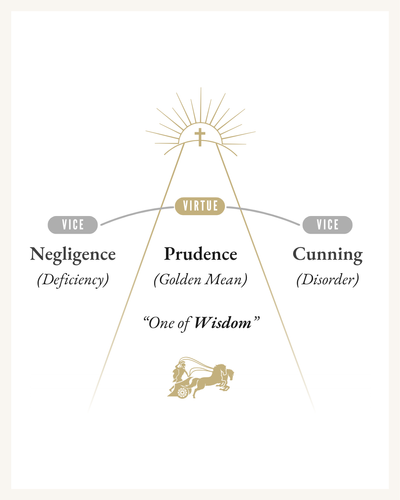
The vice of negligence is a disposition of disregarding to think, choose, or act wisely. The negligent soul fails to seek truth, dismisses the need for careful judgment, and acts carelessly without considering the consequences. It is found in the one who makes impulsive decisions without reflection, who refuses to learn from past mistakes, who ignores wise counsel, and who drifts through life without direction. Negligence blinds the soul, leaving it vulnerable to error, ensuring wisdom is neither sought nor followed, and dooming it to sin and regret.
The vice of cunning is a disposition of craftiness or immoral prudence, achieving one's ends by deceit or deception. The cunning soul twists wisdom into manipulation, using intelligence to serve selfish goals rather than the pursuit of God’s will. It is found in the one who lies or distorts facts for personal advantage, who plays people against one another, and who seeks to control rather than to guide. Cunning corrupts prudence, making wisdom a tool for deception rather than virtue, ensuring the intellect serves evil ambition instead of righteousness.
Both negligence and cunning defraud the virtue of prudence—one by failing to think, the other by thinking wickedly. Together, they distort the soul’s ability to see and act rightly, leading it either into carelessness or calculated deceit, both of which remove it from the way of wisdom.
Thus, whether it be by negligence or cunning, the outcome is the same—folly. Scripture says, “It is the wisdom of the [prudent] to understand where they go, but the folly of fools misleads” (Proverbs 14:8); for to abandon prudence—whether by neglecting wisdom or twisting it for selfish gain—is to walk blindly into ruin. Folly clouds the soul, ignores grace, and strips it of true discernment, leading to imprudent sins of endless sorts and a life untethered from Truth.
5. Cultivating Prudence
The best defense against folly and the vices opposed to prudence is to develop prudence itself. For prudence is not inherited at birth; it is cultivated by practice. It does not come through passive learning but through intentional discipline. To become prudent, you must first desire wisdom more than ease, comfort, or the fleeting satisfaction of giving in to impulse. You must learn to pause before acting, to think before speaking, and to listen before deciding. The first step toward prudence is simple but not easy: slow down. Stop reacting, and start discerning.
Pray, think, then act. That’s the prudent way. If you want to learn to be prudent, it begins not by acting, and thinking, and then praying, but by praying first, then thinking, then taking action. How many get themselves into trouble and then use their prayer as a remedy for acting poorly? They act and then ask for forgiveness. Not the prudent. They put right judgment ahead of action, and right judgment always begins with prayer. Scripture advises, “But if any of you lack wisdom, you should pray to God, who will give it to you; because God gives generously and graciously to all” (James 1:5). Prayer becomes the wellspring of prudence, aligning the heart and mind with divine truth.
A prudent soul hungers for truth, knowing wisdom is not stumbled upon but actively sought. They immerse themselves in prayer, speaking to God, and then turn to Scripture to hear Him speak in return, for “When we pray we speak to God; but when we read, God speaks to us” (St. Jerome). By grounding oneself in these practices, the prudent soul allows divine wisdom to take root and grow within.
But the prudent do not stop at prayer and Scripture—they embrace learning as a lifelong pursuit. “The cultivation of the intellect is man's highest good and purest happiness” (Aristotle), for a well-formed mind is essential to sound judgment. The prudent soul actively seeks to grow, surrounding themselves with those of sound character and pursuing the learning and living of virtue with urgency. Simply acquiring the knowledge of virtue allows prudence to take unstoppable form.
Yet, the prudent do not rely solely on their own understanding but measure every decision against the eternal wisdom of God, for it is said, “Satan's greatest weapon is man's ignorance of God's word” (A.W. Tozer). True wisdom comes not only from knowing what is right but also from surrendering what is unnecessary or harmful. “The greatest wisdom is to let go of what is not for God's glory” (St. Francis de Sales). Prudence demands that we detach ourselves from anything that diverts us from the path of righteousness and instead seek what is truly good in God’s eyes.
As valuable as anything else is strengthening prudence in small, daily choices. It is resisting procrastination and choosing diligence. It is seeking counsel before making a decision. It is choosing to speak truth with kindness, not cruelty. It is considering the consequences of your actions, avoiding past mistakes, and choosing what is best over what is easiest. Stack good decisions on top of good decisions. Stop choosing what you know is wrong and start choosing what you know is right—in all situations, big and small. Make it a habit.
As prudence grows, it transforms the soul. The one who was once thoughtless becomes measured. The one who was once hesitant becomes decisive. The one who was once ruled by emotion is now ruled by wisdom. They no longer drift in confusion or live in regret, for their decisions are made in the light of truth. Clarity replaces uncertainty, confidence replaces fear, and wisdom replaces folly.
Ultimately, prudence is the path to peace. A life governed by prudence is a life free from avoidable sorrow, unnecessary failure, and heedless remorse. The prudent soul walks with confidence, knowing their steps are ordered, their choices are right, and their life is aligned with God’s will. As the saying goes, “We're not born winners. We're not born losers. We're born choosers” (unknown). For in the end, wisdom is not about knowing much—it is about choosing well. And those who choose well, choose God.
6. The Way of Prudence
Seeker of virtue, the way of prudence is the path of wisdom—where every step demands discernment, every choice carries weight, and every decision shapes the soul. Prudence is not just about being street-smart, book-smart, or business-smart—it’s about being life-smart. True prudence extends into all aspects of life. Someone may exhibit great prudence at work, carefully choosing their words and actions to lead by good example, yet fail to show the same discernment and care at home with their own family. This is not true prudence. To be truly prudent is to align all thoughts, decisions, and actions with the pursuit of virtue in every area of life.
There are countless men and women with above-average intelligence who are deeply unwise, and yet there are those with little formal education who display profound wisdom. The virtue of prudence and the gift of wisdom are far more connected to your character score than your IQ score. Take hope in this: while you may not be the most academically intelligent, you can still be among the most prudent and wise.
Prudence is the art of choosing rightly—at the right time, in the right way, with the right means, to the right end. It is the virtue that orchestrates all others, ensuring courage is not recklessness, justice is not cruelty, and temperance is not deprivation. Without prudence, honor turns to dishonor, courage falls to cowardice, and purity gives in to impurity. It is prudence that steers the soul away from the margins of vice and keeps it on the narrow road of virtue—the path to fulfillment and the glorification of God. And make no mistake—this path will test you.
At first, prudence may seem straightforward: gather knowledge, weigh the options, choose wisely, and act accordingly. But soon you will find yourself at a crossroads where the right path is unclear, where emotion battles against reason, and where urgency demands action before wisdom has spoken. You will be tempted to rush, to act on impulse, and to listen to fear or pride instead of truth. The world will offer shortcuts—compromise here, justify there, choose what is easiest, not what is best. Even virtues may seem to conflict, and you will wrestle with what is truly good.
But if you stay the course—if you choose wisdom over folly—something transformative will happen: prudence. For when prudence is sharpened through discipline, it becomes unfailing. It will become your light in the darkness, your compass in the storm. You will learn to pause before speaking, to weigh consequences before acting, to see not just the immediate but the eternal. Prudence will ensure your life is not ruled by impulse, foolishness, or regret. More than that, it will teach you to look where you are going and to order your every thought, decision, and action toward your ultimate purpose: to glorify God in all you do by pursuing a virtuous life. All other decisions will be subordinate to this highest end.
Prudence requires discipline, patience, and a relentless pursuit of holiness. It will cost you your laziness, your rashness, your excuses. But it will give you everything—clarity, confidence, and a life in harmony with God’s will.
You can do this. Not by your own power, but by His. By grace. The path of prudence is trying, but it leads to wisdom. You’re not alone. Lift the sails of your soul so the Holy Spirit can fill you, and the winds of grace can move you to—choose rightly, seek truth, and walk with virtue. For in the end, only the wise reach their true destination.

Scroll down for the lesson plan and other related resources associated with this teaching.
Copyright © 2022 Horse & Chariot. All rights reserved.
New teachings like this are released often. Subscribe free and never miss a teaching!
Resources
Visual Resource
Illustration of the virtue of prudence and the vices that oppose it, including definitions.
Free Lesson Plan
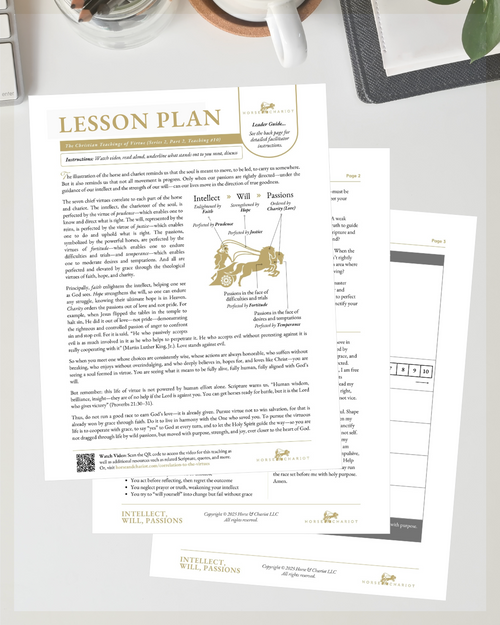
Perfect for small groups, families, classrooms, or personal reflection.
Related Quotes
Prudence as the Guide and Governor of the Soul
Prudence is the ruling virtue of the moral life. It orders the intellect, governs the will, and directs all other virtues toward their proper end.
“Prudence is the charioteer of the virtues; it guides and directs them all.” — St. Bernard of Clairvaux
“Prudence is the eye of the soul.” — St. Francis de Sales
“Prudence is the knowledge of what to seek and what to avoid.” — St. Augustine
“The whole concern of prudence is with the reasoned choice of good and evil.” — St. Thomas Aquinas
“Prudence directs and centers all the affections upon the highest Good, as if no other object existed.” — Mary of Agreda
“Prudence governs all the others, and all her works will show the splendor of this virtue.” — Mary of Agreda
“[The virtues] cannot exist without Prudence…” — Aristotle
“The mind is the pilot of the soul.” — Socrates
Prudence, Truth, and Right Judgment
Prudence aligns the intellect with truth. Rather than bending reality to desire, the prudent soul conforms desire to what is real, good, and ordered.
“A prudent man does not try to bend the truth to his desires, but rather he conforms his desires to the truth.” — St. Thomas Aquinas
“A prudent man does not trust himself too much.” — St. Josemaría Escrivá
“The prudent Christian does not allow himself to be deceived by the false maxims of the world.” — St. Pius X
“The devil often presents evil as something good and good as something evil. A prudent person can discern the difference.” — St. Josemaría Escrivá
“The least initial deviation from the truth is multiplied later a thousand fold.” — Aristotle
“When a man is getting better he understands more and more clearly the evil that is still left in him…” — C.S. Lewis
“Satan's greatest weapon is man's ignorance of God's word.” — A.W. Tozer
“Allow me to offer a simple definition of wisdom. Wisdom is looking at life from God's point of view.” — Charles R. Swindoll
Prudence, Self-Mastery, and Daily Decision-Making
Prudence is not abstract wisdom but lived discernment. It is exercised in restraint, humility, patience, and thousands of small daily choices.
“A prudent man is more powerful than a strong man; for the strong man conquers his enemies, but the prudent man conquers himself.” — St. John Chrysostom
“A prudent person does not act according to human impulses but according to the Spirit of God.” — St. Louis de Montfort
“Prudence is not a matter of deciding once and for all. It is a matter of making small, ethical choices every day.” — Joan Chittister
“Be simple, be humble, and always act prudently.” — St. Padre Pio
“Be slow in choosing, but once chosen, never waver.” — St. John Bosco
“Do nothing without prayer, and deliberate well before acting.” — St. Alphonsus Liguori
“Prudence teaches us when to be silent and when to speak.” — St. Pius X
“Wisdom is not about knowing all the answers. It is about knowing what questions to ask.” — Joan Chittister
“We're not born winners, we're not born losers, we're born choosers.” — Unknown
Prudence, Wisdom, and the Formation of the Intellect
Prudence depends upon a well-formed intellect—one shaped by humility, study, prayer, and openness to divine wisdom.
“When we pray we speak to God; but when we read, God speaks to us.” — St. Jerome
“It is through faith that we transcend our human limitations and come to participate in the infinite wisdom of God.” — St. Edith Stein
“True wisdom, then, consists in works, and the truly wise man is he who is wise in the works of God.” — St. Teresa of Ávila
“The cultivation of the intellect is man's highest good and purest happiness.” — Aristotle
“Jesus, help me to simplify my life by learning what you want me to be and becoming that person.” — St. Thérèse of Lisieux
“Let no one be slow to seek wisdom when he is young nor weary in the search of it when he has grown old…” — Epicurus
“And all knowledge, when separated from justice and virtue, is seen to be cunning and not wisdom…” — Plato
“True wisdom comes to each of us when we realize how little we understand…” — Socrates
Prudence, God’s Will, and Trustful Action
At its highest level, prudence submits human judgment to divine wisdom. It teaches the soul when to act, when to wait, and when to trust.
“The greatest prudence is to trust completely in God.” — St. Maximilian Kolbe
“The greatest wisdom is to let go of what is not for God's glory.” — St. Francis de Sales
“Earthly wisdom is doing what comes naturally. Godly wisdom is doing what the Holy Spirit compels us to do.” — Charles Stanley
“The Lord grants in a moment what we may have been unable to obtain in dozens of years.” — St. Philip Neri
“The wise man builds his house upon the rock.” — St. Louis de Montfort
“We must be ready to discern the signs of the times and act accordingly.” — St. Maximilian Kolbe
“The prudent man does himself good; the virtuous one does it to other men.” — Voltaire
Related Scripture
The Divine Origin of Wisdom and Prudence
Wisdom and prudence are not merely human traits but gifts from God, given to those who seek Him with a humble and prayerful heart.
“The fear of the Lord is the beginning of wisdom, and knowledge of the Holy One is understanding.” — Proverbs 9:10 (NRSVue)
“For the Lord gives wisdom; from his mouth come knowledge and understanding.” — Proverbs 2:6 (NRSVue)
“If any of you is lacking in wisdom, ask God, who gives to all generously and ungrudgingly, and it will be given you.” — James 1:5 (NRSVue)
“Call to me and I will answer you and tell you great and unsearchable things you do not know.” — Jeremiah 33:3 (NRSVue)
“Still, I realized that I would never receive Wisdom unless God gave her to me—and knowing that only God could give her to me was itself a sign of understanding. So I prayed, begging the Lord with all my heart.” — Wisdom 8:21 (GNT)
“Because of this, I prayed, and understanding was given to me; I appealed, and the spirit of Wisdom came to me. I preferred her to scepters and thrones, and I accounted wealth as nothing in comparison with her.” — Wisdom 7:7-8 (NABRE)
“The root of wisdom is to fear the Lord, and its branches are long-lived.” — Sirach 1:20 (NRSVue)
Prudence as the Guide to Virtue
Prudence is traditionally called the "auriga virtutum" (the charioteer of the virtues); it allows us to apply moral principles to real-life situations.
“The wise in heart is called prudent, and pleasant speech increases persuasiveness.” — Proverbs 16:21 (NRSVue)
“To you, therefore, O kings, are my words addressed, that you may learn wisdom and that you may not fall away. For those who keep the holy precepts hallowed will be found holy, and those learned in them will have ready a response. Desire therefore my words; long for them and you will be instructed. Resplendent and unfading is Wisdom... setting your heart on her is the perfection of prudence.” — Wisdom 6:9-15 (NABRE)
“It is the wisdom of the prudent to understand where they go, but the folly of fools misleads.” — Proverbs 14:8 (NRSVue)
“Learn where prudence is, where virtue is, where understanding is, so that you may know at the same time where long life and prosperity are, where the light of the eyes and peace are.” — Baruch 3:14 (NRSVue)
“Blessed is the person who finds wisdom and the one who gets understanding, for her income is better than silver and her revenue better than gold.” — Proverbs 3:13-14 (NRSVue)
“Do you love justice? All the virtues are the result of Wisdom's work: justice and courage, self-control and understanding. Life can offer us nothing more valuable than these.” — Wisdom 8:7 (GNT)
Prudence vs. Folly and the "Flesh"
True prudence is spiritual; it distinguishes between the temporary, deceptive wisdom of the world and the eternal light of God.
“For the setting of the mind on the flesh is death, but the setting of the mind on the Spirit is life and peace.” — Romans 8:6 (NRSVue)
“Now this I affirm and insist on in the Lord: you must no longer walk as the Gentiles walk, in the futility of their minds; they are darkened in their understanding, alienated from the life of God because of their ignorance and hardness of heart.” — Ephesians 4:17-18 (NRSVue)
“Look, I am sending you out like sheep into the midst of wolves, so be wise as serpents and innocent as doves.” — Matthew 10:16 (NRSVue)
“Sometimes there is a way that seems to be right, but in the end it is the way to death.” — Proverbs 16:25 (NRSVue)
“The crooked of mind do not prosper, and the perverse of tongue fall into calamity.” — Proverbs 17:20 (NRSVue)
“Better is a person who lacks understanding but fears the Lord than one of great prudence who transgresses the law.” — Sirach 19:24 (NRSVue)
“Better to meet a she-bear robbed of its cubs than to confront a fool immersed in folly.” — Proverbs 17:12 (NRSVue)
“The weight of stone and sand is nothing compared to the trouble that stupidity can cause.” — Proverbs 27:3 (GNT)
The Moral Life: Purity and Truth
Wisdom and prudence cannot dwell in a soul that loves sin; they require a commitment to walking in the truth.
“All wisdom is fear of the Lord; and in all wisdom, the observance of the Law.” — Ben Sira 19:20 (NABRE)
“For wisdom will not enter a deceitful soul or dwell in a body enslaved to sin.” — Wisdom 1:4 (NRSVue)
“I have no greater joy than to hear that my children are walking in the truth.” — 3 John 1:4 (NRSVue)
“Wisdom is more beautiful than the sun and all the constellations. She is better than light itself, because night always follows day, but evil never overcomes Wisdom.” — Wisdom 7:29-30 (GNT)
“Happy is the person who meditates on wisdom and reasons with understanding, who considers her ways in their heart and ponders her secrets.” — Sirach 14:20-21 (NRSVue)
“By your wisdom you have formed humankind to have dominion over the creatures you have made and rule the world in holiness and righteousness and pronounce judgment in uprightness of soul.” — Wisdom 9:2-3 (NRSVue)
“For the Lord is a sun and shield; he bestows favor and honor. No good thing does the Lord withhold from those who walk uprightly.” — Psalm 84:11 (NRSVue)
The Benefits and Fruits of Wisdom
Choosing wisdom over material riches leads to a life of peace, divine friendship, and internal grace.
“She is more precious than jewels, and nothing you desire can compare with her. Long life is in her right hand; in her left hand are riches and honor. Her ways are ways of pleasantness, and all her paths are peace. She is a tree of life to those who lay hold of her; those who hold her fast are called happy.” — Proverbs 3:15-18 (NRSVue)
“Indeed, she is an infinite treasure for mortals; those who use it become partakers in the friendship of God, commended for the gifts that come from instruction.” — Wisdom 7:14 (NRSVue)
“For God loves nothing so much as the person who lives with wisdom.” — Wisdom 7:28 (NRSVue)
“In this way people on earth have been set on the right path, have learned what pleases you, and have been kept safe by Wisdom.” — Wisdom 9:18 (GNT)
“Wisdom breathes life into her children and helps those who seek her. Whoever loves her loves life, and those who seek her from early morning will be filled with joy.” — Sirach 4:11-12 (NRSVue)
“Preserve sound wisdom and prudence; do not let them escape from your sight. They will be life for your soul and adornment for your neck. Then you will walk on your way securely, and your foot will not stumble.” — Proverbs 3:21-23 (NRSVue)

Never miss a teaching — get all new teachings of virtue sent to your inbox free!