
All Series > Seven Chief Virtues > Part 5
The Virtue of Justice
(Series 5, Part 5, Teaching #37)
Quick Links
Help fund this video: Donate

1. The Virtue of Justice
The honorable scale weighing right from wrong and giving each their due is justice.
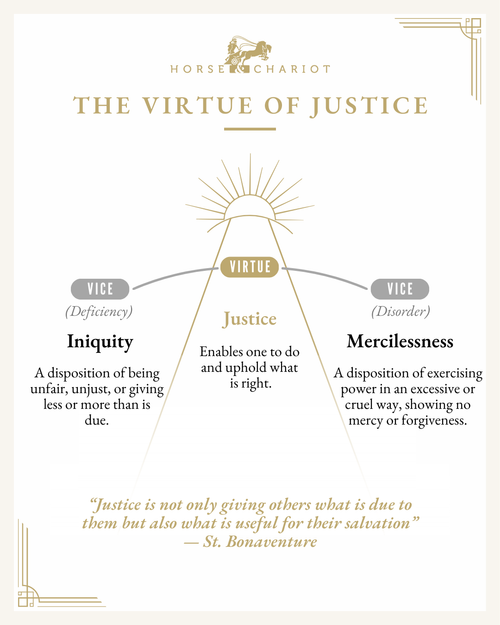
The virtue of justice enables one to do and uphold what is right.
Justice is fifth among the seven chief virtues and second among the cardinal virtues, following prudence. It is the virtue that perfects the will, serving as the “reins of the soul.” Where prudence discerns and directs what is right, justice ensures it is carried out with honor.
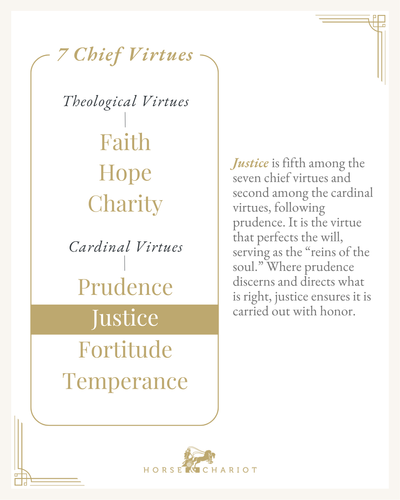
Justice demands that each person receives what they are owed—whether to God, to others, or to oneself. It is more than fairness; it is the habit of living in truth and righteousness, honoring the dignity of every person, and acting with integrity in all things. Justice governs relationships, creates harmony in society, ensures duties are fulfilled, and guarantees that the weak are protected from oppression. It is the virtue that binds people together in peace, ensuring that goodness is not merely pursued but upheld.
Just as a charioteer must keep a steady hold on the reins—ensuring the horses do not pull too far in one direction or the other—justice holds the will firmly in place, directing the soul toward virtue and away from vice. Without justice, the will wavers—either becoming weak and negligent, failing to give what is owed, or becoming harsh and merciless, wielding power without fairness. Justice ensures that strength is exercised rightly, duty is not abandoned, and the path of righteousness is not lost to compromise or corruption.
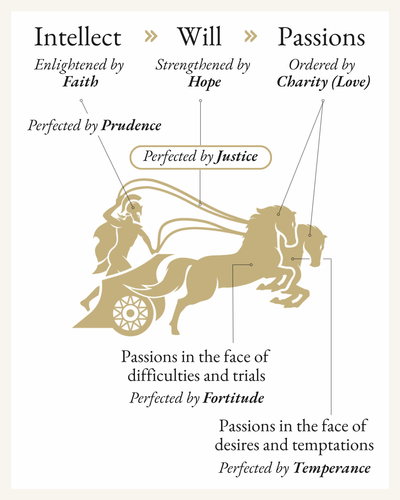
True justice is not merely a human construct; it is a reflection of divine order, for God Himself is perfectly just. Scripture declares, “The Lord is a God of justice” (Isaiah 30:18), and Christ commands, “Strive first for the kingdom of God and His righteousness” (Matthew 6:33). Justice flows from God’s nature, for He is the source of all that is right and true. To act justly is to participate in His divine plan and bring His virtue into the world by ensuring that truth, fairness, and the moral law are maintained.
The key dimensions of justice are justice toward God, justice toward others, and justice toward self.
Justice toward God is the highest form, for it is the duty of every soul to give Him the worship, love, and obedience He is owed. This is why faith and reverence are not optional—they are matters of justice. God has given you life, and it is right that you honor Him.
Justice toward others ensures each person is treated with fairness, dignity, and respect. It governs honesty in speech, integrity in business, and responsibility in relationships. It demands that promises be kept, debts be paid, and no one be deprived of what is rightfully theirs. But justice is not merely about external fairness—it also seeks the highest good of every soul, including your own. As it is said, “Justice is not only giving others what is due to them but also what is useful for their salvation” (St. Bonaventure). True justice considers not only temporal needs but eternal ones, ensuring that every action leads closer to God, rather than away from Him.
2. Pillars of Justice
Justice is upheld by the pillar virtues of righteousness, obedience, and graciousness. Upon these pillars, justice stands, enabling one to do and uphold what is right. Without all three, justice falls.
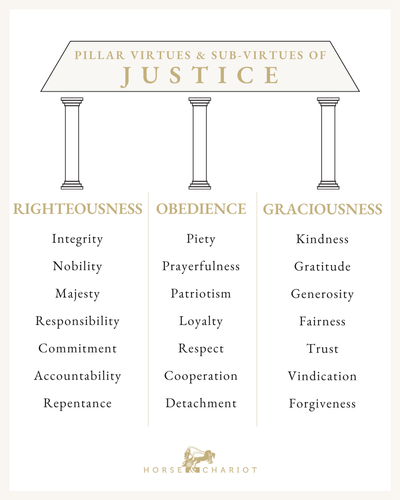
The virtue of righteousness enables one to pursue what is right and just. It ensures justice is not compromised, one’s actions align with truth, and character is upheld—even when no one is watching. The just do not bend morality for convenience, nor manipulate truth to serve their own interests. For as it is said, “No one in the world can change truth. What we can do and should do is seek truth and serve it when we have found it” (St. Maximilian Kolbe). Righteousness ensures justice is not selective but steadfast—not contingent on circumstance, but rooted in unwavering moral character. Its sub-virtues include integrity, nobility, majesty, responsibility, commitment, accountability, and repentance.
The virtue of obedience enables one to revere authority justly. It upholds justice by recognizing and submitting to rightful authority—whether divine, moral, or lawful. Obedience is not blind compliance, nor does it tolerate injustice, but it ensures that duty is fulfilled, discipline is maintained, and laws are upheld for the good of all. True obedience also includes obedience to one’s rightly formed conscience—the inner voice that discerns God’s law written on the heart. Thus, obedience is not mere conformity, but a deliberate act of the will to honor both the external order and the internal truth. It demands due honor and respect toward religion, parents, country, and community, while remaining rooted in the ultimate authority of God. Without obedience, justice collapses into rebellion, where self-interest takes precedence over duty, and authority is disregarded in favor of personal will. Its sub-virtues include piety, prayerfulness, patriotism, loyalty, respect, cooperation, and detachment.
The virtue of graciousness enables one to treat others kindly and mercifully. It ensures justice is not only fulfilled, but also expressed with dignity and respect. Justice is not merely about law and order—it is about how we treat one another. Graciousness is more than politeness; it is the recognition of human dignity, ensuring that truth is spoken with charity, respect is shown even in disagreement, and all people—friend or enemy—are treated with civility and honor. The just do not judge based on status or self-interest but act fairly in all relationships, whether with the powerful or the weak, the admired or the despised. Without graciousness, justice can become cold and rigid—enforcing rules without compassion and forgetting that justice serves not only truth, but also peace and harmony among people. Its sub-virtues include kindness, gratitude, generosity, fairness, trust, vindication, and forgiveness.
These pillar virtues form the foundation of justice. To live in justice is to walk in step with God, to govern one’s life with truth and integrity, and to ensure every action reflects the divine order. It is what holds the soul steady on the path of virtue—ensuring that in every duty, every choice, and every relationship, the will remains firmly aligned with what is true and good.
Without justice, the charioteer loses control of the path—the will becomes weak, allowing the horses to veer toward selfish gain, or becomes too rigid, pulling the reins so tightly the horses stumble under the weight of severity. But one who upholds justice rightly guides the will with wisdom, ensuring strength does not become cruelty, mercy does not become weakness, and righteousness does not become self-righteousness.
3. Justice in Action
Justice is more than due regard—it is fidelity to what is right in the eyes of God. It orders the soul, elevates society, and honors both truth and dignity. The just person does not merely follow rules; they embody righteousness in the quiet details of life. They reflect the character of Christ—living with integrity, honoring others, and striving to bring order to a disordered world.
One with justice seeks to uphold truth, defend the oppressed, and act with untiring righteousness. They honor God with obedience, treat others graciously, and carry themselves with character. Their word is sure, their actions just, and their heart good—committed to what is right, even when it is difficult. Justice is not just what they do—it is who they are, for they know that to walk in justice is to walk in step with the Just One Himself.
Justice looks like the worker who labors honestly, even when no one is watching. It looks like the leader who upholds the law without corruption, the friend who refuses to gossip, and the teacher who grades fairly without favoritism. It is found in the one who repays a debt rather than avoiding it, the child who tells the truth even when it costs them, and the citizen who seeks the good of their community rather than their own advantage. It is found in the hearts of those who whisper to themselves, “I alone cannot change the world, but I can cast a stone across the waters to create many ripples” (St. Mother Teresa).
Justice is Noah obeying God's command despite the world’s corruption, Moses standing before Pharaoh demanding freedom for the oppressed, and Boaz redeeming Ruth with honor. It is the prophets calling Israel back to righteousness, John the Baptist preaching repentance, and Jesus driving out the moneychangers who defiled His Father’s house. Above all, it is Christ Himself—the Just One—who bore the weight of sin so that mercy and justice might be fulfilled, for “He is a God of justice, who shows no partiality” (Ben Sira 35:15, NABRE).
Justice may not always be praised, but it is always powerful. It is the virtue that protects the vulnerable, restores what is broken, and reflects the order of Heaven on earth. To live justly is to walk in truth, to serve with integrity, and to love without bias. And in doing so, you not only honor others—you honor the God who is justice itself.
4. Vices Opposed to Justice
The vices opposed to justice are, at one extreme, a deficiency of justice—which is iniquity, and at the other extreme, one can never have too much justice, but one can have disordered justice—which is mercilessness.
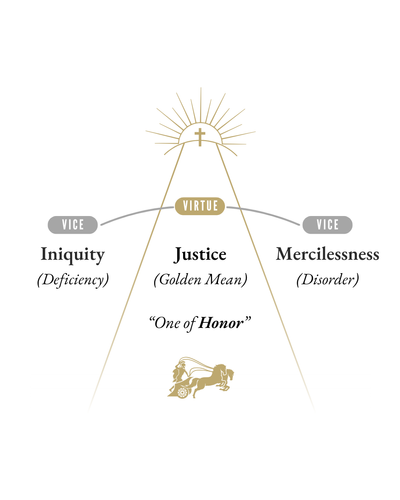
The vice of iniquity is a disposition of being unfair, unjust, or giving less or more than is due. The iniquitous one distorts justice, either by withholding what is rightfully owed or by exploiting power for personal gain, disregarding the dignity and rights of others. It is found in the person who lies to gain an advantage, in the employer who withholds fair wages, in the leader who rules through corruption. Iniquity turns justice into a tool of self-interest, making it a commodity to be traded rather than a truth to be upheld.
The vice of mercilessness is a disposition of exercising power in an excessive or cruel way, showing no mercy or forgiveness. The merciless one enforces the law or their own authority with severity, refusing compassion and failing to temper justice with love. It is found in the judge who punishes without considering repentance, in the person who refuses to forgive, and in the one who takes pleasure in the downfall of others. Mercilessness twists justice into a weapon of destruction, forgetting true justice seeks not only to punish but to restore.
Both iniquity and mercilessness corrupt the harmony of justice—one by denying fairness, the other by denying mercy—leading the soul away from the divine balance of righteousness and compassion that true justice requires.
Thus, whether it be by iniquity or mercilessness, the outcome is the same—dishonor. The dishonor of corruption, the perversion of fairness, and the degradation of human dignity. To dishonor justice defiles the soul and turns it from grace, leading to unjust sins such as partiality, exploitation, theft, cruelty, vengeance, and an unforgiving spirit. Thus, it is written, “When justice is done, it is a joy to the righteous, but dismay to evildoers” (Proverbs 21:15), for to abandon justice is to forsake the path of honor and to walk instead in the shadow of corruption and cruelty.
5. Cultivating Justice
The best defense against dishonor and the vices opposed to justice is to develop justice itself. “Justice is not upheld in the grand moments of life if it is not first upheld in the small ones” (Mary of Agreda). To become just, you cannot wait for a great cause to defend or a moment of crisis to act rightly—you must train your soul daily in truth and righteousness. You must understand, “Injustice anywhere is a threat to justice everywhere” (Martin Luther King, Jr.). So you cannot cheat in small things and expect to be honest in greater ones. You cannot dismiss little injustices and expect to stand firm when it matters most. Justice is cultivated in the details—in the words you speak, the promises you keep, and the duties you fulfill.
The just love truth above all else. They do not bend it for personal gain, twist it for convenience, or withhold it out of fear. They speak with honesty, act with integrity, and refuse to participate in deception—whether in business, relationships, or self-examination. They understand justice begins with truth, for where there is falsehood, there can be no virtue. Thus, they measure their words carefully, ensuring what they say and do aligns with reality, not personal preference.
Justice grows in humility and responsibility. The just do not demand fairness for themselves while denying it to others. They do not rationalize dishonesty when it serves their interest, nor do they excuse negligence in their duties. They fulfill their obligations—to God, to others, and to themselves—not out of mere obligation, but because justice demands it. They take responsibility for their actions, repay debts without excuse, and seek to restore what they have wronged. They live in such a way that, if every person acted as they did, the world would be rightly ordered.
As justice takes root, it brings clarity and peace to the soul. The just soul fears no accusation, for it carries no burden of deceit. It moves through life with confidence, undeterred by moral confusion, for its choices are not governed by shifting emotions but by unswerving principles. Relationships flourish because others are treated with fairness, respect, and dignity. The guilty conscience is foreign to the just, for they owe no one falsehood and have nothing to hide.
Above all, justice begins in the heart, and the heart is formed by prayer, Scripture, and reflection. The just do not rely on their own wisdom or strength but seek the guidance of God, who is the source of all righteousness. Prayer aligns the heart with God’s truth, Scripture illuminates the path of justice, and reflection reveals where growth is needed. Without these disciplines, the pursuit of justice falters, for no one can truly walk the path of virtue without God’s grace and guidance. The just soul, therefore, cultivates these practices daily, knowing they are the foundation of living justly in every thought, word, and deed.
Ultimately, justice is the path of honor. It lifts the soul above selfishness and deceit, ensuring every action is measured against truth, every duty is fulfilled with rectitude, and every relationship is governed by virtue. To be just is to walk in step with God, to reflect His truth in every decision, and to order your life in harmony with His perfect will.
6. The Way of Justice
Seeker of virtue, the way of justice is the path that demands integrity, courage, and an unrelenting commitment to truth. Justice is not about fairness in the shallow sense—it is about giving to each what is due, without compromise, without favoritism, without fear. It is a virtue that calls for strength, for the world does not love justice. It twists it, resents it, and punishes those who uphold it. If you choose this path, prepare for resistance.
At first, justice may seem simple: do what is right, treat others fairly, and stand for truth. But soon the trials will come. You will be pressured to look the other way, to remain silent when wrong is done, to excuse evil for the sake of comfort or approval. You will see injustice rewarded and righteousness punished. You will be tempted to take shortcuts, to bend the truth, to act in self-interest rather than for the common good. And perhaps most difficult of all, you will be confronted by your own failures—your own moments of selfishness—when you are the one who must be corrected.
But if you stand firm, if you refuse to bend to dishonor, something magnificent will happen: justice. For when justice is upheld with valor, it becomes indomitable. You will not only demand fairness from others—you will live with honor, treating all people, even your enemies, with the dignity they are owed. You will learn that true justice is not merely about laws and punishment, but about mercy, truth, and responsibility. Justice will not allow you to be ruled by vengeance, nor will it permit you to be passive in the face of wrong. It will make you bold—a defender of the weak, a voice for truth, a servant of Christ.
Justice requires principle, humility, and the willingness to suffer for what is right. It will cost you your comfort, your reputation, perhaps even your safety. But it will give you everything—Christlike character, a clean conscience, and a life free of deceit and regret.
You can do this. Not by your own power, but by His. By grace. The path of justice is demanding, but it is a path of honor. You’re not alone. Lift the sails of your soul so the Holy Spirit can fill you, and the winds of grace can move you to—stand for what is right, speak truth, and defend the innocent. For in the end, justice will stand before the throne of God.

Scroll down for the lesson plan and other related resources associated with this teaching.
Copyright © 2022 Horse & Chariot. All rights reserved.
New teachings like this are released often. Subscribe free and never miss a teaching!
Resources
Visual Resource
Illustration of the virtue of justice and the vices that oppose it, including definitions.

Free Lesson Plan
Perfect for small groups, families, classrooms, or personal reflection.
Related Quotes
What Justice Is: Giving Each Their Due
Justice is the virtue that orders our relationships rightly. It renders to God and to neighbor what is owed, guided by truth, reason, and a steady will to do what is right.
“Justice consists in recognizing the rights of each one and in establishing in human relationships the harmony that promotes equity with respect to persons and to the common good.” — St. Thomas Aquinas
“Justice is a certain rectitude of mind whereby a man does what he ought to do in the circumstances confronting him.” — St. Thomas Aquinas
“Justice is a habit whereby a man renders to each one his due with constant and perpetual will.” — St. Thomas Aquinas
“Justice is not only giving others what is due to them but also what is useful for their salvation.” — St. Bonaventure
“Justice is that virtue which gives everyone his due. It belongs to God alone to judge with perfect justice, because He alone sees the inmost heart.” — St. Francis de Sales
“Nothing is to be preferred before justice.” — Socrates
“To do injustice is the greatest of all evils.” — Plato
Justice, Truth, and the Moral Order
Justice cannot stand apart from truth. Where truth is compromised, justice collapses, and the moral order gives way to disorder and harm.
“Justice begins with truth, for where there is falsehood, there can be no virtue.” — Mary of Agreda
“Justice cannot be founded on laws alone, but must be rooted in love and truth.” — Pope John Paul II
“It is not enough for justice to be done; it must be seen to be done.” — St. Ambrose of Milan
“No one in the world can change truth. What we can do and should do is seek truth and serve it when we have found it.” — St. Maximilian Kolbe
“What is morally wrong can never be advantageous, even when it enables you to make some gain that you believe to be to your advantage. The mere act of believing that some wrongful course of action constitutes an advantage is pernicious.” — Marcus Tullius Cicero
Justice in Practice: Habit, Formation, and the Small Things
Justice is not proved in big moments alone—it is formed in daily choices. We become just by practicing just actions until the will is trained to do what is right consistently.
“Justice is not upheld in the grand moments of life if it is not first upheld in the small ones.” — Mary of Agreda
“The great virtue of justice is most necessary for the exercise of the love of God and man.” — Mary of Agreda
“We become just by the practice of just actions, self-controlled by exercising self-control, and courageous by performing acts of courage.” — Aristotle
“Without justice, courage is weak.” — Benjamin Franklin
“Act, and God will act.” — St. Joan of Arc
“Never see a need without doing something about it.” — St. Mary MacKillop
“I alone cannot change the world, but I can cast a stone across the waters to create many ripples.” — St. Mother Teresa
“If we do not maintain justice, justice will not maintain us.” — Francis Bacon
“A just man works for the good of others as if it were his own.” — St. Josemaría Escrivá
Justice, Mercy, and Charity: The Heart Behind What Is Due
Justice and mercy are not enemies—both belong to the moral life, but in different ways. Justice gives what is owed; mercy goes beyond obligation, and charity animates both.
“Justice must be animated by charity, and charity must be animated by justice.” — St. Hildegard of Bingen
“By definition, the big difference between mercy and justice is that mercy is never ever obligatory.” — R. C. Sproul
“I have always found that mercy bears richer fruits than strict justice.” — Abraham Lincoln
“It is a denial of justice not to stretch out a helping hand to the fallen; that is the common right of humanity.” — Seneca
“I must be willing to give whatever it takes to do good to others. This requires that I be willing to give until it hurts. Otherwise, there is no true love in me, and I bring injustice, not peace, to those around me.” — St. Mother Teresa
“Don’t allow the sad sight of human injustice to sadden your soul; someday you will see the unfailing justice of God triumph over it!” — St. Padre Pio
“If God gives you a few more years, remember, it is not yours. Your time must honor God, your home must honor God, your activity must honor God, and everything you do must honor God.” — A.W. Tozer
Justice and the Common Good: Courage to Uphold What Is Right
Justice is not neutrality; it is the courage to uphold what is right and resist what is wrong. It seeks peace, protects the vulnerable, and serves the common good—even at personal cost.
“As we contemplate the vast amount of work to be done for justice and peace in this world, we trust that we will find the grace to accomplish , to believe in, and to hope for the greatest things. As we gather here, we look for grace in the smallest things, and are sustained by our confidence in God's presence in our work and our gatherings.” — St. Peter Faber
“Injustice anywhere is a threat to justice everywhere.” — Martin Luther King, Jr.
“The moral arc of the universe bends at the elbow of justice.” — Martin Luther King, Jr.
“Justice consists not in being neutral between right and wrong, but finding out the right and upholding it, wherever found, against the wrong.” — Theodore Roosevelt
“The probability that we may fail in the struggle ought not to deter us from the support of a cause we believe to be just.” — Abraham Lincoln
Related Scripture
The Call to Personal Righteousness
Justice begins with the integrity of the individual—choosing the path of the upright over the shortcut of the wicked.
“Better is a little with righteousness than large income with injustice.” — Proverbs 16:8 (NRSVue)
“The highway of the upright avoids evil; those who guard their way preserve their lives.” — Proverbs 16:17 (NRSVue)
“Blessed are those who act justly, who always do what is right.” — Psalm 106:3 (GNT)
“The Lord loves righteousness and justice; the earth is full of his unfailing love.” — Psalm 33:5 (NRSVue)
“Pray for us; we are sure that we have a clear conscience, desiring to act honorably in all things.” — Hebrews 13:18 (NRSVue)
“Sometimes there is a way that seems to be right, but in the end it is the way to death.” — Proverbs 16:25 (NRSVue)
“He has told you, O mortal, what is good, and what does the Lord require of you but to do justice and to love kindness and to walk humbly with your God?” — Micah 6:8 (NRSVue)
Justice in Word and Deed
True justice is active; it is found in how we treat others, how we speak, and how we handle our responsibilities.
“Whoever is faithful in a very little is faithful also in much, and whoever is dishonest in a very little is dishonest also in much.” — Luke 16:10 (NRSVue)
“Whoever pursues righteousness and kindness will find life, righteousness, and honor.” — Proverbs 21:21 (NRSVue)
“If anyone loves justice, her labors hold great virtues; for she teaches temperance and prudence, justice and courage, and nothing is more useful in human life.” — Wisdom 8:7 (NABRE)
“The mind of the wise makes their speech judicious and adds persuasiveness to their lips. Pleasant words are like a honeycomb, sweetness to the soul and health to the body.” — Proverbs 16:23-24 (NRSVue)
“Woe to you... for you tithe mint and dill and cummin and have neglected the weightier matters of the law: justice and mercy and faith.” — Matthew 23:23 (NRSVue)
“When wickedness comes, contempt comes also, and with dishonor comes disgrace.” — Proverbs 18:3 (NRSVue)
The Hunger for Justice and the Beatitudes
Jesus elevates justice to a spiritual longing, promising that those who suffer for righteousness will find their ultimate reward in the Kingdom.
“Blessed are those who hunger and thirst for righteousness, for they will be filled.” — Matthew 5:6 (NRSVue)
“Blessed are those who are persecuted for the sake of righteousness, for theirs is the kingdom of heaven.” — Matthew 5:10 (NRSVue)
“And, once made perfect, he became the source of eternal salvation for all who obey him.” — Hebrews 5:9 (NRSVue)
“Blessed are the merciful, for they will receive mercy. Blessed are the pure in heart, for they will see God. Blessed are the peacemakers, for they will be called children of God.” — Matthew 5:7-9 (NRSVue)
“But strive first for the kingdom of God and his righteousness, and all these things will be given to you as well.” — Matthew 6:33 (NRSVue)
Justice and the Heart of God
Because God searches the heart, His justice is perfect. He rewards and corrects according to the truth of one's inner life.
“I the Lord search the heart and examine the mind, to reward each person according to their conduct, according to what their deeds deserve.” — Jeremiah 17:10 (NRSVue)
“For God will bring every deed into judgment, including every secret thing, whether good or evil.” — Ecclesiastes 12:14 (NRSVue)
“The human mind plans the way, but the Lord directs the steps.” — Proverbs 16:9 (NRSVue)
“Let the righteous strike me in kindness and correct me; may the oil of the wicked never anoint my head.” — Psalm 141:5 (NABRE)
“Pride goes before destruction and a haughty spirit before a fall.” — Proverbs 16:18 (NRSVue)
“For the Lord is righteous; he loves righteous deeds. The upright shall behold his face.” — Psalm 11:7 (NRSVue)
“...For he is a God of justice, who shows no partiality.” — Ben Sira 35:15 (NABRE)
The Fruits and Protection of Justice
Living a just life provides a strong foundation and a "robe of honor," offering safety and lasting prosperity to the soul.
“Precious treasure and oil are in the house of the wise, but a fool devours them.” — Proverbs 21:20 (NRSVue)
“Righteousness guards one whose way is upright, but sin overthrows the wicked.” — Proverbs 13:6 (NRSVue)
“The path of the righteous is like the first gleam of dawn, shining ever brighter till the full light of day.” — Proverbs 4:18 (GNT)
“Those who are attentive to a matter will prosper, and happy are those who trust in the Lord.” — Proverbs 16:20 (NRSVue)
“If you pursue justice, you will obtain it and put it on like a glorious robe. You will dwell with her, and she will protect you forever; on the day of reckoning you will find a strong foundation.” — Ben Sira 27:8-9 (NABRE)

Never miss a teaching — get all new teachings of virtue sent to your inbox free!