
All Series > Seven Chief Virtues > Part 6
The Virtue of Fortitude
(Series 5, Part 6, Teaching #38)
Quick Links
Help fund this video: Donate

1. The Virtue of Fortitude
The courage to forge through the fire of adversity is fortitude.
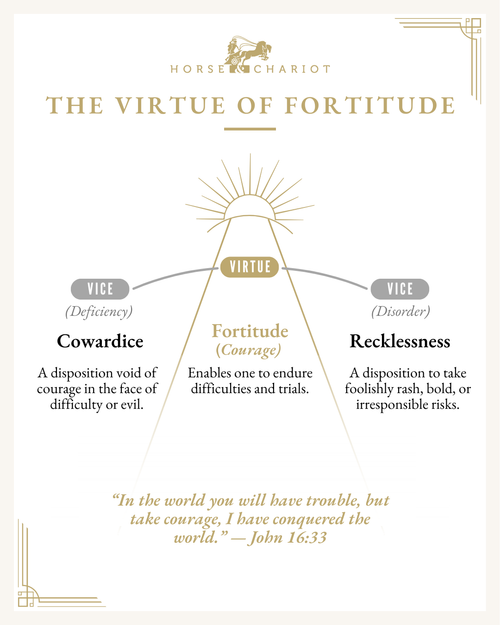
The virtue of fortitude enables one to endure difficulties and trials.
Fortitude is sixth among the seven chief virtues and third among the cardinal virtues, following prudence and justice. It is the virtue that perfects the passions in pursuit of the “arduous good.” Where prudence discerns what is right and justice demands it be done, fortitude provides the strength to carry it out—even in the face of tremendous struggle.
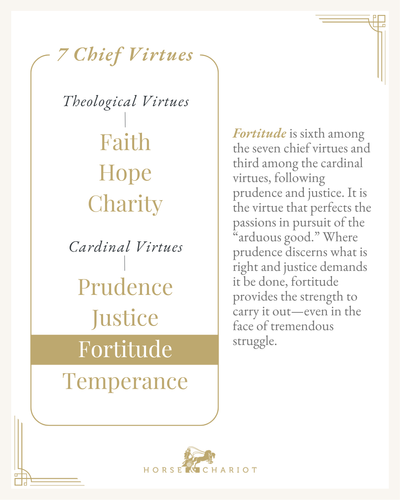
Fortitude gives the soul the courage to stand firm in truth, to endure suffering for faithfulness, and to persist in virtue despite fear, hardship, or opposition. It is not reckless boldness, nor is it stubborn defiance; rather, it is the steady and unyielding will to remain faithful to what is right, no matter the cost. Fortitude is the virtue of the martyrs, the saints, and all who have suffered for the sake of God’s kingdom.
Just as a charioteer must hold firm to the reins when the road grows rough, so too must you remain steadfast when trials press in. Without fortitude, the horses of passion rear in fear or falter in exhaustion—either turning away from hardship or collapsing under its weight. But with fortitude, the charioteer does not let go. The grip is steady, the resolve unbroken, the will fixed on the destination ahead.
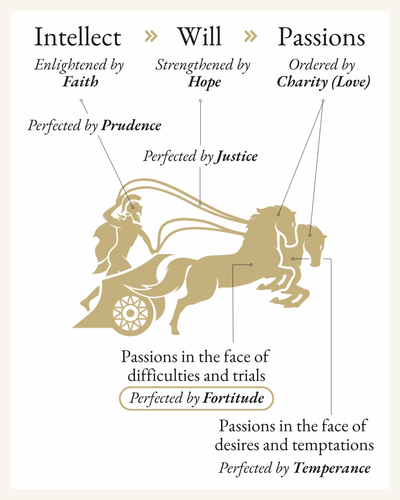
For the faithful, true fortitude is more than human resilience—it is a supernatural grace that strengthens the soul beyond natural endurance. On your own, fear and weakness often lead you to shrink back in the face of adversity. But fortitude, infused by God, enables you to endure trials with patience, to fight for truth with conviction, and to press on even when all seems lost.
This is why Scripture so often commands, “Be determined and confident! Do not be afraid or discouraged, for I, the Lord your God, am with you wherever you go” (Joshua 1:9). The strength of fortitude is not found in self-reliance but in complete dependence on God’s power.
2. Pillars of Fortitude
Fortitude is upheld by the pillar virtues of bravery, perseverance, and patience. Upon these pillars, fortitude stands, enabling one to endure difficulties and trials. Without all three, fortitude crumbles.
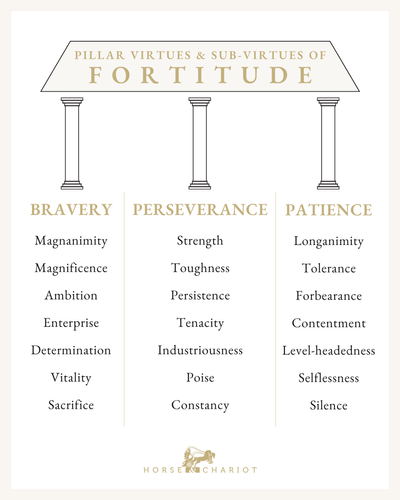
The virtue of bravery enables one to fight for the good. It ensures fortitude is not cowardly or timid but resolute in standing for truth. It is the strength to act when the good can only be attained by charging forward. There are moments in life when evil must be confronted, wrongs must be righted, and risks must be taken for righteousness’ sake. Bravery equips the soul not to retreat in fear but to step forward with confidence—even when the outcome is uncertain. It is the courage to speak when silence would be easier, to defend what is right when it is unpopular, and to fight for the good even when it comes at great personal cost. Bravery does not mean recklessness, but it does mean that when the path demands action, the virtuous do not hesitate to take it. Its sub-virtues include magnanimity, magnificence, ambition, enterprise, determination, vitality, and sacrifice.
The virtue of perseverance enables one to persist for the good. It ensures fortitude is not momentary but enduring. Some battles are not won in a single charge; rather, some goods can only be attained by pressing forward step by step, refusing to yield to exhaustion or discouragement. Perseverance is the strength to remain committed when the journey is long, the progress is slow, and the trials are many. It is the endurance to suffer for the good, to resist the temptation to surrender when the fight is draining, and to remain faithful even when the rewards are unseen. Just as a charioteer must not drop the reins when the road stretches endlessly ahead, so too must one with fortitude grasp tightly to truth, refusing to let go even when the journey is arduous. Perseverance does not seek shortcuts—it commits to the long road of virtue, no matter how difficult the terrain. Its sub-virtues include strength, toughness, persistence, tenacity, industriousness, poise, and constancy.
The virtue of patience enables one to wait for the good. It ensures strength does not become restless or impulsive. Not every battle is won by charging forward or persisting at full force—some victories can only come through waiting with trust. When the good cannot be attained any faster, when all that can be done has been done, patience is what keeps the soul steady, resisting frustration and despair. Patience is not passive resignation—it is the courage to wait well, knowing God’s timing is greater than human urgency. It allows a person to endure suffering with grace, to sit in uncertainty with faith, and to withstand the delays and trials of life without bitterness. Its sub-virtues include longanimity, tolerance, forbearance, contentment, level-headedness, selflessness, and silence.
These pillars form the foundation of fortitude. To live with fortitude is to keep moving forward—to fight for the glory of God even when the battle is hard, and to trust that every trial, every hardship, and every moment of suffering is leading the soul toward its eternal reward. It is the unyielding grip of faith, the dogged will to endure, and the ardent belief that “Nothing is unbearable to those who trust in God” (St. Thomas Aquinas).
A charioteer without fortitude lets the horses slow to a halt at the first sign of difficulty—one horse pulling away in fear, the other collapsing in exhaustion. But the charioteer with fortitude presses on, gripping the reins even when the road is long, guiding the soul through trial, through suffering, and through hardship toward glory. Fortitude does not remove difficulty—it overcomes it.
3. Fortitude in Action
Fortitude is the virtue that rises when everything else falls. It doesn’t wait for ease or comfort—it shows up when things get hard. It is not the absence of fear, but the will to move forward in spite of it. Fortitude is the grit of the soul, the strength to endure suffering, resist discouragement, and remain faithful when quitting would be easier. Without fortitude, no other virtue can last. With it, the soul learns to persevere, to fight, and to finish the race.
One with fortitude puts their head down and drives their knees when the road gets steep, endures all the more when others surrender, and stands with their chin held high when the world demands they kneel. Their courage is not loud but unhesitating—a quiet resolve that does not seek attention but refuses defeat. They know suffering is not the enemy—giving up is. True fortitude is not found in strength of body, but in a heart that will not yield. Thus, their spirit does not break when tested, their will does not falter under pressure, and their faith does not collapse when challenged. They acknowledge, “Nothing great is ever achieved without much enduring” (St. Catherine of Siena).
Fortitude looks like the man who speaks the truth, even when his voice shakes. It looks like the woman who faces suffering with grace, the soldier who fights with tireless honor, and the friend who remains when others walk away. It is found in the child who faces bullies with courage, the believer who holds to their faith despite ridicule, and the weary soul who prays one more time when hope feels distant.
Fortitude is David standing before Goliath with only a sling and faith, Esther risking her life to plead for her people, and Job refusing to curse God in the midst of suffering. It is the apostles preaching the Gospel despite persecution, the martyrs embracing death rather than denying Christ, and Paul pressing on despite beatings, imprisonment, and shipwrecks. Above all, it is Jesus Himself, who did not turn away from the cross but embraced it and endured it to the very end—even unto death. Declaring, “In the world you will have trouble, but take courage, I have conquered the world” (John 16:33), He proved that true fortitude is not found in avoiding trials but in enduring them through faith.
Fortitude doesn’t promise an easy path—but it makes the hard path holy. It is the virtue that keeps you standing when the world tries to knock you down. And when it is perfected by grace, it becomes a force that hell cannot take. So take courage. Stand firm. Press on. For with fortitude, you do not merely survive the trials—you overcome them.
4. Vices Opposed to Fortitude
The vices opposed to fortitude are, at one extreme, a deficiency of fortitude—which is cowardice, and at the other extreme, one can never have too much fortitude, but one can have disordered fortitude—which is recklessness.
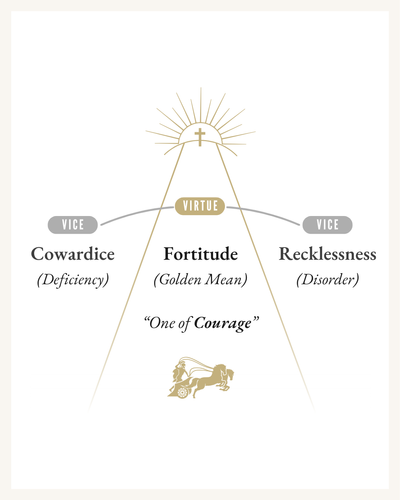
The vice of cowardice is a disposition void of courage in the face of difficulty or evil. The cowardly soul shrinks back when confronted with hardship, avoiding suffering at the cost of truth, justice, or morality. It is found in the one who remains silent when evil should be resisted, in the believer who compromises faith to avoid persecution, and in the person who chooses comfort over confrontation. Cowardice weakens the soul, making fear the master of its choices, ensuring what is right is abandoned whenever it becomes too costly.
The vice of recklessness is a disposition to take foolishly rash, bold, or irresponsible risks. The reckless soul rushes into danger without wisdom, mistaking recklessness for courage, seeking conflict for their own sake rather than for the sake of good. It is found in the one who takes unnecessary risks to prove bravery, in the person who speaks without thinking, and in the fighter who battles without purpose. Recklessness distorts fortitude, turning courage into foolishness, and ensuring boldness serves pride rather than truth.
Both cowardice and recklessness subvert the virtue of fortitude—one by fleeing when it should stand firm, the other by charging forward when it should proceed with wisdom. Together, they lead the soul away from true courage, either into the shadows of fear or the chaos of rashness, both of which separate one from the strength fortitude rightly provides.
Thus, whether it be by cowardice or recklessness, the outcome is the same—ruin. The ruin of integrity, the collapse of moral strength, and the failure to remain strong in the face of trial. The ruin of an uncourageous spirit fractures the soul from grace, giving way to sins such as vainglory, inconstancy, faintheartedness, and indifference. Thus, it is written, “If you are weak in a crisis, you are weak indeed” (Proverbs 24:10), for to abandon fortitude is to forfeit the strength virtue provides, and to walk the path of brokenness and defeat.
5. Cultivating Fortitude
The best defense against ruin and the vices opposed to fortitude is to develop fortitude itself. And fortitude does not grow in theory—it grows in practice. For “a gem cannot be polished without friction, nor a man perfected without trials” (Seneca). It is easy to speak of courage when there is no danger, to claim perseverance when there is no hardship, and to believe in patience when waiting is not required. But the moment difficulty arrives, many shrink back, making excuses, choosing comfort over conviction, and mistaking avoidance for peace. Fortitude is cultivated not in what you intend to do, but in what you actually do when the moment demands it.
Most people do not lack knowledge—they lack courage. They know the right thing but hesitate to do it. They remain silent when they should speak, delay when they should act, and retreat when they should charge. They fear discomfort more than dishonor, rejection more than wrongdoing, and hardship more than mediocrity. A soul that desires fortitude must ask: Where have I chosen comfort over courage? Where have I let fear stop me from doing what I know is right? Where have I avoided difficulty instead of facing it head-on? Fortitude demands an answer—and then demands action.
True fortitude begins in small, hidden moments long before it is tested in great trials. It is found in the one who stops making excuses and does what must be done. It is found in the one who pushes through exhaustion to fulfill their duty, who keeps their word even when it costs them, and who does what is required when no one is watching. It is in the one who endures suffering with grace, who bears insult without hatred, and who presses on in faithfulness despite discouragement. Fortitude is not just standing up in the big moments—it is showing up every day and doing what is right, even when it is hard, even when it hurts.
Courage begins within, and it is fortified by prayer, Scripture, and reflection. The courageous soul does not rely on their own resolve but seeks the strength of God, who is the source of all courage. Prayer infuses the soul with God’s power, Scripture reveals examples of endurance and faithfulness, and reflection exposes both progress and areas for growth. Without these disciplines, courage falters, and perseverance wanes, for no one can truly withstand the trials of life without God’s grace. The soul that desires fortitude cultivates these practices daily, knowing they are the wellspring of strength to face every challenge with “the whole armor of God” (Ephesians 6:13).
As fortitude grows, it changes the soul. The one who once avoided conflict now faces it with courage. The one who once quit when things became difficult now perseveres to the end. The one who once let fear rule their decisions now acts in unwavering trust. They no longer let hardship dictate their faithfulness, nor do they let fear determine their course. They embrace suffering as the price of virtue. And, like a mountain standing against the storm, they refuse to surrender to vice.
Ultimately, “The field of battle between God and Satan is the human soul. It is in the soul that the battle rages every moment of life” (St. Padre Pio). Fortitude is the fire that forges warriors for Christ. It marks the difference between a life of purpose and one of regret. Without fortitude, even the best intentions collapse under pressure. With it, the soul becomes unbreakable—divinely strengthened to withstand trials, remain faithful through suffering, and persevere to the very end. For in the end, victory belongs not to the strong or the swift, but to those who refuse to surrender.
6. The Way of Fortitude
Seeker of virtue, the way of fortitude is the path of unshakable strength, where fear, suffering, and hardship will test your resolve at every turn. Fortitude is not mere toughness or stubbornness; it is the unrelenting commitment to pursue the good, no matter the sacrifice. It is the courage to act when others shrink back, the endurance to press on when others surrender, and the patience to suffer when others despair. And if you choose this path, be ready—for it will demand your all.
At first, fortitude may feel like confidence—like the thrill of standing firm, of conquering obstacles, of proving yourself strong. But soon, the real trials will come. You will face battles that do not end quickly, pain that does not go away, opposition that does not yield. You will experience moments of exhaustion when everything in you screams to quit. Fear will press in on you, whispering, “The price is too great.” Doubt will tempt you to believe suffering is meaningless. The world will urge you to take the easy way out, to retreat, to compromise, to give in.
But if you hold the line, if you refuse to surrender, something extraordinary will happen: fortitude. For when fortitude is erected and fortified through trial—it becomes impenetrable. You will learn to rise when others fall, to endure adversity with patience, and to face trials with a heart that does not break. Fortitude will teach you to fight for the good, persevere in hardship, and wait with untroubled resolve. You will discover that courage is not the absence of fear, but the refusal to let it rule. You will become someone who does not crumble under pressure, who does not abandon the fight when it gets difficult, and who does not allow suffering to define them. For you will accept the sanctifying truth: “Afflictions are the steps to Heaven” (St. Elizabeth Ann Seton).
Fortitude requires grit, endurance, and trust in God’s strength rather than your own. It will cost you your comfort, your ease, and your right to give up. But it will give you everything—a soul that cannot be conquered, a heart that will not be broken, and a life lived without regret.
You can do this. Not by your own power, but by His. By grace. The path of fortitude is painful, but it is divinely courageous. You’re not alone. Lift the sails of your soul so the Holy Spirit can fill you, and the winds of grace can move you to—never run, never bow, and never break. For in the end, only the strong will endure to see the glory of God.

Scroll down for the lesson plan and other related resources associated with this teaching.
Copyright © 2022 Horse & Chariot. All rights reserved.
New teachings like this are released often. Subscribe free and never miss a teaching!
Resources
Visual Resource
Illustration of the virtue of fortitude and the vices that oppose it, including definitions.
Free Lesson Plan
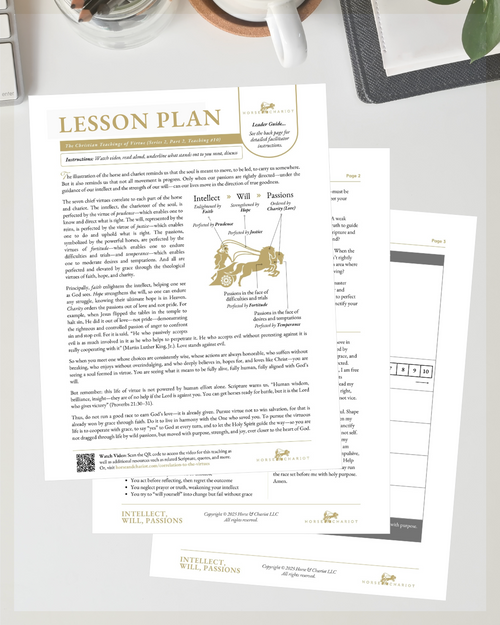
Perfect for small groups, families, classrooms, or personal reflection.
Related Quotes
What Fortitude Is: Courage Rooted in Love and Truth
Fortitude is not recklessness or stubbornness. It is the strength to endure and act for the good, even when fear, suffering, or opposition are present.
“A man has the virtue of fortitude, not because he does not flee, but because he endures and perseveres in doing good.” — St. Thomas Aquinas
“Fortitude is love bearing all things readily for the sake of the Beloved.” — St. Augustine
“Fortitude is the virtue which renders us courageous to the point of not fearing danger, not even death, for the service of God.” — St. Pius X
“The highest manifestation of courage is to stand firm in the truth in the face of great opposition.” — St. Thomas Aquinas
“A courageous person is one who faces fearful things as he ought and as reason directs for the sake of what is noble.” — Aristotle
“He is a man of courage who does not run away, but remains at his post and fights against the enemy.” — Socrates
Fortitude in Trial: Suffering, Endurance, and the Cross
Fortitude is proven not in comfort, but in trial. God forms strength in the soul through suffering patiently endured in union with Christ.
“The most beautiful act of faith is one made in darkness, in sacrifice, and with extreme effort.” — St. Padre Pio
“Nothing is unbearable to those who trust in God.” — St. Thomas Aquinas
“In tribulation, immediately draw near to God with confidence, and you will receive strength, enlightenment, and instruction.” — St. John of the Cross
“The longer the trial to which God subjects you, the greater the goodness in comforting you during the time of trial and in the exaltation after the combat.” — St. Padre Pio
“Afflictions are the steps to heaven.” — St. Elizabeth Ann Seton
“The more we are crucified with Christ, the more we shall be glorified with Him.” — St. Louis de Montfort
“To suffer and to be despised for Christ is the greatest honor that can come to us.” — St. Alphonsus Liguori
“I know that God will not give me anything I can't handle. I just wish He didn't trust me so much.” — St. Thérèse of Lisieux
Fortitude in the Daily Battle of the Soul
Fortitude is not only heroic in dramatic moments; it is exercised daily through perseverance, discipline, and fidelity in ordinary duties.
“The heroism of fortitude is to persevere in the simple and ordinary duties of each day.” — St. Josemaría Escrivá
“Do not be content to do no wrong; be good for something.” — St. Vincent de Paul
“Do not put off till tomorrow the good you can do today.” — St. John Bosco
“The devil is afraid of resolute souls.” — St. John Bosco
“Be courageous and separate your heart from earthly things.” — St. John Bosco
“The field of battle between God and Satan is the human soul. It is in the soul that the battle rages every moment of life.” — St. Padre Pio
“Without fortitude, many execrable and deformed vices will result. But with fortitude, the soul remains invincible and constant in all its undertakings.” — Mary of Agreda
Courage to Act: Boldness, Witness, and Moral Resolve
Fortitude moves the soul from endurance to action. It gives the strength to proclaim truth, resist injustice, and act boldly for what is right.
“In God's name, forward boldly!” — St. Joan of Arc
“Proclaim the truth and do not be silent through fear.” — St. Catherine of Siena
“To have courage for whatever comes in life—everything lies in that.” — St. Teresa of Ávila
“Nothing great is ever achieved without much enduring.” — St. Catherine of Siena
“We always find that those who walked closest to Christ were those who had to bear the greatest trials.” — St. Teresa of Ávila
“Our Lord has given me a greater courage and strength to suffer than I have ever had before.” — St. Angela of Foligno
“Jesus promised his disciples three things—that they would be completely fearless, absurdly happy, and in constant trouble.” — G.K. Chesterton
Human Courage Perfected by Grace
Natural courage is real, but grace perfects it. God uses adversity, resistance, and hardship to form strength of character and holiness.
“Fortitude is a more noble and excellent virtue than temperance…” — Mary of Agreda
“People grow through experience if they meet life honestly and courageously. This is how character is built.” — Eleanor Roosevelt
“I know that suffering gives us new perspectives and helps us to clarify our real value.” — Sister Thea Bowman
“A gem cannot be polished without friction, nor a man perfected without trials.” — Seneca
“In the middle of every difficulty lies opportunity.” — Albert Einstein
“Adversity has the effect of eliciting talents which, in prosperous circumstances, would have lain dormant.” — Horace
“I learned that courage was not the absence of fear, but the triumph over it.” — Nelson Mandela
“Courage is an inner resolution to go forward despite obstacles; Cowardice is submissive surrender to circumstances. Courage breeds creativity; Cowardice represses fear and is mastered by it. Cowardice asks the question, is it safe?...But conscience ask the question, is it right? And there comes a time when we must take a position that is neither safe, nor politic, nor popular, but one must take it because it is right.” — Martin Luther King Jr.
“Remembering and keeping one’s focus on God’s unchangeable character and His eternal faithfulness becomes one of our greatest resources for courage and the faithfulness we need to go on even when things seem their blackest.” — J. Hampton Keathley
"I shall work and pull at it as long as God gives me life." — Augustus Tolton
"There is a quiet courage that comes from an inward spring of confidence in the meaning and significance of life." — Howard Thurman
Related Scripture
Divine Strength: God as Our Fortress
Fortitude is not based on self-reliance, but on the security of knowing that God is a stable and unshakeable protector.
“Since you are my rock and my fortress, for the sake of your name lead and guide me.” — Psalm 31:3 (NRSVue)
“The name of the Lord is a strong tower; the righteous run to it and are safe.” — Proverbs 18:10 (NRSVue)
“In God we shall do bravely; it is he who will tread down our foes.” — Psalm 108:13 (NRSVue)
“The Lord is my light and my salvation; whom shall I fear? The Lord is the stronghold of my life; of whom shall I be afraid?” — Psalm 27:1 (NRSVue)
“The Lord is my strength and my shield; in him my heart trusts; so I am helped, and my heart exults, and with my song I give thanks to him.” — Psalm 28:7 (NRSVue)
The Command to Take Courage
Biblical bravery is often a response to a direct command from God, calling us to act with boldness despite our natural fears.
“But you, take courage! Do not let your hands be weak, for your work shall be rewarded.” — 2 Chronicles 15:7 (NRSVue)
“I have said this to you so that in me you may have peace. In the world you face persecution, but take courage: I have conquered the world!” — John 16:33 (NRSVue)
“Wait for the Lord; be strong, and let your heart take courage; wait for the Lord!” — Psalm 27:14 (NRSVue)
“Be strong and courageous; do not be frightened or dismayed, for the Lord your God is with you wherever you go.” — Joshua 1:9 (NRSVue)
“Fight to the death for truth, and the Lord God will fight for you.” — Sirach 4:28 (NRSVue)
“Do not be cowardly in your soul; do not neglect to pray, and do not fail to give alms.” — Ben Sira 7:10 (NABRE)
Spirit of Power vs. Spirit of Fear
Fortitude is a gift of the Holy Spirit that replaces timidity with a sound mind and the ability to testify to the truth.
“For God did not give us a spirit of cowardice but rather a spirit of power and of love and of self-discipline. Do not be ashamed, then, of the testimony about our Lord or of me his prisoner, but join with me in suffering for the gospel, relying on the power of God.” — 2 Timothy 1:7-8 (NRSVue)
“Be on your guard; stand firm in the faith; be courageous; be strong.” — 1 Corinthians 16:13 (NRSVue)
“For you did not receive a spirit of slavery to fall back into fear, but you have received a spirit of adoption. When we cry, ‘Abba! Father!’ it is that very Spirit bearing witness with our spirit that we are children of God.” — Romans 8:15-16 (NRSVue)
Patience and Perseverance in Suffering
A major aspect of fortitude is the "long view"—the ability to endure hardship, humiliation, and delay with a steady heart.
“Cling to him and do not leave him, so that you may be honored at the end of your life. Accept whatever befalls you, and in times of humiliation be patient. For gold is tested in the fire, and those found acceptable, in the furnace of humiliation.” — Sirach 2:3-5 (NRSVue)
“As for that in the good soil, these are the ones who, when they hear the word, hold it fast in an honest and good heart and bear fruit with patient endurance.” — Luke 8:15 (NRSVue)
“And not only that, but we also boast in our sufferings, knowing that suffering produces endurance, and endurance produces character, and character produces hope.” — Romans 5:3-4 (NRSVue)
“You need to be patient, in order to do the will of God and receive what he promises.” — Hebrews 10:36 (GNT)
“Let us not grow weary in doing what is right, for we will reap at harvest time, if we do not give up.” — Galatians 6:9 (NRSVue)
Spiritual Warfare and the Armor of God
Fortitude is the internal "armor" that allows a believer to stand firm against external spiritual pressures and temptations.
“Put on the whole armor of God, so that you may be able to stand against the wiles of the devil.” — Ephesians 6:11 (NRSVue)
“Therefore take up the whole armor of God, so that you may be able to withstand on that evil day, and having done everything, to stand firm.” — Ephesians 6:13 (NRSVue)
“The Lord will fight for you, and you have only to keep still.” — Exodus 14:14 (NRSVue)
“Stand therefore, and fasten the belt of truth around your waist, and put on the breastplate of righteousness. As shoes for your feet put on whatever will make you ready to proclaim the gospel of peace. With all of these, take the shield of faith, with which you will be able to quench all the flaming arrows of the evil one.” — Ephesians 6:14-16 (NRSVue)
“Take the helmet of salvation, and the sword of the Spirit, which is the word of God.” — Ephesians 6:17 (NRSVue)

Never miss a teaching — get all new teachings of virtue sent to your inbox free!