
All Series > Seven Chief Virtues > Part 3
The Virtue of Charity
(Series 5, Part 3, Teaching #35)
Quick Links
Help fund this video: Donate

1. The Virtue of Charity
The highest calling, symphony of the soul, and heartbeat of holiness is charity.
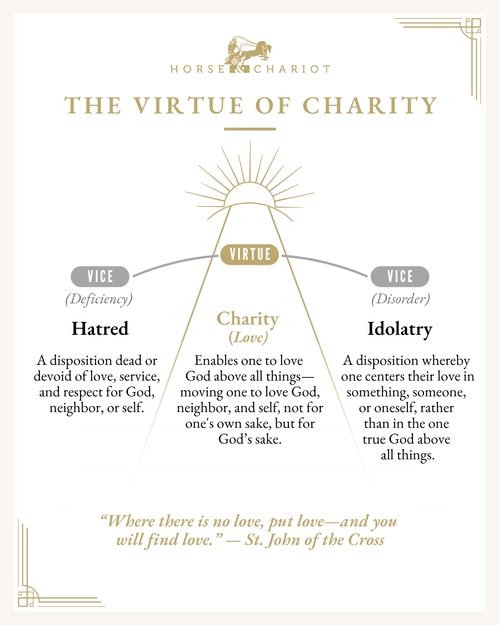
The virtue of charity enables one to love God above all things—moving one to love God, neighbor, and self, not for one's own sake, but for God’s sake.
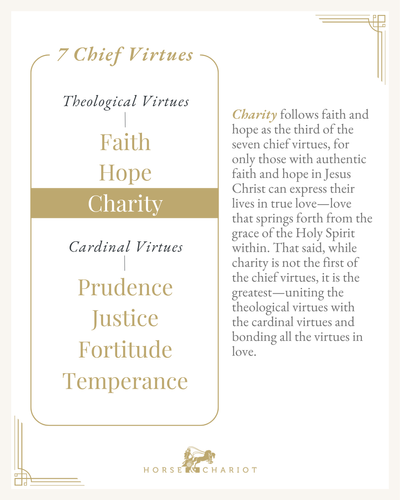
Charity follows faith and hope as the third of the seven chief virtues, for only those with authentic faith and hope in Jesus Christ can express their lives in true love—love that springs forth from the grace of the Holy Spirit within. That said, while charity is not the first of the chief virtues, it is the greatest—uniting the theological virtues with the cardinal virtues and bonding all the virtues in love.
Charity is the very pulse and pattern of the Christian life. It is not merely kindness or generosity, nor is it a fleeting emotion or sentiment. Charity is divine love itself—the love of God poured into the soul, transforming it, elevating it, and making it capable of loving as God loves. Unlike human affection, which is often conditional or self-serving, charity is supernatural in origin—an infused virtue that enables the soul to love purely, sacrificially, and unconditionally. It is the virtue that unites us to God and makes us most like Him, for “God is love” (1 John 4:8). Without charity, every other virtue remains incomplete, for it is love that perfects and animates them all.
Because charity is a supernatural gift, it is not something you can generate on your own. It is given by God through grace and must be received with an open heart. Human love is often fragile, inconsistent, and driven by personal desires, but charity transcends these weaknesses. It does not love merely because it feels good or benefits the one who loves; it loves because it is the very nature of God to love. As Scripture declares, “God’s love has been poured into our hearts through the Holy Spirit who has been given to us” (Romans 5:5). To grow in charity, therefore, is to grow in closer union with God Himself.
To love God rightly is to love others rightly, “for those who do not love a brother or sister whom they have seen, cannot love God whom they have not seen” (1 John 4:20). True charity is not simply well-wishing or good intentions—it is active, self-giving, and sacrificial. It seeks the good of the beloved above all else, even at great personal cost. This is why charity is not limited to loving those who love you in return. It extends to the difficult, the ungrateful—even the enemy. It is the love that forgives when wronged, that gives when it hurts, and that serves when unrecognized. It is the love Christ demonstrated when He laid down His life for humanity, for the sinner—for you.
Like all virtues, charity is not just a feeling but an act or habit of the will. While emotions may rise and fall, true love endures because it is rooted in a deliberate choice. The passions of the soul, when left unchecked, are often ordered according to pride—seeking love for self, and demanding recognition, comfort, and reward. But charity orders the passions according to love—love that seeks to give rather than to take, to serve rather than to be served. Without charity, the soul becomes a chariot with unbridled horses led by emotions, pulling in every direction—passions demanding self-interest, resisting humility, and selfishly opposing surrender. But with charity, the will grips the reins with love, guiding the passions toward holiness. This is why charity perfects all other virtues: ensuring that prudence is not cunning, justice is not harsh, fortitude is not reckless, and temperance is not rigid.
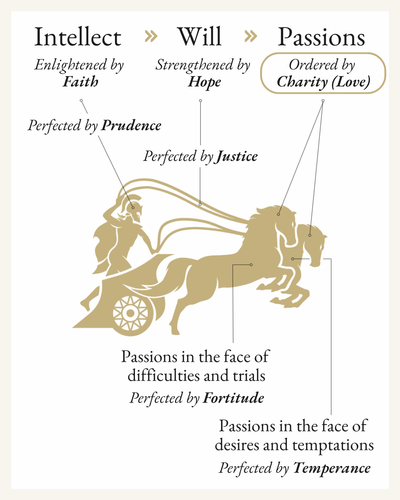
To love with charity is to seek the highest good for another—to will their eternal happiness, even when it requires sacrifice. This is why charity is a reflection of God's own love for us. He does not love us because we are perfect or because we have earned it. He loves us because He is love—and He calls you to love in the same way.
2. Charity in Action
Charity is more than a feeling—it is the purest form of love, made visible through action. It is not content to remain hidden in the heart; it must pour itself out. True charity mirrors the love of Christ: selfless, sacrificial, and steadfast. It seeks not recognition but transformation—the transformation of hearts, homes, and the world through love in motion.
Since “love does not stay idle” (St. Catherine of Siena), one with charity seeks to love continuously—without condition, serve without recognition, and forgive without restriction. Their love is active—proven in service, patient in suffering, and steadfast in loyalty. Their heart is grateful; their ways, generous. They show kindness not only to friends but also to strangers, to the difficult, and even to their enemies. They do not love for what they can gain but because love itself is their calling.
Charity looks like the person who gives their time to help another, even when it is inconvenient. It looks like the mother who cares for her child through exhaustion, the friend who listens when it would be easier to walk away, and the man who forgives an old betrayal rather than holding onto resentment. It looks like the one who gives, expecting nothing in return, and the one who loves even when that love is not deserved—believing, “Love is the only force capable of transforming an enemy into a friend” (Martin Luther King, Jr.).
Charity is Ruth staying with Naomi despite having no obligation, the Good Samaritan crossing the road to help a stranger, and the father in the parable welcoming home his prodigal son. It is Jesus healing the sick, washing the feet of His disciples, and feeding the hungry. Above all, it is Christ on the cross, who laid down His life for sinners—proving, “No one has greater love than this, to lay down one’s life for one’s friends” (John 15:13).
Charity is love in its most complete form—love that gives, suffers, serves, and saves. When you act in charity, you don’t just reflect Christ—you become His hands and feet in the world. For in every act of selfless love, the invisible God becomes visible through you. This is the power of charity: it changes the world because it changes hearts, starting with your own.
3. Vices Opposed to Charity
The vices opposed to charity are, at one extreme, a deficiency of charity—which is hatred, and at the other extreme, one can never have too much charity, but one can have disordered charity—which is idolatry.
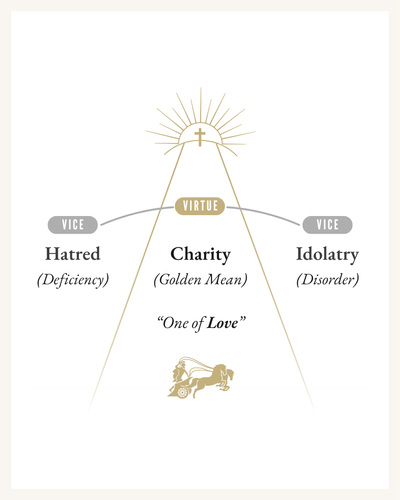
The vice of hatred is a disposition dead or devoid of love, service, and respect for God, neighbor, or self. The hateful soul rejects love, either by despising others, resenting God, or degrading themself through sin. It is found in the one who harbors unforgiveness, in the person who delights in another’s downfall, in the heart that sees others as obstacles rather than souls created in God’s image. But hatred does not always rage—it sometimes hides behind cold apathy. Indifference, too, is a byproduct of hatred, for to withhold love when love is due is to commit a quiet violence of the soul. Hatred poisons the soul, twisting it inward in bitterness and pride, closing it off from the very love that could redeem it.
The vice of idolatry is a disposition whereby one centers their love in something, someone, or oneself, rather than in the one true God above all things. The idolatrous soul misdirects their highest love, elevating created things over the Creator, seeking fulfillment in power, pleasure, or people rather than in divine love. It is found in the one who places wealth or success above holiness, in the person who worships human relationships over their relationship with God, and in the heart that serves its own desires rather than surrendering to God's will. Idolatry corrupts love by chaining it to what cannot satisfy, turning the heart away from the only Love that is eternal and true.
Both hatred and idolatry deny the nature of charity—one by rejecting love entirely, the other by misplacing it. Together, they lead the soul away from the greatest commandment, either into the cold void of lovelessness or the false warmth of misplaced devotion, both paths severing the soul from the divine love that alone can bring it to eternal life.
Thus, whether it be by hatred or idolatry, the outcome is the same—destruction. The destruction of marriages, families, friendships, communities, and souls. The destruction of authentic love, the withering of the soul’s highest calling, and the severing of the bond that unites man to God and neighbor. Lovelessness turns the heart cold, closing it off from grace and spawning charity-killing sins such as envy, wrath, greed, malice, and pride. Thus, it is written, “Whoever does not love remains in death” (1 John 3:14), for to reject true charity is to reject the very essence of God, who is Love.
4. Pride & The Heart of Charity
It is the heart of charity that safeguards one from the destructive forces of hatred and idolatry. It is the enemy of pride, which leads to both. For where charity is the greatest of virtues, pride is the greatest of vices. Thus, a heart ruled by pride cannot be ruled by charity, just as a heart rooted in charity cannot be ruled by pride.
Pride demands; charity gives. Pride divides; charity unites. Pride destroys; charity restores. “Love recognizes no barriers. It jumps hurdles, leaps fences, penetrates walls to arrive at its destination full of hope” (Maya Angelou). A heart of charity is the most beautiful thing in the world; a heart of pride is the most repulsive.
Yet not all pride is evil. There is a form of natural pride that is good—pride in a job well done, in being part of a team, in upholding a noble tradition. But even this must be rightly ordered. If it is rooted in self-glory rather than the glory of God, it quickly becomes corrupted. If it seeks to elevate the self rather than build up others, it ceases to be good. Rightly ordered pride should flow from charity. It is not “self-centered” but “others-centered”—grounded in faithfulness, humility, and gratitude.
If one turns from sin only out of fear of punishment, is that not a form of pride? If one obeys merely for the reward of Heaven, is that not a form of pride? But if one pursues virtue out of love—out of devotion to God and a desire to serve others as a reflection of His love—is that not charity? Charity frees the soul to live as it was created to live—not in selfish ambition, but in self-giving love.
To that end, a heart of charity recognizes every form of pride, no matter how small, and roots it out. So when you find yourself putting your desires before your spouse, your family, your coworkers, or God—remember charity. At first, choosing charity over pride will feel uncomfortable. But the more you do it, the more natural it will become. Eventually, pride will feel foreign, and charity will feel like home. “Where there is no love, put love—and you will find love” (St. John of the Cross). For when you continually put the love of God and the good of others first, pride withers, charity flourishes, and virtue forms.
5. Cultivating Charity
The best defense against pride and the vices opposed to charity is to cultivate charity itself. But true charity is not natural to the human heart—it is supernatural. It is not simply friendliness or affection, nor is it the warm feeling of love that comes and goes with circumstances. Charity is love purified, love rightly ordered, love given as a gift of grace. It is the love that serves, sacrifices, and forgives even when wounded. And this kind of love does not arise easily. It must be fashioned. It must be chosen. It must be pursued.
Where is your love misplaced? Do you cling to selfish desires, loving yourself above all else? Do you place another person or thing on the throne of your heart where only God belongs? Do you hold onto bitterness, unwilling to forgive? Charity demands love be set in order. Love of God must be first, for only in loving Him rightly can all other loves be rightly directed. The one who loves God first finds their love for others transformed—not a love that grasps, controls, or expects repayment, but a love that is free, selfless, and true.
Charity is cultivated in the small, unseen moments. As it is said, “Not all of us can do great things. But we can do small things with great love” (St. Mother Teresa). It is in the decision to love when it is inconvenient, to care for the difficult, the undeserving, and the ungrateful. Charity is the one who does a good deed in secret, the one who listens without interruption, and the one who lays down their pride to reconcile. It is in the one who does not withhold love from the wounded, from the trespasser, and from the foe. For Christ loved us while we were still sinners—and so charity asks us to do the same.
The soul is drawn into the transforming love of God through prayer, Scripture, and humility. In prayer, we encounter His boundless love, learning to love others selflessly. Scripture reveals the perfect example of Christ, who humbled Himself to serve and sacrifice for others. Humility opens the heart to recognize our dependence on God’s grace, allowing His love to flow through us. Together, these practices root the soul in divine love, inspiring us to love not out of obligation, but as an overflow of God’s grace working within.
As charity grows, it consumes the soul, burning away selfishness, envy, and resentment. The one who once sought love only for themselves now pours it out without measure. The one who was once timid in sharing the Good News of Christ now proclaims it courageously—recognizing, “The greatest charity is to give oneself totally for the salvation of souls” (St. Maximilian Kolbe). The more charity takes root, the more the soul becomes like Christ—loving not with human love, but with divine love, the love that transforms, heals, and redeems.
Ultimately, charity is the soul’s highest calling and greatest fulfillment. It is the one virtue that never ends, the fire that does not fade, the heartbeat of Heaven itself. To live in charity is to live in harmony with the love of God. It is the virtue that gives life to all others, for without love, faith is empty, hope is hollow, and every good work is meaningless. And so, the soul must strive for one thing above all: to love as Jesus loves. For in the end, when all else passes away, when faith is fulfilled and what is hoped for is attained, only love remains.
6. The Way of Charity
Seeker of virtue, the way of charity is the grandest and most demanding path of all. Charity is not mere decency. It is not generosity or goodwill. It is the total surrender of self in love—a love that gives without counting the cost, a love that sacrifices, a love that does not die even when wounded. Charity is the very essence of Christ, and if you choose this path, you must be ready to be refined by fire.
At first, charity may feel natural, even joyful—loving others when it is easy, serving when it is rewarding, and forgiving when the offense is small. But then the real trials will come. You will love and not be loved in return. You will give and be taken for granted. You will show mercy and receive cruelty. You will open your heart and feel it break. The world will tell you to stop, to close yourself off, to love only those who deserve it. Bitterness will beckon. Pride will whisper, “You are a fool.” Every wound will tempt you to harden your heart.
But if you persist—if you refuse to let love die—something miraculous will happen: charity. For when charity is sanctified and made pure through suffering, it becomes divine. You will learn to love as Christ loves—not because it is easy, but because it is right. You will love when it is painful, forgive when it is undeserved, and serve when you have nothing left. You will be emptied, yes—but only so that God may fill you with His own love, a love that never fails, never fades, and never ends.
Charity requires effort, humility, and the willingness to sacrifice for the good of another. It will cost you your pride, your comfort, and your right to hold grudges. But it will give you everything—freedom from selfishness, joy beyond understanding, and a heart that beats in union with the Creator of all things.
You can do this. Not by your own power, but by His. By grace. The path of charity is the path of Christ—the way of the Cross, but also the way of resurrection. Do not be afraid to love, to give, to pour yourself out. You’re not alone. Lift the sails of your soul so the Holy Spirit can fill you, and the winds of grace can move you to embrace love—and let your heart be consumed by the fire of divine charity. For in the end, love alone will stand before the throne of God and remain for all eternity.

Scroll down for the lesson plan and other related resources associated with this teaching.
Copyright © 2022 Horse & Chariot. All rights reserved.
New teachings like this are released often. Subscribe free and never miss a teaching!
Resources
Visual Resource
Illustration of the virtue of charity and the vices that oppose it, including definitions.
Free Lesson Plan
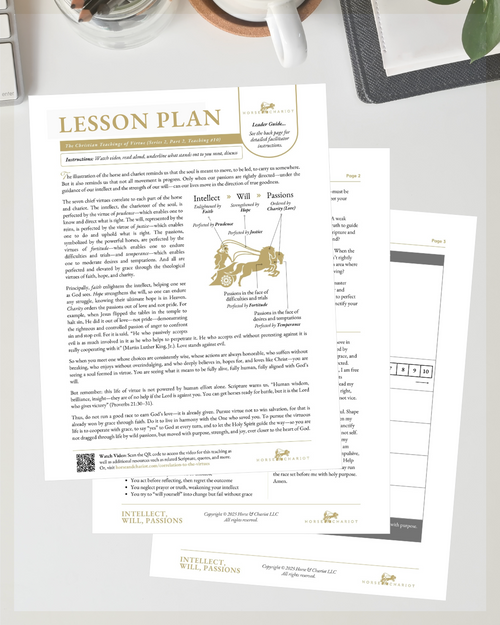
Perfect for small groups, families, classrooms, or personal reflection.
Related Quotes
Charity Begins in God and is the Measure of Life
Charity is not merely kindness or emotion; it is participation in God’s own life. Love begins in God, is revealed fully in Christ, and becomes the true measure by which a life is judged.
“In the twilight of life, God will not judge us on our earthly possessions and human success, but rather on how much we have loved.” — St. John of the Cross
“God himself is charity, and he who abides in charity abides in God.” — St. Thomas Aquinas
“God loves each of us as if there were only one of us.” — St. Augustine
“The Passion of Christ is the greatest and most stupendous work of Divine Love. The greatest and most overwhelming work of God's love.” — St. Paul of the Cross
“He who loves Jesus Christ is never content with loving Him only a little.” — St. Alphonsus Liguori
“Where there is no love, put love—and you will find love.” — St. John of the Cross
“A soul cannot live without loving. It must have something to love, for it was created to love.” — St. Catherine of Siena
“All of creation is a symphony of God’s love.” — St. Hildegard of Bingen
“When you know how much God is in love with you then you can only live your life radiating that love.” — St. Mother Teresa
Charity Orders Every Virtue by Love
Charity is the life of every virtue. It orders love rightly—toward God first, then neighbor—so that faith becomes living, fruitful, and true.
“Charity is the cement which binds Communities to God and persons to one another.” — St. Vincent de Paul
“Charity is the form, mover, mother, and root of all the virtues.” — St. Thomas Aquinas
“Charity is the soul of faith, makes it alive; without love, faith dies.” — St. Anthony of Padua
“Charity is the sweet and holy bond which links the soul with its Creator: it binds God with man and man with God.” — St. Catherine of Siena
“To love is to will the good of another.” — St. Thomas Aquinas
“Well-ordered self-love is right and natural.” — St. Thomas Aquinas
“Without charity all is of small value, obscure, languid, lifeless and unprofitable.” — Mary of Agreda
“Love is not affectionate feeling, but a steady wish for the loved person’s ultimate good as far as it can be obtained.” — C. S. Lewis
“Since love grows within you, so beauty grows. For love is the beauty of the soul.” — St. Augustine
“Charity, born of God, leads to nothing but goodness. Let it guide your heart, for it will light your way to Him.” — St. Bridget of Sweden
Charity is Proven in Action
Charity proves itself in action. Love is shown in service, sacrifice, forgiveness, and faithfulness in ordinary circumstances.
“Lord, make me an instrument of thy peace. Where there is hatred, let me sow love.” — St. Francis of Assisi
“If you are silent, be silent with love; if you speak, speak with love; if you correct, correct with love; if you forgive, forgive with love.” — St. Augustine
“Love is shown more in deeds than in words.” — St. Ignatius of Loyola
“The more completely we empty ourselves, the more room we give God to fill us with His love.” — St. Ignatius of Loyola
“The works of charity are the most perfect exercise of the Christian life.” — St. Padre Pio
“Love is the first ingredient in the relief of suffering.” — St. Padre Pio
“Charity begins at home, and it is not how much we do, but how much love we put in that action.” — St. Mother Teresa
“Not all of us can do great things, but we can do small things with great love.” — St. Mother Teresa
“People are unrealistic, illogical, and self-centered. Love them anyway.” — St. Mother Teresa
“In loving one another through our works we bring an increase of grace and a growth in divine love.” — St. Mother Teresa
“The Lord does not look so much at the greatness of our works as at the love with which they are done.” — St. Teresa of Ávila
“Accustom yourself continually to make many acts of love, for they enkindle and melt the soul.” — St. Teresa of Ávila
Charity Evangelizes, Endures, and Loves Enemies
True charity endures suffering and extends even to those who oppose us. Love is most Christlike when it costs us something.
“Love that cannot suffer is not worthy of that name. Charity embraces sacrifice for the sake of the beloved.” — St. Clare of Assisi
“True charity consists in doing good to those who do us evil, and in thus winning them over.” — St. Alphonsus Liguori
“The greatest charity is to give oneself totally for the salvation of souls.” — St. Maximilian Kolbe
“It fills me with joy to realize that I can lay down my life daily for God, that I can sacrifice it willingly for Him. I may not be a martyr for the faith, but I can be a martyr of charity.” — St. Rose Philippine Duchesne
“The faithful soul sees Christ in all things, and faith helps it to love Him even in suffering.” — St. Clare of Assisi
“There are only two ways: either we love—and love in action is service—or we put hatred into action and destroy.” — St. Mother Teresa
“Darkness cannot drive out darkness; only light can do that. Hate cannot drive out hate; only love can do that.” — Martin Luther King Jr.
“Love is the only force capable of transforming an enemy into a friend.” — Martin Luther King Jr.
“Now there is a final reason I think that Jesus says, ‘Love your enemies.’ It is this: that love has within it a redemptive power. And there is a power there that eventually transforms individuals. Just keep being friendly to that person. Just keep loving them, and they can’t stand it too long. Oh, they react in many ways in the beginning. They react with guilt feelings, and sometimes they’ll hate you a little more at that transition period, but just keep loving them. And by the power of your love they will break down under the load. That’s love, you see. It is redemptive, and this is why Jesus says love. There’s something about love that builds up and is creative. There is something about hate that tears down and is destructive. So love your enemies.” — Martin Luther King Jr.
Charity's Ultimate True Love is God
Charity requires right order. When love is disordered, it becomes idolatry; when ordered toward God, it becomes the path to joy, freedom, and transformation.
“The opposite of Christianity is not atheism, but idolatry.” — Peter Kreeft
“There is nothing so abominable in the eyes of God and of men as idolatry, whereby men render to the creature that honor which is due only to the Creator.” — Blaise Pascal
“Idolatry happens when we take good things and make them ultimate things.” — Timothy Keller
“If you love anything better than God you are idolaters: if there is anything you would not give up for God it is your idol: if there is anything that you seek with greater fervor than you seek the glory of God, that is your idol, and conversion means a turning from every idol.” — Charles Spurgeon
“We become what we love and who we love shapes what we become. If we love things, we become a thing. If we love nothing, we become nothing. Imitation is not a literal mimicking of Christ, rather it means becoming the image of the beloved, an image disclosed through transformation. This means we are to become vessels of God's compassionate love for others.” — St. Clare of Assisi
“Everybody can be great because anybody can serve. You don’t have to have a college degree to serve. You don’t have to make your subject and verb agree to serve. You only need a heart full of grace. A soul generated by love.” — Martin Luther King Jr.
“Hate, it has caused a lot of problems in the world, but has not solved one yet.” — Maya Angelou
“Whoever seeks the truth is seeking God, whether consciously or unconsciously. And charity is to lead others to that truth in gentleness and love.” — St. Edith Stein
“Love recognizes no barriers. It jumps hurdles, leaps fences, penetrates walls to arrive at its destination full of hope.” — Maya Angelou
“I slept and dreamt that life was joy. I awoke and saw that life was service. I acted and behold, service was joy.” — Rabindranath Tagore
“Life’s most persistent and urgent question is ‘what are you doing for others?’” — Martin Luther King Jr.
“Why, then, did God give them free will? Because free will, though it makes evil possible, is also the only thing that makes possible any love or goodness or joy worth having. A world of automata - of creatures that worked like machines - would hardly be worth creating. The happiness which God designs for His higher creatures is the happiness of being freely, voluntarily united to Him and to each other in an ecstasy of love and delight compared with which the most rapturous love between a man and a woman on this earth is mere milk and water. And for that they've got to be free.” — C.S. Lewis
Related Scripture
The Divine Source: God is Love
Love is not merely a human emotion but the very nature of God and the foundation of our relationship with Him.
“We love because he first loved us.” — 1 John 4:19 (NRSVue)
“And we ourselves know and believe the love which God has for us. God is love, and those who live in love live in union with God and God lives in union with them. Love is made perfect in us in order that we may have courage on the Judgment Day; and we will have it because our life in this world is the same as Christ's.” — 1 John 4:16-17 (GNT)
“Because your love is better than life, my lips will glorify you.” — Psalm 63:3 (NRSVue)
“Whoever does not love does not know God, because God is love.” — 1 John 4:8 (NRSVue)
“Beloved, let us love one another, because love is from God; everyone who loves is born of God and knows God.” — 1 John 4:7 (NRSVue)
The Heart of Charity vs. Selfishness
Charity stands in contrast to pride and selfish ambition, requiring deep humility to love others truly.
“Do nothing from selfish ambition or empty conceit, but in humility regard others as better than yourselves. Let each of you look not to your own interests but to the interests of others. Let the same mind be in you that was in Christ Jesus.” — Philippians 2:3-5 (NRSVue)
“Pride goes before destruction and a haughty spirit before a fall. Those who are attentive to a matter will prosper, and happy are those who trust in the Lord.” — Proverbs 16:18, 20 (NRSVue)
“For where jealousy and selfish ambition exist, there will be disorder and every vile practice.” — James 3:16 (NRSVue)
“Incline my heart to your testimonies, and not to selfish gain!” — Psalm 119:36 (NRSVue)
“For by the grace given to me I say to everyone among you not to think of yourself more highly than you ought to think, but to think with sober judgment, each according to the measure of faith that God has assigned.” — Romans 12:3 (NRSVue)
“Beware of practicing your righteousness before other people in order to be seen by them, for then you will have no reward from your Father who is in heaven.” — Matthew 6:1 (NRSVue)
“For you were called to freedom, brothers and sisters; only do not use your freedom as an opportunity for self-indulgence, but through love become slaves to one another.” — Galatians 5:13 (NRSVue)
The New Commandment: Loving One Another
Charity finds its practical application within the community of faith and serves as a powerful witness to the world.
“I give you a new commandment, that you love one another. Just as I have loved you, you also should love one another. By this everyone will know that you are my disciples, if you have love for one another.” — John 13:34-35 (NRSVue)
“Above all, clothe yourselves with love, which binds everything together in perfect harmony.” — Colossians 3:14 (NRSVue)
“Above all, maintain constant love for one another, for love covers a multitude of sins. Be hospitable to one another without complaining.” — 1 Peter 4:8-9 (NRSVue)
“Let love be genuine; hate what is evil; hold fast to what is good; love one another with mutual affection; outdo one another in showing honor.” — Romans 12:9-10 (NRSVue)
“Dear children, let us not love with words or speech but with actions and in truth.” — 1 John 3:18 (GNT)
“But if anyone has the world's goods and sees his brother in need, yet closes his heart against him, how does God's love abide in him?” — 1 John 3:17 (NRSVue)
“In all things I have shown you that by working hard in this way we must help the weak and remember the words of the Lord Jesus, how he himself said, ‘It is more blessed to give than to receive.’” — Acts 20:35 (NRSVue)
“Whoever is kind to the poor lends to the Lord, and will be repaid in full.” — Proverbs 19:17 (NRSVue)
“Do not neglect to do good and to share what you have, for such sacrifices are pleasing to God.” — Hebrews 13:16 (NRSVue)
“For there will never cease to be some in need on the earth; I therefore command you, ‘Open your hand to the poor and needy neighbor in your land.’” — Deuteronomy 15:11 (NRSVue)
Love as the Greatest Virtue
The characteristics of charity declare its supremacy over all other spiritual gifts and works.
“If I speak in the tongues of humans and of angels but do not have love, I am a noisy gong or a clanging cymbal. And if I have prophetic powers and understand all mysteries and all knowledge and if I have all faith so as to remove mountains but do not have love, I am nothing. If I give away all my possessions and if I hand over my body so that I may boast but do not have love, I gain nothing.” — 1 Corinthians 13:1-3 (NRSVue)
“Love is patient; love is kind; love is not envious or boastful or arrogant or rude. It does not insist on its own way; it is not irritable; it keeps no record of wrongs; it does not rejoice in wrongdoing but rejoices in the truth. It bears all things, believes all things, hopes all things, endures all things.” — 1 Corinthians 13:4-7 (NRSVue)
“And now these three remain: faith, hope and love. But the greatest of these is love.” — 1 Corinthians 13:13 (GNT)
“Do everything in love.” — 1 Corinthians 16:14 (NRSVue)
“May you be able to embrace, with all the saints, what is the width and length and height and depth of the love of Christ, and to know this love that surpasses knowledge, so that you may be filled with all the fullness of God.” — Ephesians 3:18-19 (NRSVue)
“Let all that you do be done in love.” — 1 Corinthians 16:14 (NRSVue)
Love, Obedience, and Union with Christ
Loving God is inextricably linked to keeping His word, a path of charity that leads to the indwelling of the Holy Spirit.
“Those who accept my commandments and obey them are the ones who love me. My Father will love those who love me; I too will love them and reveal myself to them.” — John 14:21 (GNT)
“Jesus answered him, 'Those who love me will keep my word, and my Father will love them, and we will come to them and make our home with them. Whoever does not love me does not keep my words, and the word that you hear is not mine but is from the Father who sent me.'” — John 14:23-24 (NRSVue)
“If you love me, you will keep my commandments. And I will ask the Father, and he will give you another Advocate, to be with you forever.” — John 14:15-16 (NRSVue)
“Therefore be imitators of God, as beloved children, and walk in love, as Christ loved us and gave himself up for us, a fragrant offering and sacrifice to God.” — Ephesians 5:1-2 (NRSVue)
“For the love of Christ urges us on, because we are convinced that one has died for all; therefore all have died. And he died for all, so that those who live might live no longer for themselves but for the one who for their sake died and was raised.” — 2 Corinthians 5:14-15 (NRSVue)
“Peace be to the brothers and sisters and love with faith, from God the Father and the Lord Jesus Christ. Grace be with all who have an undying love for our Lord Jesus Christ.” — Ephesians 6:23-24 (NRSVue)
“Sell your possessions, and give alms. Make purses for yourselves that do not wear out, an unfailing treasure in heaven, where no thief comes near and no moth destroys.” — Luke 12:33 (NRSVue)
“No one has greater love than this, to lay down one’s life for one’s friends.” — John 15:13 (NRSVue)

Never miss a teaching — get all new teachings of virtue sent to your inbox free!