
All Series > Seven Chief Virtues > Part 1
The Virtue of Faith
(Series 5, Part 1, Teaching #33)
Quick Links
Help fund this video: Donate

1. The Virtue of Faith
The beginning, root, and foundation of a virtuous life is faith.
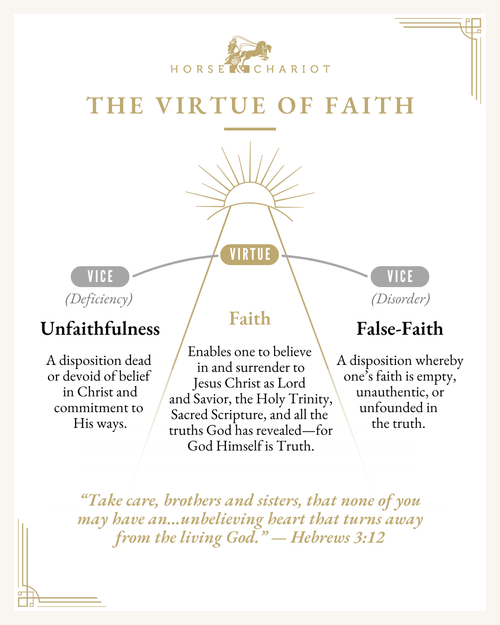
The virtue of faith enables one to believe in and surrender to Jesus Christ as Lord and Savior, the Holy Trinity, Sacred Scripture, and all the truths God has revealed—for God Himself is Truth.
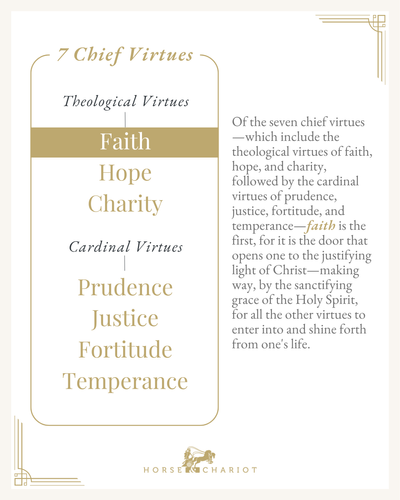
Of the seven chief virtues—which include the theological virtues of faith, hope, and charity, followed by the cardinal virtues of prudence, justice, fortitude, and temperance—faith is the first, for it is the door that opens one to the justifying light of Christ—making way, by the sanctifying grace of the Holy Spirit, for all the other virtues to enter into and shine forth from one's life.
While charity, which is love, is indeed the “greatest of virtues” (1 Corinthians 13:13), faith is still the first, for hope and charity are the fruits of faith, not the other way around. Faith that abounds in hope and is a reflection of God’s love is true and living faith.
As a theological virtue, faith is supernaturally infused into one’s soul by divine grace. It can not be earned; it can only be given. God is the cause. Yet, God extends each person sufficient grace to receive it—and be saved.
Jesus is the gate. He stands knocking at the door of one’s heart, waiting, but He will not force His way in. Only by the consent of one's own free will is the renewing life of Christ infused within—inaugurating the transformative process described by Saint Paul, “...it is no longer I who live, but it is Christ who lives in me” (Galatians 2:20)—filling one with indescribable hope, immeasurable love, and the eternal truth: God’s grace from beginning to end justifies, sanctifies, and saves—through faith in Jesus Christ.
Faith, therefore, is not some kind of human achievement; it is a divine invitation, calling the soul into relationship with God—a grace given freely by God to those who are open to receiving it. As Scripture teaches, “For by grace you have been saved through faith, and this is not your own doing; it is the gift of God” (Ephesians 2:8). Though faith requires your cooperation, for “He who created us without our help will not save us without our consent” (St. Augustine).
To have faith means to believe in divine revelation—to accept as true all that God has unfolded. Faith is not vague spiritual optimism or a blind leap in the dark; it is rooted in the truth God has spoken. He has revealed Himself through the prophets, through His Word, through His Church, and most perfectly through His Son, Jesus Christ. This belief is not irrational, but it does require trust—even when you do not fully understand His ways. Faith is more than intellectual agreement; it is deep reliance on God’s promises, His providence, and His love.
Faith both enlightens the intellect to perceive the truth and emboldens the will to pursue it—just as a charioteer must engage both sight and strength to direct the horses and guide the chariot. Faith is not a passive state of mind, but an active choice to believe. The intellect seeks to understand the truths of God, while the will freely assents to them. Without faith, the intellect remains blind—a charioteer unable to see the path ahead—and the will is without direction, unable to guide the passions toward what is good. But with faith, the charioteer sees clearly, and the will firmly grips the reins, directing the passions toward virtue, toward holiness, toward God.
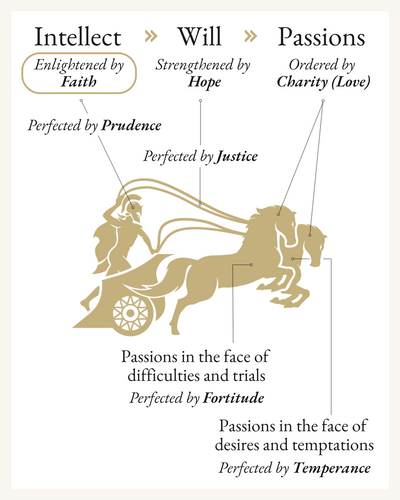
This is why faith is not stagnant but dynamic—it moves you to action. Just as the charioteer must actively guide the horses, so the faithful must actively choose to believe in God, follow His commands, and walk in His ways. For this reason, faith and works cannot be separated. As Scripture declares, “Faith without works is dead” (James 2:26). If you truly believe in God, your life will show it. Faith expresses itself in obedience, in love, and in the daily choices to trust God over fear, to serve others over self, to follow Christ even when it is difficult.
Faith of this kind puts you in right relationship with God, with yourself, and with your neighbor. It invites the Holy Spirit to begin the sanctifying work of spiritual formation—ever molding, directing, and bringing your intellect, will, and passions into harmony with the will of God. Throughout this lifelong process, Christ takes deeper root within you, progressively freeing you from sinful traits and bringing to full flower the character qualities of Christ.
Upon faith, then, stands not just the act of believing—but the rightly ordered way of living—the way of love. Faith inspires action. Hence, the fruits of a virtuous life, by grace, spring from the fountain of faith.
As a result, divinely infused faith leaves no area of the Christian moral life unmoved. It elevates the cardinal virtues from the natural to the supernatural—one degree of glory at a time: perfecting prudence with the mind of Christ, justice with the will of Christ, fortitude with the strength of Christ, and temperance with the purity of Christ.
For the devoted, faith increasingly becomes the rudder of life—guiding you to the truth, steering you through the storms, and directing your heart in the way of Christ—which lovingly, but righteously, drags at the vessel of your soul whenever you stray from the Way.
Divine faith brings order from disorder, hope from despair, and fulfillment from emptiness. It provides purpose, reveals truth, and restores meaning. It speaks to your heart—showing you what to do, what to avoid, and what to stand for. Through sanctifying grace, it helps you gradually see as God sees, will as God wills, and come to the ever firmer assent that Jesus is “...the Way, the Truth, and the Life” (John 14:6).
Faith is the cornerstone of moral life, and by the grace of the Holy Spirit working within, the believer builds a virtuous life upon it—firm in the knowledge that it is only by grace through faith, utterly unmerited by works, that one is saved. Thus, the virtuous one strives to live a faith-driven life, not to earn salvation, for that is already won by Christ—but to do God's will, as a disciple of His Word and a channel of His love.
2. Faith in Action
Faith is not merely an internal conviction or a private belief—it is a living force that moves the soul to act. It does not remain idle or hidden but bears fruit in the choices, habits, and sacrifices of everyday life. True faith transforms how one thinks, speaks, and lives—because to believe in God is to trust Him enough to follow Him, no matter the cost.
One with faith seeks truth, stands firm, and lives in obedience—knowing faith is not just belief, but action. They walk with confidence in God, trusting His word even when the path is unclear. Their heart is steady, their hope unwavering, because they do not rely on what they see but on the One who is unseen. They resist fear, doubt, and complacency, for their trusting belief in God is greater than their circumstances.
Faith looks like the man who wakes early to pray, even when he feels nothing—recognizing that “prayer is oxygen to the soul” (St. Padre Pio). Faith looks like the woman who remains faithful to God when life takes an undesired turn. It looks like the student who holds to their beliefs despite pressure to compromise, the father who continues to lead his family in faith despite uncertainty, and the widow who finds peace in her relationship with God.
Faith is Noah building the ark before the flood came, Abraham leaving his home for an unknown land, and Moses standing before the Red Sea, trusting it would part. It is the centurion who believed Jesus could heal with a word, the blind man who cried out for mercy, and the apostles who left everything to follow Christ. Above all, it is Jesus Himself, who entrusted His life completely into the hands of the Father—even unto the Passion of the Cross.
Faith in action is what makes faith come alive. When you live what you believe—when you trust God enough to obey, endure, and move forward—you become a witness of the Gospel. For faith, when expressed through action, becomes light in darkness, courage in fear, and strength in weakness. This is the faith that saves, sanctifies, and glorifies God.
3. Vices Opposed to Faith
The vices opposed to faith are, at one extreme, a deficiency of faith—which is unfaithfulness, and at the other extreme, one can never have too much faith, but one can have disordered faith—which is false-faith.
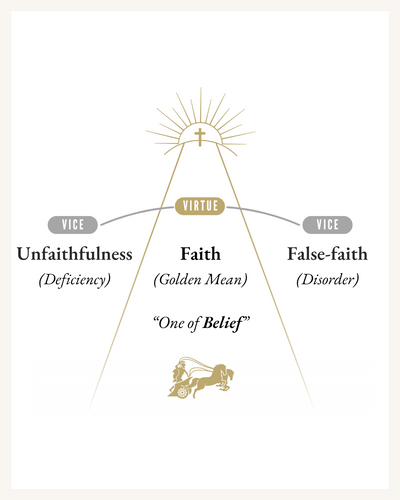
The vice of unfaithfulness is a disposition dead or devoid of belief in Christ and commitment to His ways. The unfaithful one holds their life tight to their chest, unwilling to give it fully to Christ, they search for fulfillment everywhere but Christ—never to find it. They either reject faith outright or allow it to fade into indifference, choosing doubt, neglect, or denial over trust in God. It is found in the person who ceases to pray, slowly drifting away from God without realizing it, in the skeptic who demands proof before belief, in the soul that once believed but now chooses the world over the Word. Unfaithfulness drains the soul of light, leaving it lost in the shadows of doubt, where belief in God is replaced by belief in self, and eternal fulfillment is traded for emptiness.
The vice of false-faith is a disposition whereby one’s faith is empty, unauthentic, or unfounded in the truth. It is said, “If you believe what you like in the gospels, and reject what you don’t like, it is not the gospel you believe, but yourself” (St. Augustine). Do not be deceived. Many are misled by “false teachers” (2 Peter 2:1) and errant thoughts that “suit their own desires” (2 Timothy 4:3). Scripture warns of both. Real faith cannot be faked or fabricated. God sees the genuineness of one’s heart and truthfulness of one’s faith. False-faith is found in the one who prays superstitiously, believing in empty gestures rather than in God’s grace, in the hypocrite who professes belief but refuses to live according to it, and in the teacher who twists doctrine for personal gain. It poisons the soul, reducing faith to a performance, a lifeless shell of belief that speaks of God with the lips but denies Him with the heart.
Both unfaithfulness and false-faith lead the soul away from true belief—one by rejecting God entirely, the other by distorting Him into something He is not. Together, they destroy the foundation upon which all other virtues stand, leaving the soul either wandering in doubt or clinging to a false security that cannot save.
Thus, whether it be by unfaithfulness or false-faith, the outcome is the same—unbelief. Unbelief denies grace and breeds faith-combating sins of many kinds—including infidelity, heresy, apostasy, blasphemy, and beyond. As a byproduct of pride, it is said, “Unbelief is the greatest of sins” (St. Thomas Aquinas), for one who does not place their belief in the Way of the Truth, places it in the way of destruction.
4. Reason & The Light of Faith
Sadly, there are many who know of Christ yet do not believe—oftentimes remaining in unbelief because they think faith ignores reason, failing to understand that faith does not work contrary to reason but in partnership with it, graciously shedding light where reason cannot.
Even so, reason alone often suggests there is a God. Consider the unexplainable awe evoked by the wonder and beauty of a sunset, the stars, nature, music, or the eyes of a newborn child—reason will often whisper from the depths of your soul, “There must be a God as the author.”
Should one endeavor to study the historical evidence of Christ, reason will also be unable to deny that Jesus did, in fact, live and perform many miracles. At His last breath, there was an earthquake, darkness, and the curtain of the temple was torn in two. For a forty-day period following His crucifixion, He was seen by countless eyewitnesses—risen from the dead. These testimonies were held to the end, even unto death. At these discoveries and more, reason concludes, “Jesus must be the Son of God.”
But even atop all that, for one to truly believe in Jesus Christ as Lord and Savior, and in the Bible as the inspired Word of God—reason requires faith.
5. Cultivating Faith
The best defense against unbelief and the vices opposed to faith is to cultivate faith itself. But faith is not passive—it must be fought for. It does not remain strong without effort, nor does it deepen without pursuit. The world will try to erode it, suffering will seek to shake it, and doubt will whisper, “It is foolish.” Faith is not the absence of questions; it is the refusal to let questions turn into unbelief. It is the choice to trust when answers do not come, to stand firm when the ground beneath you trembles, to believe even when you cannot yet see.
Does your faith waver? Do you pray only when it is convenient, or do you persevere even when God seems silent? Do you trust in His promises, or do you live as though His Word is not enough? Do you let doubt paralyze you, or do you seek truth with an open heart, knowing true faith withstands scrutiny? Faith requires endurance—it does not crumble in trials but is refined through them.
Faith is cultivated in daily surrender. It is found in the one who prays on the days when it’s the hardest, the one who clings to God’s Word instead of their own emotions, and the one who worships even in suffering. It is strengthened in the one who studies Scripture, allowing truth to shape their mind, in the one who receives the sacraments, drawing grace to nourish their soul, and in the one who surrounds themselves with believers, knowing faith thrives in communion, not isolation. Faith is not just believing once—it is choosing to believe again and again, each day.
Belief is most fortified by prayer. For it is said, “Prayer makes your heart bigger, until it is capable of containing the gift of God himself. Prayer begets faith, faith begets love” (St. Mother Teresa). Through prayer, faith is nourished, strengthened, and sustained, transforming uncertainty into confidence and drawing the believer ever closer to the heart of God.
As faith grows, it transforms the soul. The one who once wavered in doubt now walks with conviction. The one who once feared suffering now endures with hope. The one who once relied on human reasoning alone now trusts in divine wisdom. The soul that cultivates faith is unshaken by the storms of life, for they know beneath it all, God is faithful, and His promises will never fail.
Ultimately, faith is the path to eternal life. It is the foundation of salvation, the bridge between humanity and God. Without faith, we remain separated from our Creator, wandering without purpose or direction. But through faith, we are drawn into communion with Him, set on a path that leads not only to fulfillment in this life but to the glory of life everlasting. Faith is the first step toward the greatest promise ever given—to see God face to face, to dwell in His presence, and to know the fullness of joy that can never be taken away.
6. The Way of Faith
Seeker of virtue, the way of faith is the first and most fundamental step in the life of virtue. This path is not for the faint of heart. It is a journey through the unknown—requiring you to believe when you do not see, to trust when you do not understand, and to hold fast when everything around you shudders. Faith is not merely an idea; it is a battle—a battle for your soul, for truth, for eternity. And make no mistake, this battle will be fierce.
At first, faith may come easily, like a flame newly lit, flickering with excitement and hope. You may feel strong in belief, confident in God's presence, sure of His guidance. But the path of faith does not remain easy for long. You will be tested. There will come a time when doubt whispers in your ear, when the world mocks what you believe, when suffering shakes the very foundation of your soul. You may cry out to God and hear only silence. You may long for certainty but be given only the command to trust. You will be tempted to let go—to demand proof before you believe, to drift into complacency, to trade faith for comfort.
And yet, if you endure—if you keep your belief in mind, heart, and action, especially when all else fails—something incredible will happen: faith. For when faith is tested and purified, it does not weaken—it strengthens. The struggle will teach you to cling to God—not because you always feel Him, but because you have come to know He is true. You will learn to walk through the darkness with steadfast trust, to stand firm when the world calls you foolish, to endure trials with the knowledge that God’s plan is higher than your understanding. And in that perseverance, faith will become like an oak tree, its roots gripping deep into the earth.
Faith requires effort. It demands focus. It will cost you your pride, your reliance on your own strength, your desire for control. It will strip away illusions and expose the depths of your heart. But it will also give you everything—a soul open to God’s grace, a peace the world cannot take away, and a purpose far greater than yourself. It will carry you through every trial, give meaning to every struggle, and fulfill you in every way.
Humbly then, accept the divine invitation—a free gift extended to all—for Christ to enter into the whole of your life. Not as a one-time consent, but an ongoing assent—forever casting off the garments of your old self and bringing forth the garments of your new self. Not only keeping the faith, but living it, sharing it, and bravely bearing witness to it—making the way of Christ, by grace, the very pattern of your life.
Pray for faith so deep, so true, and so real that the fire of the Holy Spirit burns inside you—empowering you to freely surrender your will entirely to God’s will. Pour the fullness of your belief into Jesus Christ, and by the strength of the Holy Spirit—be moved. For it is by faithfully and willfully moving toward God, that God, through Christ, reaches out and touches you by the finger of His grace—infusing you with the virtue of faith.
So when Scripture says there is only one name by which you can be saved, and that name is Jesus Christ (Acts 4:12)—you believe. When it says Scripture is the inspired Word of God, equipping you in the Way of Truth (2 Timothy 3:16–17)—you believe. When it says nothing can separate you from the love of God (Romans 8:39)—you believe. When it says all things work together for good for those who love God (Romans 8:28)—you believe. When it says nothing is impossible with God (Luke 1:37)—you believe. That is true faith.
You can do this. Not by your own power, but by His. By Grace. Grace will sustain you when you are weak, lift you when you fall, and guide you when you cannot see the way. The path of faith is hard—but it is worth it. You’re not alone. Lift the sails of your soul so the Holy Spirit can fill you, and the winds of grace can move you to trust beyond your understanding, hope beyond your sight, and love beyond your strength. For in the end, faith will not only sustain you—it will transform you into the beauty and fullness of the character of Christ.

Scroll down for the lesson plan and other related resources associated with this teaching.
Copyright © 2022 Horse & Chariot. All rights reserved.
New teachings like this are released often. Subscribe free and never miss a teaching!
Resources
Visual Resource
Illustration of the virtue of faith and the vices that oppose it, including definitions.

Free Lesson Plan
Perfect for small groups, families, classrooms, or personal reflection.
Related Quotes
Faith as a Grace and Divine Invitation
Faith begins with God. Before it is chosen, reasoned through, or lived out, it is received as a gift of grace that invites a human response.
“He who created us without our help will not save us without our consent.” — St. Augustine
“God does not believe for us, but He does through His Spirit create spiritual life in us so that we can believe. Faith is a gift of God. It is part of the whole salvation package that God gives to us through the work of Christ for us and the work of the Holy Spirit in us. It is not our contribution, so to speak, to God’s great plan of salvation. God does it all. Faith is part of the unsearchable riches of Christ.” — Jerry Bridges
“Faith is a gift from God, but it is also a response to His call.” — St. Vincent de Paul
“Faith is the light that shines in the deepest recesses of the human heart, illuminating truths that reason alone cannot grasp.” — St. Edith Stein
“God is very generous and does not deny His grace to anyone. Indeed he gives more than what we ask of Him. Faithfulness to the inspirations of the Holy Spirit - that is the shortest route.” — St. Faustina
“Faith is the foundation of the whole building of spiritual life. Without it, everything else would collapse.” — St. Teresa of Ávila
“Faith is the key that opens the door to the infinite riches of God’s love and mercy.” — St. Maximilian Kolbe
“Faith is the union of the soul with God. It is the means by which the intellect and will are led to the heights of divine knowledge and love.” — St. John of the Cross
Faith Perfects Reason
Faith does not silence reason; it completes it. Through faith, the intellect learns its limits and is elevated to see reality more fully.
“To one who has faith, no explanation is necessary. To one without faith, no explanation is possible.” — St. Thomas Aquinas
“There is a vast difference between a struggling faith and a stubborn unbelief.” — Jerry Bridges
“Unbelief is the greatest of sins.” — St. Thomas Aquinas
“We can’t have full knowledge all at once. We must start by believing; then afterward we may be led on to master the evidence for ourselves.” — St. Thomas Aquinas
“The ultimate purpose of reason is to bring us to the place where we can see that there is a limit to reason.” — Blaise Pascal
“Without God, what am I but a guide to my own destruction.” — St. Augustine
“In faith, there is enough light for those who want to believe and enough shadows to blind those who don’t.” — Blaise Pascal
“Faith, in the sense in which I am here using the Word, is the art of holding on to things your reason has once accepted, in spite of your changing moods.” — C.S. Lewis
“I believe in Christianity as I believe that the sun has risen: not only because I see it, but because by it I see everything else.” — C. S. Lewis
“The problem of disbelieving in God is not that a man ends up believing nothing. Alas, it is much worse. He ends up believing anything.” — G.K. Chesterton
Faith Requires a “Yes”
Faith requires a free and willing “yes.” Grace invites, but belief is a choice that demands surrender, obedience, and commitment.
“Believing is a matter of the will. A man does not believe without being willing to believe.” — C.H. Spurgeon
“Take the first step in faith. You don’t have to see the whole staircase, just take the first step.” — Martin Luther King Jr.
“To believe is to step beyond the limits of the world and into the boundless truth of God’s eternal design.” — St. Hildegard of Bingen
“As soon as I believed there was a God, I understood I could do nothing else but live for him, my religious vocation dates from the same moment as my faith: God is so great. There is such a difference between God and everything that is not.” — St. Charles de Foucauld
“Continually exercise this virtue of faith, for it places thee near to thy last end, after which thou strivest, and brings thee near to the object of thy desires and thy love.” — Mary of Agreda
“Faith is powerful to do all things, for nothing is impossible to the believer; faith makes all things attainable and possible. Faith illumines and ennobles the understanding of man, since it directs him in the darkness of his natural ignorance.” — Mary of Agreda
“Faith enlivens the other virtues and serves as a nourishment of the just man and a support in his labors.” — Mary of Agreda
“Becoming a Christian is the work of a moment; being a Christian is the work of a lifetime." — Billy Graham
Faith Expressed in Prayer and Faithfulness
Prayer sustains faith, and faith reveals itself through faithfulness. What we believe inwardly is proven by how we live outwardly.
“Prayer is oxygen to the soul.” — St. Padre Pio
“Prayer makes your heart bigger, until it is capable of containing the gift of God himself. Prayer begets faith, faith begets love” — St. Mother Teresa
“Faith and prayer are the vitamins of the soul; man cannot live in health without them.” — Mahalia Jackson
“Be faithful in small things because it is in them that your strength lies.” — St. Mother Teresa
“God does not demand that I be successful. God demands that I be faithful. When facing God, results are not important. Faithfulness is what is important.” — St. Mother Teresa
“I do not pray for success, I ask for faithfulness.” — St. Mother Teresa
“The Spirit is compared to the wind, and, like the wind, He cannot be seen by our bodily eyes. But just as we know there is a wind by the effect it produces on waves, and trees, and smoke, so we may know the Spirit is in a man by the effects He produces in the man’s conduct. It is nonsense to suppose that we have the Spirit, if we do not also ‘walk in the Spirit’ (Gal. 5:25). We may depend on it as a positive certainty, that where there is no holy living, there is no Holy Ghost.” — J.C. Ryle
“Biblically speaking, faith and faithfulness stand to each other as root and fruit.” — J. Hampton Keathley
Faith Transforms the Soul
True faith transforms how we see, how we love, and how we endure—especially in darkness, suffering, and mystery.
“The fruit of faith is love.” — St. Mother Teresa
“Paul says, ‘It’s no longer I who live; it’s Christ who lives in me.' That’s the whole picture right there. It’s no longer I, this old self. That old self has been put away by grace, accepted in faith. What does that faith look like? Love. It expresses itself as love...So, how are we saved? By faith, yes. Accepting the grace of Christ, absolutely. Without that, we can’t be saved. But that’s the door, that’s the beginning, that’s the root; this faith now, having taken root, increasingly expresses itself in this startling love.” — Robert Barron
“Faith is like a bright ray of sunlight. It enables us to see God in all things as well as all things in God.” — St. Francis de Sales
“Faith sees God in all things, and we see things as God sees them.” — St. Peter Julian Eymard
“These are His ways, unfathomable and incomprehensible to us. It is for us to submit ourselves completely to His holy will. There are mysteries that the human mind will never fathom here on earth; eternity will reveal them.” — St. Faustina
“Faith is the key to the treasure of hope and charity. Without it, the soul is locked out of the house of divine love.” — St. Catherine of Siena
“Just as love is a verb, so is faith.” — Nannie Helen Burroughs
“With faith, we are like a lamp filled with oil. Without faith, we are an empty vessel that cannot give light.” — St. Catherine of Siena
“Faith is to believe what you do not see; the reward of this faith is to see what you believe.” — St. Augustine
“Even when I feel nothing, when I see nothing, I know that He is there. Faith guides me more surely than sight.” — St. Thérèse of Lisieux
“A little faith will bring your soul to heaven; a great faith will bring heaven to your soul.” — C.H. Spurgeon
“If you believe what you like in the gospels, and reject what you don’t like, it is not the gospel you believe, but yourself” — St. Augustine
Related Scripture
The Foundation and Nature of Faith
Faith is a conviction in the unseen, the necessity of belief to please God, and the source of spiritual understanding.
“Now faith is the assurance of things hoped for, the conviction of things not seen. Indeed, by faith our ancestors received approval. By faith we understand that the worlds were prepared by the word of God, so that what is seen was made from things that are not visible.” — Hebrews 11:1-3 (NRSVue)
“To have faith is to be sure of the things we hope for, to be certain of the things we cannot see.” — Hebrews 11:1 (GNT)
“...without faith it is impossible to please God, for whoever would approach him must believe that he exists and that he rewards those who seek him. ” — Hebrews 11:6 (NRSVue)
“So faith comes from what is heard, and what is heard comes through the word of Christ.” — Romans 10:17 (NRSVue)
“Then Jesus said to her, ‘Did I not tell you that if you believe, you will see the glory of God?’” — John 11:40 (NRSVue)
“...For truly I tell you, if you have faith the size of a mustard seed, you will say to this mountain, ‘Move from here to there,’ and it will move; and nothing will be impossible for you.” — Matthew 17:20 (NRSVue)
“Ever since God created the world, his invisible qualities, both his eternal power and his divine nature, have been clearly seen; they are perceived in the things that God has made. So those people have no excuse at all!” — Romans 1:20 (GNT)
“For we fix our attention, not on things that are seen, but on things that are unseen. What can be seen lasts only for a time, but what cannot be seen lasts forever.” — 2 Corinthians 4:18 (GNT)
“In the beginning was the Word, and the Word was with God, and the Word was God. He was in the beginning with God. All things came into being through him, and without him not one thing came into being. What has come into being in him was life, and the life was the light of all people.” — John 1:1-4 (NRSVue)
Salvation and Grace through Jesus Christ
The gift of salvation is received through faith, focusing on Christ as the exclusive way to the Father.
“For by grace you have been saved through faith, and this is not your own doing; it is the gift of God—not the result of works, so that no one may boast.” — Ephesians 2:8-9 (NRSVue)
“For God so loved the world that he gave his only Son, so that everyone who believes in him may not perish but may have eternal life.” — John 3:16 (NRSVue)
“‘Do not let your hearts be troubled. Believe in God, believe also in me. In my Father’s house there are many dwelling places. If it were not so, would I have told you that I go to prepare a place for you? And if I go and prepare a place for you, I will come again and will take you to myself, so that where I am, there you may be also. And you know the way to the place where I am going.’ Thomas said to him, ‘Lord, we do not know where you are going. How can we know the way?’ Jesus said to him, ‘I am the way, and the truth, and the life. No one comes to the Father except through me. If you know me, you will know my Father also. From now on you do know him and have seen him.’” — John 14:1-7 (NRSVue)
“There is salvation in no one else, for there is no other name under heaven given among mortals by which we must be saved.” — Acts 4:12 (NRSVue)
“...if you confess with your lips that Jesus is Lord and believe in your heart that God raised him from the dead, you will be saved.” — Romans 10:9 (NRSVue)
“The one who believes and is baptized will be saved; but the one who does not believe will be condemned.” — Mark 16:16 (NRSVue)
“Whoever has the Son has life; whoever does not have the Son of God does not have life.” — 1 John 5:12 (NRSVue)
“I am the gate. Whoever enters by me will be saved, and will come in and go out and find pasture.” — John 10:9 (NRSVue)
“But God, who is rich in mercy, out of the great love with which he loved us even when we were dead through our trespasses, made us alive together with Christ—by grace you have been saved…” — Ephesians 2:4-5 (NRSVue)
“For we consider that a person is justified by faith apart from works of the law.” — Romans 3:28 (NRSVue)
“In him we have redemption through his blood, the forgiveness of our trespasses, according to the riches of his grace that he lavished on us. With all wisdom and insight he has made known to us the mystery of his will, according to his good pleasure that he set forth in Christ, as a plan for the fullness of time, to gather up all things in him, things in heaven and things on earth.” — Ephesians 1:7-11 (NRSVue)
“...turn from darkness to light and from the power of Satan to God, so that they may receive forgiveness of sins and a place among those who are sanctified by faith in me.” — Acts 26:18 (NRSVue)
The Evidence of Faith: Works, Love, and Obedience
True faith is transformative, resulting in a life of love, adherence to God's commands, and spiritual fruit.
“And now faith, hope, and love abide, these three; and the greatest of these is love.” — 1 Corinthians 13:13 (NRSVue)
“For just as a body without a spirit is dead, so also faith without works is dead.” — James 2:26 (NABRE)
“But someone will say, “You have faith and I have works.” Show me your faith apart from your works, and I by my works will show you my faith. You believe that God is one; you do well. Even the demons believe—and shudder. Do you want to be shown, you senseless person, that faith apart from works is barren? Was not our ancestor Abraham justified by works when he offered his son Isaac on the altar? You see that faith was active along with his works, and faith was brought to completion by the works. Thus the scripture was fulfilled that says, “Abraham believed God, and it was reckoned to him as righteousness,” and he was called the friend of God. You see that a person is justified by works and not by faith alone. Likewise, was not Rahab the prostitute also justified by works when she welcomed the messengers and sent them out by another road? For just as the body without the spirit is dead, so faith without works is also dead.” — James 2:18-26 (NRSVue)
“Do not deceive yourselves by just listening to his word; instead, put it into practice.” — James 1:22 (GNT)
“For the love of God is this, that we obey his commandments. And his commandments are not burdensome. For whatever is born of God conquers the world. And this is the victory that conquers the world, our faith.” — 1 John 5:3-4 (NRSVue)
“I am the vine, you are the branches. Those who abide in me and I in them bear much fruit, because apart from me you can do nothing.” — John 15:5 (NRSVue)
“I am the true vine, and my Father is the vinegrower. He removes every branch in me that bears no fruit. Every branch that bears fruit he prunes to make it bear more fruit.” — John 15:1-2 (NRSVue)
“My Father is glorified by this, that you bear much fruit and become my disciples.” — John 15:8 (NRSVue)
“You did not choose me but I chose you. And I appointed you to go and bear fruit, fruit that will last, so that the Father will give you whatever you ask him in my name." — John 15:16 (NRSVue)
“so that you may lead lives worthy of the Lord, fully pleasing to him, as you bear fruit in every good work and as you grow in the knowledge of God." — Colossians 1:10 (NRSVue)
Abiding in God’s Strength and Faithfulness
The believer finds security in union with Christ, God's unchanging character, and His indwelling presence.
“...it is no longer I who live, but Christ who lives in me." — Galatians 2:20 (NRSVue)
“Jesus Christ is the same yesterday and today and forever.” — Hebrews 13:8 (NRSVue)
“The steadfast love of the Lord never ceases, his mercies never come to an end; they are new every morning; great is your faithfulness." — Lamentations 3:22-23 (NRSVue)
“Nor height, nor depth, nor anything else in all creation will be able to separate us from the love of God in Christ Jesus our Lord.” — Romans 8:39 (NRSVue)
“We know that all things work together for good for those who love God, who are called according to his purpose.” — Romans 8:28 (NRSVue)
“For nothing will be impossible with God.” — Luke 1:37 (NRSVue)
“A new heart I will give you, and a new spirit I will put within you, and I will remove from your body the heart of stone and give you a heart of flesh. I will put my spirit within you and make you follow my statutes and be careful to observe my ordinances.” — Ezekiel 36:26-27 (NRSVue)
“God abides in those who confess that Jesus is the Son of God, and they abide in God.” — 1 John 4:15 (NRSVue)
“Jesus said to her, ‘I am the resurrection and the life. Those who believe in me, even though they die, will live, and everyone who lives and believes in me will never die. Do you believe this?’” — John 11:25-26 (NRSVue)
“He who lives forever created the whole universe; the Lord alone is just. To none has he given power to proclaim his works; and who can search out his mighty deeds? Who can measure his majestic power? And who can fully recount his mercies? It is not possible to diminish or increase them, nor is it possible to fathom the wonders of the Lord. When human beings have finished, they are just beginning, and when they stop, they are still perplexed. What are human beings, and of what use are they? What is good in them, and what is evil? The number of days in their life is great if they reach one hundred years. Like a drop of water from the sea and a grain of sand, so are a few years among the days of eternity. That is why the Lord is patient with them and pours out his mercy upon them. He sees and recognizes that their end is miserable; therefore he grants them forgiveness all the more. The compassion of human beings is for their neighbors, but the compassion of the Lord is for every living thing. He rebukes and trains and teaches them, and turns them back, as a shepherd his flock. He has compassion on those who accept his discipline and who are eager for his precepts.” — Sirach 18:1-14 (NRSVue)
“Have you not known? Have you not heard? The Lord is the everlasting God, the Creator of the ends of the earth. He does not faint or grow weary; his understanding is unsearchable.” — Isaiah 40:28 (NRSVue)
“Every house is founded by someone, but the founder of all is God.” — Hebrews 3:4 (NRSVue)
“Beloved, let us love one another, because love is from God; everyone who loves is born of God and knows God.” — 1 John 4:7 (NRSVue)
Perseverance, Discernment, and Spiritual Growth
The practical walk of the believer involves guarding against false teachings, enduring trials, and growing in knowledge.
“All scripture is inspired by God and is useful for teaching, for reproof, for correction, and for training in righteousness, so that the person of God may be proficient, equipped for every good work.” — 2 Timothy 3:16–17 (NRSVue)
“Beware of false prophets, who come to you in sheep’s clothing but inwardly are ravenous wolves.” — Matthew 7:15 (NRSVue)
“But false prophets also arose among the people, just as there will be false teachers among you, who will secretly bring in destructive opinions. They will even deny the Master who bought them—bringing swift destruction on themselves.” — 2 Peter 2:1 (NRSVue)
“I urge you, brothers and sisters, to keep an eye on those who cause dissensions and offenses, in opposition to the teaching that you have learned; avoid them. For such people do not serve our Lord Christ, but their own appetites, and by smooth talk and flattery they deceive the hearts of the simple-minded.” — Romans 16:17-18 (NRSVue)
“For the time is coming when people will not put up with sound teaching, but, having their ears tickled, they will accumulate for themselves teachers to suit their own desires” — 2 Timothy 4:3 (NRSVue)
“This people honors me with their lips, but their hearts are far from me;” — Matthew 15:8 (NRSVue)
“They profess to know God, but they deny him by their actions. They are detestable, disobedient, unfit for any good work.” — Titus 1:16 (NRSVue)
“So we see that they were unable to enter because of unbelief.” — Hebrews 3:19 (NRSVue)
“That is true. They were broken off because of their unbelief, but you stand only through faith. So do not become proud, but stand in awe.” — Romans 11:20 (NRSVue)
“Take care, brothers and sisters, that none of you may have an evil, unbelieving heart that turns away from the living God.” — Hebrews 3:12 (NRSVue)
“Those who believe in him are not condemned; but those who do not believe are condemned already, because they have not believed in the name of the only Son of God. And this is the judgment, that the light has come into the world, and people loved darkness rather than light because their deeds were evil.” — John 3:18-19 (NRSVue)
“Therefore rid yourselves of all sordidness and rank growth of wickedness, and welcome with meekness the implanted word that has the power to save your souls.” — James 1:21 (NRSVue)
“...let us also lay aside every weight and the sin that clings so closely, and let us run with perseverance the race that is set before us, looking to Jesus the pioneer and perfecter of our faith…” — Hebrews 12:1-2 (NRSVue)
“so that the genuineness of your faith—being more precious than gold that, though perishable, is tested by fire—may be found to result in praise and glory and honor when Jesus Christ is revealed.” — 1 Peter 1:7 (NRSVue)
“Although you have not seen him, you love him; and even though you do not see him now, you believe in him and rejoice with an indescribable and glorious joy, for you are receiving the outcome of your faith, the salvation of your souls.” — 1 Peter 1:8-9 (NRSVue)
“For this very reason, make every effort to supplement your faith with virtue, virtue with knowledge, knowledge with self-control, self-control with endurance, endurance with devotion, devotion with mutual affection, mutual affection with love. If these are yours and increase in abundance, they will keep you from being idle or unfruitful in the knowledge of our Lord Jesus Christ.” — 2 Peter 1:5-8 (NABRE)
“Therefore, since we are justified by faith, we have peace with God through our Lord Jesus Christ, through whom we have obtained access to this grace in which we stand; and we boast in our hope of sharing the glory of God. And not only that, but we also boast in our sufferings, knowing that suffering produces endurance, and endurance produces character, and character produces hope, and hope does not disappoint us, because God's love has been poured into our hearts through the Holy Spirit that has been given to us.” — Romans 5:1-5 (NRSVue)
“God is faithful; by him you were called into the fellowship of his Son, Jesus Christ our Lord. May you be made strong with all the strength that comes from his glorious power, and may you be prepared to endure everything with patience, while joyfully giving thanks to the Father, who has enabled you to share in the inheritance of the saints in the light. ” — Colossians 1:9-13 (NRSVue)
“Never let go of loyalty and faithfulness. Tie them around your neck; write them on your heart.” — Proverbs 3:3-4 (GNT)
“Happy are those whose way is blameless, who walk in the law of the Lord. Happy are those who keep his decrees, who seek him with their whole heart, who also do no wrong but walk in his ways.” — Psalms 119:1-3 (NRSVue)
“The crucible is for silver and the furnace for gold, but the Lord tests the heart.” — Proverbs 17:3 (NRSVue)
“For those who want to save their life will lose it, and those who lose their life for my sake, and for the sake of the Gospel, will save it.” — Mark 8:35 (NRSVue)

Never miss a teaching — get all new teachings of virtue sent to your inbox free!