
All Series > Seven Chief Virtues > Part 2
The Virtue of Hope
(Series 5, Part 2, Teaching #34)
Quick Links
Help fund this video: Donate

1. The Virtue of Hope
The unshakeable confidence in the Good News of Christ is hope.
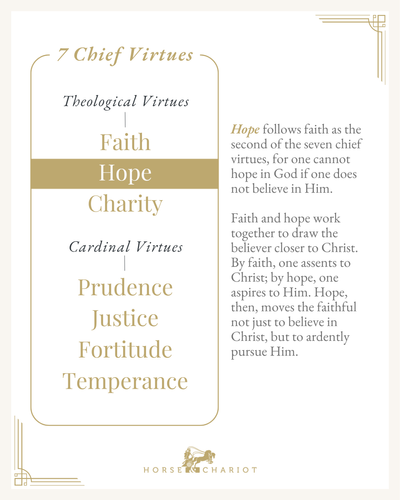
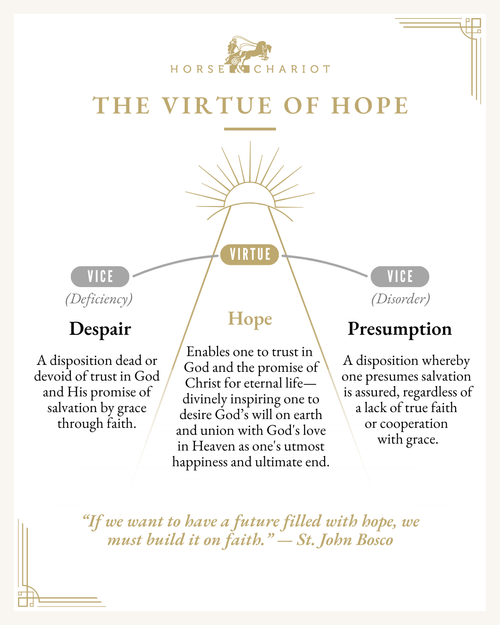
The virtue of hope enables one to trust in God and the promise of Christ for eternal life—divinely inspiring one to desire God’s will on earth and union with God's love in Heaven as one's utmost happiness and ultimate end.
Hope follows faith as the second of the seven chief virtues, for one cannot hope in God if one does not believe in Him. Faith and hope work together to draw the believer closer to Christ. By faith, one assents to Christ; by hope, one aspires to Him. Hope, then, moves the faithful not just to believe in Christ, but to ardently pursue Him.
Hope is more than a fleeting wish or an optimistic outlook—it is a supernatural virtue infused into the soul by God Himself. It is not merely human positivity or resilience; rather, it is the firm trust that God will fulfill His promises, that His mercy is greater than your failures, and that eternal life is your ultimate destiny. This is why hope is not something we create on our own, but a divine gift—a grace that lifts the heart beyond the limits of human understanding. Left to yourself, you are prone to despair, to discouragement, and to reliance on the temporary things of this world. But by God’s grace, hope is planted deep within, enabling you to trust that no matter what trials come, you are being led toward something far greater than you can now see.
To have hope means to trust unwaveringly in God’s promises, believing that what He has spoken will come to pass. The Scriptures are filled with these promises—of redemption, of grace, of victory over sin and death, of eternal happiness through faith in Jesus Christ. Hope does not require you to see the fulfillment of these promises immediately; it simply requires that you believe. This is not blind optimism, nor is it naïve wishing—“Hope is the anchor of the soul. It prevents us from drifting away in the storms of life” (St. Vincent de Paul). It is what enables the believer to endure suffering, to walk forward when life is uncertain, and to cling to the knowledge that God’s plan is always leading to a greater good, even when it cannot yet be perceived.
Where faith enlightens the intellect to perceive the truth, hope strengthens the will to pursue the truth. Without hope, then, it is possible to know the Way but do little to nothing to go the Way. Hope is the charioteer’s resolve when the road is long—the unyielding grip on the reins when trials press in. If faith is the light by which the path is seen, then hope is the strength that keeps the charioteer from collapsing, pressing onward toward the Promised Land. Without hope, the will falters, the reins slacken, and the chariot slows to a halt, overcome by doubt and despair. But with hope, the will remains steadfast, guiding the soul forward—through darkness, through suffering, through uncertainty—toward God.

Because hope is so deeply intertwined with faith, it naturally bears fruit in action. Hope is meant to be lived out—not as a distant, vague longing for something better, but as a transformative force that shapes daily life. A hopeful soul does not simply wait for Heaven; it strives toward it, living in a way that reflects the coming Kingdom of God. Just as the charioteer fixes their eyes ahead and presses forward, so too does the hopeful heart remain fixed on eternity, walking boldly in the direction of God’s promises, knowing that He who calls is unwavering.
The gift of hope is found only in the souls of the faithful on earth, still traveling the road to Heaven's gates; for in Heaven, hope is forever fulfilled, and in hell, forever lost. Thus, God gives the Christian pilgrim hope so they enduringly trust in Him, turn to Him, and reach for Him—aspiring to be a reflection of His love until they rest in His love—all while leaning on the grace of the Holy Spirit to both express it and obtain it, and to persevere through countless adversities in its pursuit.
2. Hope in Action
Just as natural hope moves one to pursue a worldly goal, though the path is difficult, supernatural hope moves one to pursue a spiritual goal, though the path is difficult—principally, the Way of Christ.
One with hope stands tall when others hide, presses forward when others give in, and waits with poise when others grow flustered. They refuse to let fear or despair defeat them. They look beyond the present struggle and cling to the promises of God. They trust that suffering is not meaningless, that every trial has a purpose, and that God’s mercy is greater than their failures. Hope keeps them steady in life’s chaos, knowing “the world's thy ship and not thy home” (St. Thérèse of Lisieux).
Hope looks like the woman who prays for a way forward when all doors seem closed. It looks like the man who remains joyful despite hardship, trusting that God is working all things for good. It looks like the cancer patient who refuses to give in to despair, the struggling worker who keeps believing a breakthrough will come, and the grieving parent who holds onto the promise of Heaven.
Hope is Joseph trusting in his dreams even from the depths of a prison, Job refusing to curse God in his suffering, and Abraham believing in God’s promise of a son despite his old age. It is the bleeding woman who reached for Jesus’ robe, the paralyzed man whose friends lowered him through the roof, and the disciples who endured persecution for the sake of the Gospel. Above all, it is Jesus Himself, who endured the cross “for the sake of the joy that lay before him” (Hebrews 12:2), knowing God’s plan would bring ultimate redemption for all.
In these ways and more, Christian hope imparts a spiritual joy that can shine in any circumstance. God would not expect Christians to be joyful if there were nothing to look forward to. But there is! That is the good news—so good, all difficulties pale in comparison. For this reason, the hopeful are resiliently joyful in the divine destiny God has in store for them.
3. Vices Opposed to Hope
The vices opposed to hope are, at one extreme, a deficiency of hope—which is despair, and at the other extreme, one can never have too much hope, but one can have disordered hope—which is presumption.
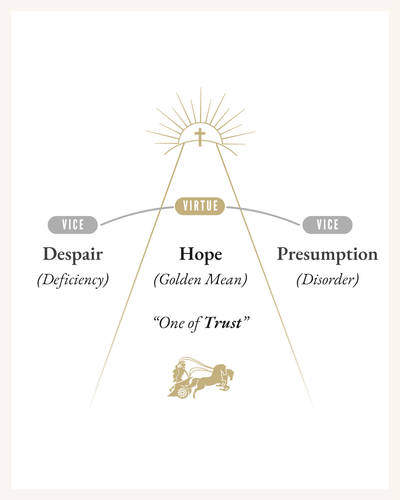
The vice of despair is a disposition dead or devoid of trust in God and His promise of salvation by grace through faith. Despair is to say, “My sad state outweighs God’s mercy.” Despair is a liar! No sin or circumstance, no matter the degree, can exceed the immense scope of God’s forgiveness and grace. Yet, the despairing soul believes otherwise, thinking their sins are too great to be forgiven, that suffering has no meaning, or that God has abandoned them entirely. It is found in the one who has given up on prayer, convinced God no longer listens, in the sinner who believes they are beyond redemption, in the weary heart who sees only darkness and refuses the light. Despair suffocates the soul, drowning it in hopelessness and severing its connection to divine mercy, where healing and renewal await.
The vice of presumption is a disposition whereby one presumes salvation is assured, regardless of a lack of true faith or cooperation with grace. The presumptuous one either takes God’s grace for granted, assuming salvation despite a lukewarm and fruitless faith and expecting pardon without repentance, or they disregard God’s grace entirely, assuming salvation by their own merit, adopting the mindset, “I’m a good person, so I’m going to Heaven.” It is found in the one who sins freely, expecting forgiveness without contrition, in the believer who sees no need to grow in virtue, and in the self-righteous who assume they are saved while condemning others. Presumption blinds the soul to its need for grace, leading one to neglect the very means of salvation they falsely believe are unnecessary.
It is said, “No one loses Heaven except by his own fault. So far as God’s part is concerned, our salvation is certain. It is only our part—our cooperation or non-cooperation with God’s grace—that is uncertain” (Leo J. Trese). Sadly, both despair and presumption reject grace—one by refusing to believe in God’s mercy, the other by abusing it. Together, they drag the soul away from trust in God’s promises, either into the pit of fear and hopelessness or into the arrogance of self-assurance, both leading to destruction rather than to the eternal life true hope secures.
Thus, whether it be by despair or presumption, the belief one has already lost or already won, prevents them from running a good race. The outcome is the same: spiritual sloth. Spiritual sloth dismisses grace and drains hope, inviting soul-dragging sins such as lust, gluttony, and aimlessness. Hence, it is written, “Hope deferred makes the heart sick…” (Proverbs 13:12) and to “...work out your salvation with fear and trembling” (Philippians 2:12)—to resist despair, avoid presumption, and hold onto hope.
4. Worldliness & The Anchor of Hope
It is the anchor of hope that keeps one from drifting into the darkness of despair—where they no longer trust God—or the disillusionment of presumption, where they believe they no longer need Him. It is worldliness that leads to both.
Worldly hope, which is natural hope, is an essential part of life. The hurting hope for healing, the persecuted long for peace, the daring dream of success. Without hope, life loses its direction; one cannot persevere without the prospect of a brighter future. Yet these hopes, while good, must never supersede one’s hope in Christ, lest the ills of despair or presumption soon follow.
Divine hope, which is supernatural hope, is the believer’s assurance of a brighter future—the crown gift of grace through faith. Scripture declares, “This [hope] we have as an anchor of the soul, sure and firm, which reaches into [Heaven] where Jesus has entered on our behalf” (Hebrews 6:18–20).
Unlike the anchor of a ship in the sea, the anchor of hope in Heaven does not merely prevent the faithful from drifting—it actively pulls them forward, keeping them grounded in Christ’s truth while encouraging them to rely on the winds of grace to guide them through their unique spiritual journey across the ocean of life.
Thus, the hopeful resist the currents of the times, while untethered souls wander far from God. It takes an elevated mind, a humble heart, and a connected soul—anchored to the Rock of Christ—not only to remain unmoved amid the waves of the world but also to be a herald of hope.
5. Cultivating Hope
The best defense against worldliness and the vices opposed to hope is to cultivate hope itself. Hope must be fought for. It does not come easily, nor does it remain without effort. The squalls of life will try to tear it from your grasp. Failure will hint you are beyond saving. Comfort will entice you to believe striving for Heaven is unnecessary. But hope is not a feeling; it is a choice. It is the decision to trust in God when nothing makes sense, to press forward when the road is long, and to refuse despair even when every voice tells you to give up. In fact, “The greater the difficulties, the greater should be our hope” (St. Maximilian Kolbe).
Where are you tempted to lose hope? Do you let failure trick you into thinking you are beyond redemption? Do you let suffering harden your heart, believing God has forgotten you? Do you live as though salvation is assured without repenting, presuming God’s mercy while neglecting to seek holiness? Hope demands vigilance. It does not sit idle, waiting for relief—it moves forward in faith. The hopeful soul fights against despair by clinging to the promises of God, and it resists presumption by striving daily for virtue, knowing the path of Christ is narrow.
Hope is cultivated in the choices no one sees. It is found in the one who seeks forgiveness after falling into sin, refusing to believe their failures define them. It is found in the one who keeps praying when Heaven seems silent, the one who continues working when they see no fruit, and the one who chooses faithfulness over fear. It is in the one who reminds their weary heart of God’s goodness when doubt creeps in, and the one who refuses to believe hardship is meaningless, knowing every trial can bring them closer to God.
Grow in hope through prayer, Scripture, and gratitude. Prayer keeps the heart connected to God, the source of all hope. To seek hope is to seek Him, for “they that hope in the Lord will renew their strength” (Isaiah 40:31). Scripture illuminates God’s promises, reminding believers of His faithfulness, for it is said, “If we want to have a future filled with hope, we must build it on faith” (St. John Bosco). Gratitude strengthens hope by shifting focus from what is lacking to the countless ways God has already provided. Together, these practices fortify the soul, enabling one to persevere through trials with trust in God’s goodness and His eternal plan.
As hope takes root, it fuels the soul. The one who once feared hardship now embraces it as a path to holiness. The one who once wavered in doubt now stands firm, trusting that God's plan is greater than their understanding. The one who once settled into complacency now runs the race with perseverance, knowing eternity is worth every struggle. The Christian soul, like a diamond, is not fractured but formed through the pressures of life.
Ultimately, hope is the flame that keeps the journey of faith alive. The faithful, although imperfect and prone to stumbling, are always picked back up by the helping hand of hope, each time arising with renewed resolve in their walk with Christ. For in the end, the soul that hopes rightly never walks in defeat—they have concrete trust in God, habitually choosing hope and moral fortitude despite having absolutely no certainty things will get better in this life, but possessing absolute certainty things will be better in the next.
As one grows in the virtue of hope, they grow in their desire for God; as one grows in their desire for God, they grow in the virtue of hope. God is both the source and object of hope, and it is His will, through faith, to bestow the grace of hope in each of our souls so we desire nothing less than what He desires for us: oneness through Christ.
6. The Way of Hope
The way of hope is a path that will demand your perseverance, stretch your trust, and challenge everything you think you know about waiting on God. Hope is not wishful thinking. It is not mere optimism. It is a battle for the soul—a fierce and unyielding grip on the promises of God when everything around you tempts you to let go.
At first, hope may feel effortless, like the sun rising on a new day, filling you with confidence that God is leading you to good things. But the path of hope is no gentle walk—it is a climb, steep and exhausting. There will be days when you feel lost, when suffering clouds your vision, when prayers seem unanswered. Doubt will whisper, “God has forgotten you.” The world will tell you to take matters into your own hands, to place your trust in wealth, success, or fleeting pleasures. You will see others prosper while you struggle, and you will be tempted to despair—to believe God has deserted you or that your faith was in vain.
But if you persist, if you press forward, something powerful will happen: hope. For when hope is forged by fire, it becomes unbreakable. It teaches you to trust in God’s goodness even when you do not see it, and to wait with confidence even when the road is long. You will learn that true hope is not found in the things of this world, but in God alone—the One who never fails, never forgets, and never forsakes His own. Hope will become your anchor, keeping you steady when seas are rough, when suffering strikes, and when the world falls apart.
Hope requires effort. It demands surrender. It will cost you your impatience, your need for control, your desire for instant answers. But it will give you everything—the strength to press on when others turn back, the strength to trust when reason fails, and the strength to endure when everything else collapses. It will equip you to bring peace, love, and encouragement to heavy-hearted circumstances where such acts seem utterly impossible. Hope does not disappoint, because its source is God Himself.
With hope, “You have a God who hears you, the power of love behind you, the Holy Spirit within you, and all of heaven ahead of you. If you have the Shepherd, you have grace for every sin, direction for every turn, a candle for every corner, and an anchor for every storm. You have everything you need” (Max Lucado).
The path of hope is difficult—but it is worth it. Do not give in to despair. Do not fall into presumption. Lift your head, set your eyes on Heaven, and press on. You’re not alone. Lift the sails of your soul so the Holy Spirit can fill you, and the winds of grace can move you—to rise when you fall, seek light in the darkness, and cling to the cross, trusting that dawn will eventually break upon the horizon, even when the night is long. For in the end, eternity awaits those who persevere in hope.

Scroll down for the lesson plan and other related resources associated with this teaching.
Copyright © 2022 Horse & Chariot. All rights reserved.
New teachings like this are released often. Subscribe free and never miss a teaching!
Resources
Visual Resource
Illustration of the virtue of hope and the vices that oppose it, including definitions.
Free Lesson Plan
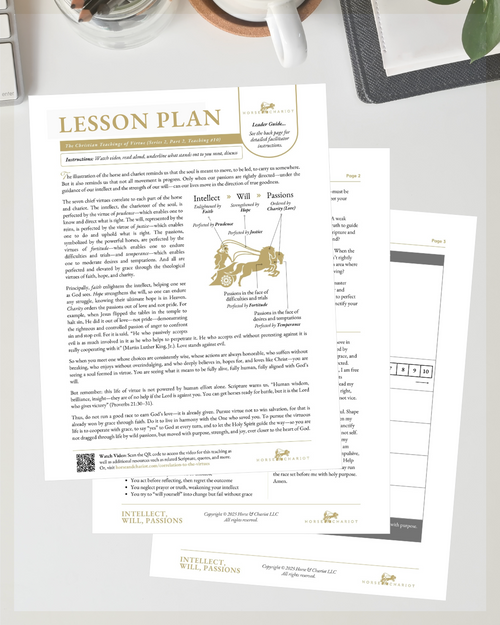
Perfect for small groups, families, classrooms, or personal reflection.
Related Quotes
Hope is Confidence in God
Christian hope is not optimism about circumstances, but confidence in God’s goodness, wisdom, and personal care. It rests on who God is and what He has promised.
“Do not look forward to the changes and chances of this life in fear; rather look to them with full hope that, as they arise, God, whose you are, will deliver you out of them. He is your keeper. He has kept you hitherto. Do you but hold fast to his dear hand, and he will lead you safely through all things; and, when you cannot stand, he will bear you in his arms.” — St. Francis de Sales
“God has created all things for good; all things for their greatest good; everything for its own good. What is the good of one is not the good of another; what makes one man happy would make another unhappy. God has determined, unless I interfere with His plan, that I should reach that which will be my greatest happiness. He looks on me individually, He calls me by my name, He knows what I can do, what I can best be, what is my greatest happiness, and He means to give it me.” — John Henry Newman
“No one loses Heaven except by his own fault. So far as God’s part is concerned, our salvation is certain. It is only our part—our cooperation or non-cooperation with God’s grace—that is uncertain.” — Leo J. Trese
“God is never outdone in generosity. The more you hope in Him, the more He will give you.” — St. Peter Julian Eymard
“Put all your confidence in God, for He will never abandon you.” — St. Vincent de Paul
“Trust the past to God’s mercy, the present to God’s love and the future to God’s providence.” — St. Augustine
“God gives to every soul he creates sufficient grace to get to Heaven.” — Leo J. Trese
“Hope comes from the knowledge of God’s infinite mercy and the assurance of His eternal promises. We can trust that He will never abandon us.” — St. Catherine of Siena
“The God whom we worship is not a weak and incompetent God. He is able to beat back gigantic waves of opposition and to bring low prodigious mountains of evil. The ringing testimony of the Christian faith is that God is able.” — Martin Luther King Jr.
Hope Between Despair and Presumption
True hope walks a narrow path. It avoids despair on one side and presumption on the other, trusting fully in God while remaining humble, obedient, and realistic about sin and grace.
“Faith has to do with things that are not seen and hope with things that are not at hand.” — St. Thomas Aquinas
“He who does not hope in God offends Him, for he doubts either His power or His goodness.” — St. Louis de Montfort
“Hope is the confident expectation of divine assistance, leading us toward eternal life.” — St. Thomas Aquinas
“The virtue of hope responds to the aspiration to happiness which God has placed in the heart of every man.” — St. Thomas Aquinas
“Now presumption is an appetitive movement, since it denotes an inordinate hope. Moreover it is conformed to a false intellect, just as despair is: for just as it is false that God does not pardon the repentant, or that He does not turn sinners to repentance, so is it false that He grants forgiveness to those who persevere in their sins, and that He gives glory to those who cease from good works: and it is to this estimate that the movement of presumption is conformed. Consequently presumption is a sin.” — St. Thomas Aquinas
“The other presumption is an inordinate trust in the Divine mercy or power, consisting in the hope of obtaining glory without merits, or pardon without repentance. Such like presumption seems to arise directly from pride, as though man thought so much of himself as to esteem that God would not punish him or exclude him from glory, however much he might be a sinner.” — St. Thomas Aquinas
“Two criminals were crucified with Christ. One was saved; do not despair. One was not; do not presume.” — St. Augustine
“The fact that a man deems an arduous good impossible to obtain, either by himself or by another, is due to his being over downcast, because when this state of mind dominates his affections, it seems to him that he will never be able to rise to any good. And since sloth is a sadness that casts down the spirit, in this way despair is born of sloth.” — St. Thomas Aquinas
“Hope, by means of the reasoning powers, maintains the middle road between despair and presumption.” — Mary of Agreda
Hope is Active Trust
Hope is not passive waiting. It is active trust that shapes how we act, endure hardship, and rise again after failure.
“Do not lose hope! It is the greatest gift you can give to others in times of trouble.” — St. John Bosco
“If we want to have a future filled with hope, we must build it on faith.” — St. John Bosco
“Don’t forget that the saint is not the person who never falls, but rather the one who never fails to get up again, humbly and with a holy stubbornness.” — St. Josemaría Escrivá
“He who trusts in himself is lost. He who trusts in God can do all things.” — St. Alphonsus Liguori
“The greater the difficulties, the greater should be our hope.” — St. Maximilian Kolbe
“I know well that the greater and more persistent your trials, the greater God’s confidence in you. In the midst of your suffering, hope in Him.” — St. Faustina Kowalska
“The soul that is hopeful finds God in all things, even in the trials, for hope is the confidence that He works all for our good.” — St. Elizabeth Ann Seton
“We may encounter many defeats but we must not be defeated.” — Maya Angelou
“This hard place in which you, perhaps, find yourself, is the very place in which God is giving you opportunity to look only to Him.” — Elisabeth Elliot
Hope Anchors the Soul
Hope holds the soul steady when clarity is gone. It anchors us in God when the road is painful, slow, or hidden.
“Hope is the anchor of the soul. It prevents us from drifting away in the storms of life.” — St. Vincent de Paul
“The one who has hope lives differently; the one who hopes has been granted the gift of a new life.” — Pope Benedict XVI
“Hope is the spark that ignites the soul, giving it the courage to rise from the depths and turn toward the light of God.” — St. Hildegard of Bingen
“I trust in His promise; I trust that His love will carry me, even if I see no light on the way.” — St. Thérèse of Lisieux
“Nothing is far from God. With hope in Him, my tears became prayers, and my prayers became joy.” — St. Monica
“The soul that clings to hope remains steadfast in the storms of life, for it is anchored in God’s infinite strength.” — St. Edith Stein
“The world's thy ship and not thy home.” — St. Thérèse of Lisieux
“Faith is the breath of the soul. Without it, the spirit suffocates in the darkness of despair.” — St. Hildegard of Bingen
Hope Lifts the Eyes Heavenward
Hope lifts the eyes beyond fear, despair, and self. It fuels joy, courage, endurance, and a life aimed toward heaven.
“Hope is like an anchor. Our hope in Christ stabilizes us in the storms of life, but unlike an anchor, it does not hold us back.” — Charles R. Swindoll
“If you have no joy, there’s a leak in your Christianity somewhere.” — Billy Sunday
“May your choices reflect your hope, not your fears.” — Nelson Mandela
“My faith didn't remove the pain, but it got me through the pain. Trusting God didn't diminish or vanquish the anguish, but it enabled me to endure it.” — Robert Rogers
“We cannot always trace God’s hand, but we can always trust God’s heart.” — C.H. Spurgeon
“Why should I tremble at the plow of my Lord that makes deep furrows on my soul? For He is no idle husbandman, He purposes a crop.” — Samuel Rutherford
“You have a God who hears you, the power of love behind you, the Holy Spirit within you, and all of heaven ahead of you. If you have the Shepherd, you have grace for every sin, direction for every turn, a candle for every corner and an anchor for every storm. You have everything you need.” — Max Lucado
“I am not a saint, unless you think of a saint as a sinner who keeps on trying.” — Nelson Mandela
“The movement of the Spirit of God in the hearts of men and women often calls them to act against the spirit of their times or causes them to anticipate a spirit which is yet in the making.” — Howard Thurman
“The vague and tenuous hope that God is too kind to punish the ungodly has become a deadly opiate for the consciences of millions.” — A.W. Tozer
“The average person in the world today, without faith and without God and without hope, is engaged in a desperate personal search throughout his lifetime. He does not really know where he has been. He does not really know what he is doing here and now. He does not know where he is going. The sad commentary is that he is doing it all on borrowed time and borrowed money and borrowed strength; and he already knows that in the end he will surely die! Man, made more like God than any other creature, has become less like God than any other creature. Created to reflect the glory of God, he has retreated sullenly into his cave; reflecting only his own sinfulness. Certainly it is a tragedy above all tragedies in this world that man, made with a soul to worship and praise and sing to God’s glory, now sulks silently in his cave.” — A.W. Tozer
Related Scripture
The Source and Nature of Hope
Hope is a secure, living anchor for the soul, made possible through the resurrection of Jesus Christ.
“Blessed be the God and Father of our Lord Jesus Christ! By his great mercy he has given us a new birth into a living hope through the resurrection of Jesus Christ from the dead.” — 1 Peter 1:3 (NRSVue)
“...be strongly encouraged to hold fast to the hope that lies before us. This we have as an anchor of the soul, sure and firm, which reaches into the interior behind the veil, where Jesus has entered on our behalf as forerunner..." — Hebrews 6:18-20 (NABRE)
“May the God of hope fill you with all joy and peace in believing, so that you may abound in hope by the power of the Holy Spirit.” — Romans 15:13 (NRSVue)
“So that through two unchangeable things, in which it is impossible that God would prove false, we who have taken refuge might be strongly encouraged to seize the hope set before us.” — Hebrews 6:18 (NRSVue)
“For whatever was written in former days was written for our instruction, so that by steadfastness and by the encouragement of the scriptures we might have hope.” — Romans 15:4 (NRSVue)
“Everything that happens in this world happens at the time God chooses [so remain in hope]. He sets the time for birth and the time for death, the time for planting and the time for pulling up, the time for killing and the time for healing, the time for tearing down and the time for building. He sets the time for sorrow and the time for joy, the time for mourning and the time for dancing, the time for making love and the time for not making love, the time for kissing and the time for not kissing. He sets the time for finding and the time for losing, the time for saving and the time for throwing away, the time for tearing and the time for mending, the time for silence and the time for talk. He sets the time for love and the time for hate, the time for war and the time for peace.” — Ecclesiastes 3:1-8 (GNT)
Hope in Suffering and Trials
Comfort and strength for difficult times, reminding us that present afflictions cannot compare to future glory.
“I consider that what we suffer at this present time cannot be compared at all with the glory that is going to be revealed to us.” — Romans 8:18 (GNT)
“Rejoice in hope, be patient in suffering, persevere in prayer.” — Romans 12:12 (NRSVue)
“Let your hope keep you joyful, be patient in your troubles, and pray at all times.” — Romans 12:12 (GNT)
“Therefore, since we are justified by faith, we have peace with God through our Lord Jesus Christ, through whom we have obtained access to this grace in which we stand; and we boast in our hope of sharing the glory of God. And not only that, but we also boast in our sufferings, knowing that suffering produces endurance, and endurance produces character, and character produces hope, and hope does not disappoint us, because God’s love has been poured into our hearts through the Holy Spirit that has been given to us.” — Romans 5:1-5 (NRSVue)
“We are afflicted in every way, but not crushed; perplexed, but not driven to despair; persecuted, but not forsaken; struck down, but not destroyed” — 2 Corinthians 4:8-9 (NRSVue)
“Casting all your anxieties on him, because he cares for you.” — 1 Peter 5:7 (NRSVue)
“Why are you cast down, O my soul, and why are you disquieted within me? Hope in God; for I shall again praise him, my help and my God.” — Psalm 42:11 (NRSVue)
“But recall those earlier days when, after you had been enlightened, you endured a hard struggle with sufferings, sometimes being publicly exposed to insults and afflictions and sometimes becoming partners with those so treated. For you had compassion for those who were in prison, and you cheerfully accepted the plundering of your possessions, knowing that you yourselves possessed something better and more lasting. Do not, therefore, abandon that boldness of yours; it brings a great reward. For you need endurance, so that when you have done the will of God you may receive what was promised. For yet “in a very little while, the one who is coming will come and will not delay, but my righteous one will live by faith. My soul takes no pleasure in anyone who shrinks back.” But we are not among those who shrink back and so are lost but among those who have faith and so preserve our souls.” — Hebrews 10:26-39 (NRSVue)
Trusting in the Word and Promises of God
The relationship between hope and Scripture, emphasizing patient waiting for God’s reliable promises.
“Let us hold fast to the confession of our hope without wavering, for he who has promised is faithful.” — Hebrews 10:23 (NRSVue)
“I believe that I shall see the goodness of the Lord in the land of the living.” — Psalm 27:13 (NRSVue)
“Wait for the Lord, take courage; be stouthearted, wait for the Lord!” — Psalm 27:14 (NABRE)
“Blessed are those who trust in the Lord, whose trust is the Lord. They shall be like a tree planted by water, sending out its roots by the stream. It shall not fear when heat comes, and its leaves shall stay green; in the year of drought it is not anxious, and it does not cease to bear fruit.” — Jeremiah 17:7-8 (NRSVue)
“The Lord is my portion,” says my soul, therefore I will hope in him.” — Lamentations 3:24 (NRSVue)
“My soul longs for your salvation; I put my hope in your word.” — Psalm 119:81 (NABRE)
“Remember your promise to me, your servant; it has given me hope. Even in my suffering I was comforted because your promise gave me life.” — Psalm 119:49-50 (GNT)
“I wait for the Lord, my soul waits, and in his word I hope;” — Psalm 130:5 (NRSVue)
“You are my hiding place and my shield; I hope in your word.” — Psalm 119:114 (NRSVue)
“Those who fear you shall see me and rejoice, because I have hoped in your word. I know, O Lord, that your judgments are right and that in faithfulness you have humbled me. Let your steadfast love become my comfort according to your promise to your servant.” — Psalm 119:74-76 (NRSVue)
“Let your steadfast love come to me, O Lord, your salvation according to your promise. Then I shall have an answer for those who taunt me, for I trust in your word. Do not take the word of truth utterly out of my mouth, for my hope is in your ordinances.” — Psalm 119:41-43 (NRSVue)
“We put our hope in the LORD; he is our protector and our help. We are glad because of him; we trust in his holy name. May your constant love be with us, LORD, as we put our hope in you.” — Psalm 33:20-22 (GNT)
“The Lord is not slow about his promise, as some think of slowness, but is patient with you, not wanting any to perish, but all to come to repentance.” — 2 Peter 3:9 (NRSVue)
The Hope of Eternal Life and Joy
The "blessed hope"—the promise of heaven and the joyful expectation of Christ's return.
“This Spirit he poured out on us richly through Jesus Christ our Savior, so that, having been justified by his grace, we might become heirs according to the hope of eternal life." — Titus 3:6-7 (NRSVue)
“For we know that, if the earthly tent we live in is destroyed, we have a building from God, a house not made with hands, eternal in the heavens.” — 2 Corinthians 5:1 (NRSVue)
“But we do not want you to be uninformed, brothers and sisters, about those who have died, so that you may not grieve as others do who have no hope. For since we believe that Jesus died and rose again, even so, through Jesus, God will bring with him those who have died. For this we declare to you by the word of the Lord, that we who are alive, who are left until the coming of the Lord, will by no means precede those who have died. For the Lord himself, with a cry of command, with the archangel’s call and with the sound of God’s trumpet, will descend from heaven, and the dead in Christ will rise first. Then we who are alive, who are left, will be caught up in the clouds together with them to meet the Lord in the air; and so we with the Lord forever. Therefore encourage one another with these words.” — 1 Thessalonians 4:13-18 (NRSVue)
“You show me the path of life. In your presence there is fullness of joy; in your right hand are pleasures forevermore.” — Psalm 16:11 (NRSVue)
“No, in all these things we are more than conquerors through him who loved us. For I am convinced that neither death, nor life, nor angels, nor rulers, nor things present, nor things to come, nor powers, nor height, nor depth, nor anything else in all creation, will be able to separate us from the love of God in Christ Jesus our Lord.” — Romans 8:37-39 (NRSVue)
“Who, then, can separate us from the love of Christ? Can trouble do it, or hardship or persecution or hunger or poverty or danger or death? No, in all these things we have complete victory through him who loved us! For I am certain that nothing can separate us from his love: neither death nor life, neither angels nor other heavenly rulers or powers, neither the present nor the future, neither the world above nor the world below—there is nothing in all creation that will ever be able to separate us from the love of God which is ours through Christ Jesus our Lord.” — Romans 8:35, 37-39 (GNT)
“Lord, let me know my end, and what is the measure of my days; let me know how fleeting my life is. You have made my days a few handbreadths, and my lifetime is as nothing in your sight. Surely everyone stands as a mere breath. Surely everyone goes about like a shadow. Surely for nothing they are in turmoil; they heap up, and do not know who will gather. And now, O Lord, what do I wait for? My hope is in you.” — Psalm 39:4-7 (NRSVue)
Living the Hopeful Life: Peace, Fear, and Strength
The outward result of hope: a life of peace, courage, and renewed strength.
“Since, then, we have such a hope, we act with great boldness,” — 2 Corinthians 3:12 (NRSVue)
“Now who will harm you if you are eager to do what is good? But even if you do suffer for doing what is right, you are blessed. Do not fear what they fear, and do not be intimidated, but in your hearts sanctify Christ as Lord. Always be ready to make your defense to anyone who demands from you an accounting for the hope that is in you; yet do it with gentleness and reverence.” — 1 Peter 3:13-18 (NRSVue)
“And all who have this hope in him purify themselves, just as he is pure.” — 1 John 3:3 (NRSVue)
“Do not worry about anything, but in everything by prayer and supplication with thanksgiving let your requests be made known to God. And the peace of God, which surpasses all understanding, will guard your hearts and your minds in Christ Jesus.” — Philippians 4:6-7 (NRSVue)
“But those who trust in the Lord for help will find their strength renewed. They will rise on wings like eagles; they will run and not get weary; they will walk and not grow weak.” — Isaiah 40:31 (GNT)
“The fear of the Lord is life indeed; filled with it one rests secure and suffers no harm.” — Proverbs 19:23 (NRSVue)
“You who fear the Lord, hope for good things, for lasting joy and mercy." — Sirach 2:9 (NRSVue)
“Happy are those whose hearts do not condemn them, and who have not given up their hope.” — Sirach 14:2 (NRSVue)
“So let us not grow weary in doing what is right, for we will reap at harvest time, if we do not give up. So then, whenever we have an opportunity, let us work for the good of all, and especially for those of the family of faith.” — Galatians 6:9-10 (NRSVue)
"Rejoice always, pray without ceasing, give thanks in all circumstances; for this is the will of God in Christ Jesus for you. Do not quench the Spirit. Do not despise the words of prophets, but test everything; hold fast to what is good; abstain from every form of evil. May the God of peace himself sanctify you entirely; and may your spirit and soul and body be kept sound and blameless at the coming of our Lord Jesus Christ." — 1 Thessalonians 5:16-23 (NRSVue)

Never miss a teaching — get all new teachings of virtue sent to your inbox free!